Two funds can both be called private equity and still work in opposite ways. One buys a slice of a company that has a prototype and a payroll to meet. The other buys a mature business and refinances it. Both use the same legal shell: a pool of committed money, a general partner who invests it and a fixed life. Almost everything else differs, from the size of the cheque to what counts as success.
What is a venture capital fund?
A venture capital fund is a pool of money that buys equity in young, fast-growing companies1. Those companies often cannot get money elsewhere, such as business loans from banks or the capital markets, yet still have potential for long-term growth5. Banks usually ask for collateral that a young company may be unable to give1. A venture investor injects fresh capital instead of a commercial loan, so the company carries no collateral or interest burden1.
The return arrives only on exit. A venture fund realises its gain when the investee company qualifies for a stock exchange listing, or through a management buy-back, a private placement or a trade sale1. A lender, by contrast, holds a legal right to interest and repayment whether or not the business succeeds6. That difference explains most of what follows: the investor is paid in growth, so the fund must back companies that can grow.
Investors in a venture fund make a fixed commitment that starts unfunded and is called down as the fund makes its investments6. Regulators define the label narrowly where it carries a legal benefit. In the United States, managers of venture funds are exempt from registering with the SEC, provided at least 80% of their fund holdings are in qualifying investments5. The rule behind that exemption requires a fund to represent to investors that it pursues a venture capital strategy7, to hold no more than 20 percent of its capital in assets that are not qualifying investments7, and to issue securities that carry no right to withdraw or redeem, except in extraordinary circumstances7. A fund that borrows more than 15 percent of its capital, or for longer than 120 days, falls outside the definition7.
Venture capital fund vs private equity fund
The practical difference is the company bought and the control taken. Early stage venture funds provide equity seed capital to young or emerging companies by acquiring a minority interest, which makes them significantly different from a leveraged buyout fund that seeks a controlling stake in a mature company2. Both sit under the private equity label. Common strategies are early stage or venture capital, growth capital and late stage or leveraged buyouts2. The Hong Kong association uses a similar frame: startup venture capital, development capital and buyouts are its three main types of private equity transaction1.
Control shows up in the boardroom. In a buyout the investor owns the majority of the share capital and leaves day-to-day operations to management1. A venture investor more often negotiates equity ownership, a board seat or an active role in the company’s operations5. Debt marks the other split. Venture capital firms usually put in fresh capital rather than commercial loans1, while buyout funds typically employ higher leverage8.
| Feature | Venture capital fund | Buyout fund | Source |
|---|---|---|---|
| Company bought | Young, fast-growing company1 | Mature company2 | 1,2 |
| Stake | Minority interest2 | Controlling stake2 | 2 |
| Typical cheque | US$1m to US$5m at startup stage; US$5m to US$30m for growth capital1 | US$20m to over US$1 billion1 | 1 |
| Median fund size | US$225m4 | US$600m4 | 4 |
| Companies held by a mature fund (mean) | 37.38 | 16.18 | 8 |
| Median lifetime fees, as a share of committed capital | 17.75 percent4 | 12 percent4 | 4 |
| Funds with a hurdle return | 47.6 percent4 | 93.1 percent4 | 4 |
| Carry level | 20 percent in all but five of 94 funds4 | 20 percent in all 144 funds4 | 4 |
| Average IRR, funds raised 1981 to 1993 | 14.08 percent8 | 21.83 percent8 | 8 |
Read the table with its limits. The size, fee, hurdle and carry rows come from 238 funds raised between 1992 and 2006, shown to one of the largest limited partners in the world, and about three-quarters of them focus on the United States4. The IRR row is one investor’s sample, and that sample of venture funds is fairly small because the investor put its money mostly into buyout funds8. Neither dataset describes a fund raised in Asia in the last decade. The buyout side of the story, including how debt amplifies results, is in how a leveraged buyout works; the stage between the two is growth equity, and buyout versus growth equity sets out that comparison.
How a venture capital fund is built and paid
The structure matches any private equity fund. A venture fund progresses through three phases over approximately 10 years: fundraising and formation, an investment period, then harvesting and exit9. The general partner raises the money from limited partners, who commit it up front and fund it when called. GP and LP explained covers who does what, and how a private equity fund works follows the money through the whole life.
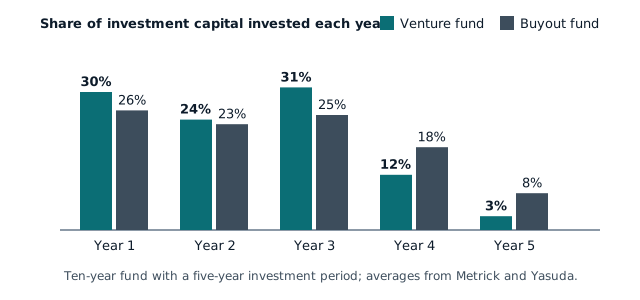
Venture funds put money to work early. A 10-year venture fund with a 5-year investment period invests 30%, 24%, 31%, 12% and 3% of its investment capital in years one to five, while a buyout fund invests 26%, 23%, 25%, 18% and 8%4. In the first three years that is 85 percent of the money for the venture fund and 74 percent for the buyout fund (our arithmetic4). Because a fund can run out of capital before the end of its life, larger venture firms usually run several overlapping funds at once6.
Follow-on money is a recurring pressure. When a manager sells most of a fund’s investment in a company but keeps a minority stake for another of its funds, that pattern is more likely in venture capital, where a fund may be too small to meet a portfolio company’s follow-on needs2. It puts the manager on both sides of one deal, and a limited partner reading a fund document should look for how the fund handles it.
Fees and carry
The fee terms resemble buyout terms with some differences at the edges. The most common initial management fee level is 2 percent, though most funds concede something to limited partners after the investment period ends4. Median lifetime fees come to 12 percent of committed capital for buyout funds and 17.75 percent for venture funds in the sample4. The venture funds are smaller: the median venture fund holds US$225m of commitments against US$600m for a buyout fund4.
Carried interest is the performance share. Nearly every fund in the sample uses 20 percent; among the 94 venture funds, one has 17.5 percent, three have 25 percent and one has 30 percent4. The carry basis is committed capital in 92.1 percent of venture funds4. In the simple case, limited partners receive every dollar of exit proceeds until they have their entire committed capital back, and then the general partner receives 20 cents of each further dollar4. Only 47.6 percent of venture funds in the sample have a hurdle return, against 93.1 percent of buyout funds4. Private equity fees and carry works through the waterfall in full.
A small team across many companies
The median venture fund expects to make 20 investments, which works out at five per partner4; the median buyout fund expects to make 12, or 2.4 per partner4. Actual portfolios follow the pattern: a mature venture fund holds 37.3 companies on average and a buyout fund 16.18. A small early-stage cheque does not cost less effort. The venture firm spends a similar amount of time evaluating, monitoring and managing a small investment as a larger one1.
What are the stages of venture capital investment?
Financing follows the company’s development, and each phase needs a different size and structure of money1. The Hong Kong association lays out five phases, and the risk falls as the company matures.
| Stage | What the company looks like | Risk and funding | Source |
|---|---|---|---|
| Seed | A business idea is conceived and the concept formed | Funded by the entrepreneur’s own resources1 | 1 |
| Startup | Product not yet widely marketed or tested; success in question | Risk is highest: the funding commitment is large and the failure rate high1 | 1 |
| Expansion | Established; products sold; a track record built | Needs more funds; may raise money in a series of rounds1 | 1 |
| Mezzanine | Several years of record; preparing for listing | The last stage of venture investment, with relatively lower risk1 | 1 |
| Buyout | An existing business with sustainable cash flows | The investor owns the majority and has strategic control1 | 1 |
Ticket size rises with the stage. Startup investors usually put in US$1m to US$5m per transaction and growth capital runs from US$5m to US$30m1. Where a project needs more, several venture firms may join to co-invest1.
Founders and investors usually use round names rather than those stage labels. The first round of institutional venture capital is called Series A6. Early stage funding covers the seed and Series A rounds, and growth capital typically means Series B, Series C and later rounds6. A startup may raise bridge financing between full rounds6, and venture-backed companies at the early and growth stage may also take venture debt6. A privately owned company with a market valuation above US$1 billion is called a unicorn6.
Exit closes each stage. Venture capitalists typically leave between 3-5 years after the investment date1. They require an exit strategy to be agreed before they invest, and review it throughout the holding period1. Routes include a listing, a buy-back through put options on a pre-agreed formula, a private placement to a third party or a trade sale1.
Advantages and costs of venture capital funding
The advantages sit mostly on the company’s side of the table. A young company lacking a track record can struggle to fund expansion, and the equity cheque avoids the collateral and interest payments a loan brings1. The fund adds advice on strategy, management, organisation, financial systems and access to its network, while staying out of day-to-day management1. A respected venture partner also raises the company’s credibility, which helps it secure later financing1.
The costs are real. A venture investor accepts a high failure rate and years without liquidity or dividends, so it normally expects a return in excess of 25% depending on the stage1. The investor gets a say in return: shareholder agreements spell out voting rights, sale arrangements, dividend policy and approval rights over matters that could change the business plan1. Preferred stock is the usual instrument, and it gives the fund liquidation preferences and protective provisions9. Structure can also include equity, quasi-equity, convertible loans, warrants and options1.
Getting the money is slow and selective. The process from first evaluation to signed documents usually takes a minimum of three to six months1, and many applications are turned down because they do not fit the fund’s criteria1. Each firm sets its own criteria1, so a mismatch of stage, size or sector ends most conversations early. The same logic applies to a fund’s backers: a venture fund is a minority investor, and the later-stage minority deal has its own mechanics in what growth equity is.
How a venture capital deal is made
A venture deal moves through the same sequence at most firms, and the steps show where the time goes.
- Initial evaluation. The company submits its financing request, a business plan and audited financial statements, and the firm decides whether the proposal fits1.
- Initial negotiation. Interested firms negotiate the general terms and structure with the company and take a recommendation to the investment committee for initial approval1.
- Due diligence. The firm tests the product and its technology, the market and its competitors, and the distribution network1. Due diligence in private equity lays out the wider checklist.
- Final negotiation. Price comes from a valuation using price to earnings multiples, asset valuation and required return calculations1. The structure decides between equity, quasi-equity and hybrid instruments1.
- Monitoring. The firm’s board representatives take part in all major decisions1.
- Exit. The investor sells through a listing, buy-back, placement or trade sale1.
For how firms choose between deals before step one, see private equity investment approach.
Worked example (our arithmetic): why one deal carries a venture fund
The numbers are invented to show the mechanism. They are not a real fund and not a forecast. The inputs follow the sample terms: 20 investments is the median a venture fund expects to make4, carry is 20 percent4, the carry basis is committed capital4, and no hurdle applies, which is true of a little over half of venture funds in the sample4. The median cost of fees over a fund’s life is 17.75 percent of committed capital4; the example uses a round 20 for fees and costs so that 80 is left to invest (our arithmetic4).
A fund has 100 of commitments. After fees and costs of 20, it invests 80 in 20 companies at 4 each (our arithmetic4).
| Outcome | Companies | Proceeds each | Total proceeds | Basis |
|---|---|---|---|---|
| Written off | 10 | 0 | 0 | 10 × 0 (our arithmetic4) |
| Returns its cost | 5 | 4 | 20 | 5 × 4 (our arithmetic4) |
| Triples | 4 | 12 | 48 | 4 × 12 (our arithmetic4) |
| One big winner | 1 | 60 | 60 | 15 × 4 (our arithmetic4) |
| Fund total | 20 | 128 | 0 + 20 + 48 + 60 (our arithmetic4) |
On the 80 invested, proceeds of 128 are a gross multiple of 1.6 times (our arithmetic4). Measured against the 100 committed, the profit is 28, carry at 20 percent is 5.6, and limited partners keep 122.4, a net multiple of 1.22 times (our arithmetic4). One company supplies 60 of the 128, or 46.9 percent of all proceeds (our arithmetic4).
Now remove the winner and let that company return its cost of 4 instead. Proceeds fall to 72, which is below the 100 committed, so no carry is paid and limited partners keep 72, or 0.72 times (our arithmetic4). A few successful exits typically drive a venture fund’s overall return9, and the example shows why: without the outlier, every other outcome together leaves the fund short of its commitments.
What the returns data show
Venture’s reputation for outsized wins sits next to data that is less flattering. The Kauffman Foundation reviewed its own twenty-year history in nearly 100 venture funds3. Sixty-two of 100 funds failed to exceed returns available from the public markets after fees and carry3. Only twenty of 100 beat a public-market equivalent by more than 3 percent a year, and half of those began investing before 19953. Of thirty funds with more than $400 million of committed capital, only four did better than a publicly traded small cap index3. The benchmark in that study is the Russell 2000 and the vintages run from 1989 to 20103.
Expectations were far higher. A Probitas Partners survey of nearly 300 institutional investors found two-thirds expected a multiple of 2x or more from top quartile, early-stage venture funds3. In the same portfolio the typical venture fund peaked early in IRR and investment multiple, and there is no consistent J-curve since 19973. The standard shape of private equity returns is described in the J-curve, and the metrics used to measure them in IRR, MOIC, DPI and TVPI.
The academic comparison with buyouts points the same way for one sample. Between 1981 and 1993 the average IRR was 21.83 percent for buyout funds against 14.08 percent for venture funds8. Distributions came faster for venture funds, yet they still took longer to break even, consistent with the hit-or-miss nature of venture investing8. The buyout lead is consistent with the higher leverage buyout funds typically employ8.
Two cautions apply. Both datasets belong to single investors, mostly US-focused and from earlier decades38. Neither predicts anything about a current fund in Asia, and nothing on this page recommends a fund or a strategy.
How Asian regulators treat venture capital funds
No single Asian rulebook exists. Each jurisdiction decides what a venture fund is, who may invest, and what its manager must do.
| Jurisdiction | What the rule or scheme sets | Source |
|---|---|---|
| United States (benchmark) | A fund pursuing a venture capital strategy, no more than 20 percent in non-qualifying assets, borrowing capped at 15 percent for no more than 120 days, no redemption rights7 | 7 |
| Singapore | At least 80% of committed capital in securities issued directly by unlisted ventures incorporated no more than ten years at first investment; up to 20% in other unlisted ventures10 | 10 |
| India | Venture capital funds, including angel funds, are a sub-category of Category I alternative investment funds; Category I and II funds are close-ended with a minimum tenure of three years11 | 11 |
| China | Private investment fund regulation of 62 items in seven chapters, effective 1 September 2023, with special provisions for venture capital funds12 | 12 |
| Hong Kong | Close to 680 open-ended fund companies and about 1 450 limited partnership funds set up by end-2025, with a government co-investment scheme for venture funds1314 | 13,14 |
Singapore
Singapore’s regime for venture managers is the most specific. A manager of a fund raised from third-party investors is treated as running a fund management business under the Securities and Futures Act, while managers of internally funded venture funds need no MAS authorisation10. Under the venture manager route, at least 80% of committed capital must sit in securities issued directly by an unlisted business venture incorporated no more than ten years before the first investment, and up to 20% may go into other unlisted ventures10. The fund must not be continuously open for subscription, nor redeemable at the investor’s discretion10, and it may be offered only to accredited investors or institutional investors10.
The regime lightened the manager’s burden. Before it, a venture manager faced the same test as any fund manager, with at least 2 experienced directors and representatives each holding 5 years of relevant experience10. The simplified route asks instead for at least two directors, at least one of them full-time and resident in Singapore10, and for disclosure to investors that the manager is not subject to every requirement placed on other fund managers10. This description comes from a Singapore law firm’s summary of the MAS regime, last updated 3 January 201810; read the current MAS guidelines before relying on any threshold.
India
SEBI places venture capital funds inside Category I of its alternative investment fund rules, the category for funds that invest in start-up or early stage ventures, social ventures, small and medium enterprises or infrastructure11. Angel funds are a sub-category of venture capital fund that raise money from angel investors11. Private equity funds are registered in Category II instead11.
The figures in SEBI’s FAQ on the AIF regulations show the shape of the regime. Each scheme needs a corpus of at least twenty crore rupees, and no investor may put in less than one crore rupees, except for angel funds11. The sponsor or manager must keep an interest of not less than two and a half percent of the corpus or five crore rupees, whichever is lesser11. An angel fund may accept, for up to a maximum of 3 years, an investment of not less than 25 lakh from an angel investor11. The thresholds quoted come from an FAQ whose latest circular reference is dated 1 October 201511, so check the current regulations before using one.
United States, China and Hong Kong
The US definition is the best-known benchmark: a fund must be a private fund pursuing a venture capital strategy7, with qualifying investments bought directly from the portfolio company7, and a portfolio company that borrows money to pay the fund back its investment does not qualify7. Qualifying portfolio companies must not be reporting or foreign traded at the time of investment7.
China set out special provisions for venture capital funds in its 2023 private fund regulation, which has 62 items in seven chapters and took effect on 1 September 202312. Hong Kong funds of every kind use the same two vehicles: close to 680 open-ended fund companies had been set up by end-2025, and about 1 450 limited partnership funds were registered13. See the Hong Kong limited partnership fund and the SFC Type 9 licence for the vehicle and the manager rules.
Public money in Asian venture capital
Governments in Asia act as investors in venture funds, which changes who the limited partners are.
China launched a national venture capital guidance fund on 26 December 2025, jointly initiated by the National Development and Reform Commission and the Ministry of Finance, with three regional funds in the Beijing-Tianjin-Hebei region, the Yangtze River Delta and the Guangdong-Hong Kong-Macao Greater Bay Area15. The fund has a 20-year lifespan with extended investment and exit periods15. At least 70 percent of its capital is to go to seed-stage and early-stage enterprises15. It uses three tiers, a fund company, regional funds and sub-funds, and officials expect more than 600 sub-funds across the three regions15. The fund works as a risk-sharing mechanism, in effect an angel investor that absorbs early-stage risk15. Professional institutions manage fundraising, investment and exits through competitive selection, with no mandatory geographic reinvestment requirement15.
Hong Kong takes two routes. The government set up the Hong Kong Investment Corporation to provide patient capital and strategic investment in high-potential ventures, particularly hard technology13. For every dollar it invests, it attracts around six dollars of private investment13. The Innovation and Technology Venture Fund exists mainly to attract more private investment to Hong Kong’s innovation and technology ecosystem14, and it co-invests with venture capital funds selected as co-investment partners in start-ups with adequate presence in Hong Kong14.
The wider market is large. Hong Kong is home to over 650 private equity firms with about US$230 billion under management, second in Asia behind the Chinese Mainland13. Asia’s private equity landscape is pivoting towards hard technology, particularly artificial intelligence, biotech and new energy13. For the Hong Kong market in detail, see the Hong Kong private equity market, and for the region, private equity in Asia.
Read next
Growth equity covers the minority deal that comes after venture, and buyout versus growth equity sets the strategies side by side. The strategies hub lists the rest. The primary texts behind this page are the SEC’s venture capital fund definition, SEBI’s AIF FAQ, the State Council’s report on the national venture capital guidance fund and the Inland Revenue Department’s practice note on fund tax exemption. Nothing here recommends a fund, a manager or an investment; the page is education only.
Read next
- What is growth equity? Structure, risk, buyout vs VCGrowth equity is a minority investment in an established, fast-growing company. How it differs from buyouts and venture, how deals are built, and the risks.
- Buyout vs growth equity: key differencesBuyout, growth equity and venture capital differ in stake, leverage, company stage and exit. A side-by-side reference with the Asia-Pacific deal mix for 2024.
- How a private equity fund works in AsiaA private equity fund is a ten-year limited partnership. Who the partners are, where liability stops, and how Hong Kong, Singapore and Cayman funds differ
Sources
- What is Venture Capital/Private Equity · Hong Kong Venture Capital and Private Equity Association · hkvca.com.hk · checked 21 October 2026
- Private Equity Conflicts of Interest: Final Report (FR11/10), November 2010 · IOSCO Technical Committee · iosco.org · checked 21 October 2026
- We Have Met the Enemy and He is Us: Lessons from Twenty Years of the Kauffman Foundation's Investments in Venture Capital Funds (May 2012) · Ewing Marion Kauffman Foundation · kauffman.org · checked 21 October 2026
- The Economics of Private Equity Funds (Metrick and Yasuda, working paper) · Wharton School, Rodney L. White Center · rodneywhitecenter.wharton.upenn.edu · checked 21 October 2026
- Private Equity, Venture Capital, and Hedge Funds: Getting Started (research guide) · Harvard Law School Library · guides.library.harvard.edu · checked 21 October 2026
- Venture capital (Wikipedia) · Wikipedia · en.wikipedia.org · checked 21 October 2026
- 17 CFR 275.203(l)-1, Venture capital fund defined (Electronic Code of Federal Regulations, via Cornell LII) · U.S. Securities and Exchange Commission (rule text) · law.cornell.edu · checked 21 October 2026
- The Cash Flow, Return and Risk Characteristics of Private Equity (NBER Working Paper 9454, January 2003) · National Bureau of Economic Research · nber.org · checked 21 October 2026
- Venture Capital vs. Private Equity Funds: Key Differences and Legal Structures (2025) · Fridman Law Firm · fridmanlawfirm.com · checked 21 October 2026
- Amendments to the Regulatory Regime for Venture Capital Managers (updated 3 January 2018), a summary of MAS's October 2017 regime · CNP Law LLP, Singapore · cnplaw.com · checked 21 October 2026
- SEBI (Alternative Investment Funds) Regulations, 2012: Frequently Asked Questions (references circulars up to October 2015) · Securities and Exchange Board of India · sebi.gov.in · checked 21 October 2026
- China unveils regulation on private investment funds (Xinhua, 9 July 2023) · State Council of the People's Republic of China · english.www.gov.cn · checked 21 October 2026
- Speech by the Financial Secretary at Asia Private Equity Forum 2026 (28 January 2026) · Government of the Hong Kong SAR · info.gov.hk · checked 21 October 2026
- Departmental Interpretation and Practice Notes No. 61: Profits Tax Exemption for Funds (June 2020) · Inland Revenue Department, Hong Kong · ird.gov.hk · checked 21 October 2026
- China unveils national venture capital guidance fund to boost innovation (Xinhua, 26 December 2025) · State Council of the People's Republic of China · english.www.gov.cn · checked 21 October 2026
Published . Education only, not an offer or advice (terms). Rules, fees and market figures change, so each source shows the day it was read. How we check facts · Report an error.