Jump to a section
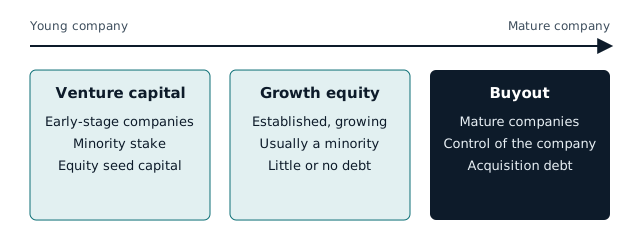
The three strategies side by side
| Feature | Venture capital | Growth equity | Buyout |
|---|---|---|---|
| Company stage | Early-stage and emerging companies with high growth potential6 | Relatively mature companies that need capital to expand5 | Mature companies, often public ones taken private7 |
| Typical stake | Not a majority, which means under 50 percent7 | Usually a minority interest5 | Control: more than 50 percent7 |
| Control | A minority interest in a young company1 | Agnostic about control, with minority positions more often than not5 | Majority ownership of the target3 |
| Debt | Equity seed capital, no acquisition debt1 | Unlevered or light leverage at purchase5 | A significant amount of borrowed money to meet the cost of acquisition4 |
| Where the return comes from | Companies that become successful6 | Growth, not leverage5 | Improving the company, with leverage enhancing the return on equity3 |
| Main risk | High rates of failure6 | Growth that does not arrive7 | Losses magnified by leverage if the deal goes wrong3 |
A firm’s strategy is set by the stage of development and the capital needs of the companies it intends to back, in the terms of the IOSCO report1. That one idea explains the whole table. Stage fixes the stake, the stake fixes control, and control fixes how much debt makes sense. Fund mechanics that all three share are on the fund page; the strategies section has the rest.
What is private equity?
Private equity is equity raised by companies privately rather than through public fundraising1. The label covers several strategies, and three matter most: venture capital, growth equity and buyouts7. The securities regulators’ body IOSCO groups them the same way, as early stage and venture capital, growth capital, and late stage or leveraged buyouts1. Each has its own page in the strategies section.
Buyouts
A leveraged buyout, or LBO, is one company’s acquisition of another using a significant amount of borrowed money4. A buyout fund wants a controlling stake in a mature company1. Typically a mature, public company is taken private by a private equity firm or by its own management team7, and that buyer must hold more than 50 percent7. In Asia-Pacific in 2024 the share of buyout deals grew to more than 50%9.
The forms you will meet: the management buyout, in which the existing team buys the company’s assets and takes control7; the management buy-in, the secondary buyout and the tertiary buyout4; and the public-to-private deal4.
What a buyout target looks like
The debt only works if the company can carry it. The target needs cash flow stable enough to pay interest and repay principal over time4. Mature companies with long-term customer contracts or predictable costs are the usual picks4. So the cash flow of the target is what pays for the loan4.
How much debt
No single ratio is typical. The amount depends on the quality of the asset, its cash flows and the economic environment4. Debt is two layers: senior debt, secured on the target’s assets at lower interest, and junior debt with no security at higher interest4. Banks have traditionally supplied it1. This page quotes no leverage percentage because the figures on offer mix periods and countries, and none comes from an Asian source.
Why leverage cuts both ways
Debt raises the return on equity by cutting the equity needed to buy the target3. The price is risk: an LBO is done at the risk of magnified cash flow losses if the company performs poorly after the buyout4. Fixed costs add to it, because the company still pays them when revenue falls4. At the extreme, an over-leveraged company cannot service its debt, and the result is insolvency or a debt-to-equity swap in which the owners lose control to the lenders4.
Time held, and exits
A fund lives about ten years1, but it holds each company for less: generally well below ten years and more often around three to five1.
Growth equity
Growth equity, also called growth capital or expansion capital, is usually a minority investment in relatively mature companies5. The money pays for expansion, restructuring, entering new markets or a major acquisition, without a change of control3. The company is cash flow positive, profitable or close to it5. The owner sells part of the business to take some value out and share the risk of growth with partners3. The capital goes to company needs or shareholder liquidity, and further financing rounds are not usually expected before exit5. That makes the case simple to read: one cheque, a minority stake and a company that already earns.
The investor looks at records, not promises. Unlike a venture investor, a growth investor can study the company’s financial track record, interview clients and try the product before deciding7. Growth capital is often structured as preferred equity5. Returns are primarily a function of growth, not leverage5. That is the cleanest contrast with a buyout, where leverage is part of the design4.
Venture capital
Venture capital is financing for startup, early-stage and emerging companies judged to have high growth potential6. A venture fund buys a minority interest in young companies1. Venture investors typically do not ask for a majority, which founders like7. Failure rates are high6.
Venture is also where past success counts most: it is the only private equity strategy with a high level of persistence7. For a closer look read venture capital funds compared with private equity funds.
What the Asia-Pacific mix looks like
The Asian mix is moving toward buyouts. The data below come from AVCJ and Bain analysis9 and run to the end of 2024. They cover Asia-Pacific, they exclude real estate and deals under $10 million9, and they reach us through a law firm’s trends paper rather than the Bain report itself9. Greater China, in that data, means China, Hong Kong and Taiwan9.
- The share of buyout deals grew to more than 50%, and the share of growth deals shrank9.
- Asia-Pacific buyout investment reached $138 billion in 2024, up 8.1% from $127 billion in 20239.
- The average deal in the region rose to $133 million, up 22% over 20239.
- Carve-outs were 20% of all buyouts over $100 million, up from 11% in 20239.
- Some firms are pivoting from growth-oriented investments to value9.
Why the tilt? Lower interest rates across most of the region seem to have fuelled more buyouts9. Carve-outs, where a group sells a non-core unit, are one channel: 44% of the Asia-Pacific GPs in Bain’s survey rank them among the main openings for deals9, with Japan and Korea singled out for conglomerates that rationalise operations and divest units9.
Size matters as much as style. The number of megadeals, deals of $1 billion or more, rose 50% in 20249. The top cohort of deals, about the top 2%, took 42% of deal value and the smallest 90% took 30%, which left just 28% for the middle9. A mid-sized buyout is therefore the hardest deal to find and, later, to sell. Do not generalise from one cohort of deals: these shares describe 2024 only, in the data set named above, and they say nothing about the quality of any individual deal or firm.
Country matters. The same data pair India with growth and Japan with stability9, and only India and Japan kept their deal count in 2024 near the previous five-year average9. Read the table above as a global map and the list here as one region’s position in one year.
One year is not a trend: the buyout share of global private equity investment fell from 89% in 2007 to 41% in 2008, in an IFSL estimate of August 2009 that IOSCO reproduces1.
Where the return is meant to come from
A buyout owner has three main levers: margin expansion, typically an EBITDA margin; free cash flow and debt paydown; and valuation multiple expansion, typically an enterprise value to EBITDA multiple3. Many strategies add governance restructuring, such as setting up a board of directors or updating the target’s management reporting3. The goal is to hand control to the investor for a period of internal improvement, and for the improvement to produce the return7. Buyouts suit companies that want to make major acquisitions without spending too much capital7.
Buyout firms sort targets into two kinds. A platform company has the scale and the business model to stand alone3. Smaller add-ons bolt onto it. For large deals, investors often club together in a syndicate3. Asia follows the same logic: platform investing, building a large portfolio company from many low-cost bolt-ons, is spreading among GPs9, and bolt-ons need smaller cheques and add no new risks to the portfolio9.
Venture investors work differently. Because investments are illiquid and take a long time to harvest, venture capitalists are expected to carry out detailed due diligence before investing6. They are also expected to nurture the companies they back, to raise the chance of an IPO when valuations are favourable6.
Where the lines blur
The three labels are a guide, not a wall. Growth capital sits at the intersection of private equity and venture capital, and traditional buyout firms also provide it5. Buyouts are generally control positions while the other strategies typically take minority stakes3. A minority stake limits how far the investor can change the company3. Private equity firms also differ from other private investors who take controlling stakes, because they raise capital regularly in sequential funds1. One firm may therefore run a buyout fund and a growth fund side by side.
Who may invest
Start with where you are. In Hong Kong, private equity funds are among the private placement products offered to professional investors, as a Legislative Council paper lays out10, and an individual qualifies with a portfolio of at least HK$8 million10. The fund page sets the Hong Kong and Singapore tests out side by side.
One rule is United States only. There a private equity fund is typically open only to accredited investors and qualified clients2, and the accredited-investor term is defined in Rule 501 of Regulation D8. Worldwide, the majority of private equity investors are institutional and sophisticated market participants1.
Conclusion: what separates the three
Three things separate them: the stage of the company, the size of the stake and the role of debt. Each strategy has its place in a company’s life, and the strategies do not compete with one another7. A buyout buys control of a mature company, often with borrowed money3. Growth equity buys a minority in a company that already works5. Venture capital backs a young company that is still proving itself6. In Asia-Pacific in 2024 the share of buyout deals grew to more than 50%, the first of the three9. For how the funds behind each are built, see how a private equity fund works.
This page compares strategies. It does not rank them, and it does not say which is better for any investor.
Questions people ask
What is the difference between growth equity and buyout?
Growth equity buys a minority stake in a company that is already working, with little or no debt5. A buyout buys control, often with a significant amount of borrowed money4.
What are the disadvantages of a buyout?
Leverage cuts both ways: if the deal goes wrong, the loss is increased by leverage, just as the profit is when it goes well3. A company that cannot service its debt can end in insolvency or a debt-to-equity swap4.
What does growth equity mean?
Growth equity, also called growth capital or expansion capital, is usually a minority investment in a relatively mature company5.
RelatedHow a leveraged buyout works: debt, equity, returnsWhat is growth equity? Structure, risk, buyout vs VCVenture capital fund vs private equity fund: how each works
Sources
- Private Equity Conflicts of Interest: Final Report (FR11/10), November 2010 · IOSCO Technical Committee · iosco.org · checked 21 October 2026
- Private Equity Funds · U.S. Securities and Exchange Commission (Investor.gov) · investor.gov · checked 21 October 2026
- Private equity · Wikipedia · en.wikipedia.org · checked 21 October 2026
- Leveraged buyout · Wikipedia · en.wikipedia.org · checked 21 October 2026
- Growth capital · Wikipedia · en.wikipedia.org · checked 21 October 2026
- Venture capital · Wikipedia · en.wikipedia.org · checked 21 October 2026
- 3 Key Types of Private Equity Strategies · Harvard Business School Online · online.hbs.edu · checked 21 October 2026
- Accredited Investors · U.S. Securities and Exchange Commission (Investor.gov) · investor.gov · checked 21 October 2026
- In Private 2025: Top 10 trends for private capital (King & Wood Mallesons, citing AVCJ and Bain & Company's Asia-Pacific Private Equity Report 2025, data to end-2024) · King & Wood Mallesons · mallesons.com · checked 21 October 2026
- Review of the Securities and Futures (Professional Investor) Rules, paper for the Legislative Council Panel on Financial Affairs, 2020 · Legislative Council, Hong Kong (paper by the Administration and the SFC) · legco.gov.hk · checked 21 October 2026
Published . Education only, not an offer or advice (terms). Rules, fees and market figures change, so each source shows the day it was read. How we check facts · Report an error.