Read a fund the way you would read a lease: who is bound, for how long, and what it costs. Private equity answers all three in one document, the limited partnership agreement, and the rest of the jargon hangs off it.
The rules change from city to city. This page uses Hong Kong, Singapore and the Cayman Islands as its Asian reference points, and it marks every rule that belongs to the United States alone.
The structure in one picture
Start from the fundamentals section if you want the map. A private equity fund is a pooled vehicle: the adviser pools the money of all the investors and invests it for them1. The firm that raises and manages it acts as general partner and adviser, and the investors join as limited partners2. Most funds take the form of a limited partnership, and the limited partnership agreement, the LPA, sets the terms2.
Hong Kong gives that partnership its own statute. The Limited Partnership Fund Ordinance came into operation on 31 August 20205. A fund registered under it has one general partner and at least one limited partner5 and an office in Hong Kong5. The general partner must appoint an investment manager for the day-to-day investment management of the fund5, and an auditor5.
The limited partner’s side of the bargain is short5:
- a right to share in the income and profits of the fund5;
- no day-to-day management rights and no control over the fund’s assets5;
- no fiduciary duty to the general partner or to other limited partners5;
- no liability for the fund’s debts beyond the agreed contribution5.
Nearly all investors in private equity are passive and rely on the manager to make investments and generate liquidity2. Governance rights for limited partners are typically minimal2.
Where limited liability stops
In plain terms: an investor can sit on the fund’s committee, vote on a term extension and read the valuations without losing limited liability, but running the fund is another matter. The last bullet has an exception, and it is the clause an expert reads first. If a limited partner takes part in the management of the fund, that partner and the general partner are jointly and severally liable for the debts and obligations the fund incurred while the partner so takes part5. That is section 26(5)5.
Section 27 draws the safe harbour. Doing any activity listed in Schedule 2 does not count as taking part in management5, and the list does not limit other cases5.
- serving on a board or committee of the fund5;
- consulting on, reviewing, approving or advising on the accounts, the valuation or the assets of the fund5;
- calling, attending or taking part in a partners’ meeting5;
- approving or disapproving an amendment to the LPA5;
- taking part in a decision on the fund’s borrowing, a change in its investment scope, or an extension of its term5;
- acting as guarantor for the fund5;
- suing for the fund when the general partner refuses without good reason5.
Funds in the more developed markets typically keep an investor advisory committee made up of a small sample of the investors8. The statute is the legal room that committee works in.
The Cayman Islands draw the line in different words. A limited partner who takes part in the conduct of the business in dealings with persons who are not partners can be liable if the partnership becomes insolvent14. The liability runs only to someone who dealt with the partnership knowing of that participation and who reasonably believed the partner to be a general partner14. Cayman’s safe harbour includes consulting with and advising the general partner and consenting, or withholding consent, to a proposed action14, and attending partners’ meetings14.
Hong Kong asks whether the partner took part in management. Cayman asks whether an outsider relied on the partner. The Hong Kong text above is the Ordinance as enacted in 20205. Read the current text on e-Legislation before relying on a clause.
Firm, fund, portfolio company
Three terms are often confused:
- The firm is the management business and acts as general partner and adviser2.
- The fund is the partnership that holds the investments2.
- The portfolio company is the business the fund buys into1.
One firm usually runs a series of distinct funds2, and follow-on funds tend to arrive at intervals of around five years8. That is why an investor in one fund is often asked about the next.
Where the fund sits in Asia
The same partnership comes in three Asian wrappers. Which one a manager picks follows the investors, the tax advice and the licence it holds. The table sets them side by side and ranks none.
| Hong Kong LPF | Singapore VCC | Cayman ELP | |
|---|---|---|---|
| What it is | A limited partnership registered under its own Ordinance5 | A company structure mainly for investment funds, as one fund or an umbrella of separate sub-funds12 | A partnership in which the general partners are liable for all debts if the assets are inadequate14 |
| Who runs it | One general partner and an appointed investment manager5 | A director, a company secretary, an auditor and one fund manager12 | One or more general partners14 |
| Regulatory gate | A manager with discretion over fund investment decisions needs an SFC Type 9 licence9 | ACRA lists three kinds of permissible fund manager, each tied to the Securities and Futures Act13 | The fund applies to register with CIMA within 21 days of accepting commitments15 |
| Limited partners | Schedule 2 safe harbour5 | Shareholders, not partners; each sub-fund is separate from the others12 | Safe harbour in the Act; liability runs only to those who relied on the partner14 |
Hong Kong. Under the SFC Licensing Handbook, a firm delegated discretionary power to make investment decisions on securities for a fund in Hong Kong must hold a licence for Type 9 regulated activity9. Under the Securities and Futures Ordinance, Type 9 means real estate investment scheme management or securities or futures contracts management9. A licensed manager then works under the SFC’s Fund Manager Code of Conduct, which applies to licensed persons whose business involves managing collective investment schemes10. The Code calls for arrangements to identify, prevent, manage and monitor conflicts of interest10 and for material conflicts to be disclosed to fund investors10.
Singapore. A VCC is built for investment funds, not businesses12. It can issue and redeem shares without shareholder approval and pay dividends from capital as well as profit12, and its member list need not be public12. Each sub-fund can be wound up or struck off on its own12. Every VCC appoints one permissible fund manager13. ACRA’s list has three routes: a holder of a capital markets services licence for fund management under the Securities and Futures Act13, a registered fund management company13, or an exempt financial institution13. The tests for each route sit in that Act and its regulations, which this page does not reproduce. The VCC’s director must be a qualified representative or a director of the fund manager13.
Cayman Islands. A fund that offers interests to pool investors’ money is a private fund under the Act15. It cannot carry on business in or from the Islands unless it has applied to register with the Monetary Authority within twenty-one days of accepting capital commitments15.
Who puts money in
Funds are sold to professional investors, not to the public, and each city draws the line with its own test. The figures below are the ones in the cited papers on their dates: a 2020 Hong Kong paper, and section 4A of Singapore’s Securities and Futures Act. Statutes change, so confirm the current text before relying on any figure1116.
| Where | Individual | Company |
|---|---|---|
| Hong Kong, professional investor | A portfolio of at least HK$8 million11 | A company or partnership with a portfolio of at least HK$8 million, or total assets of at least HK$40 million11 |
| Singapore, accredited investor | Any one of: net personal assets over S$2 million (primary residence counted at the lower of its net value and S$1 million), financial assets net of related liabilities over S$1 million, or income of at least S$300,000 in the preceding 12 months16 | A corporation with net assets over S$10 million; the statute limb names corporations only16 |
| United States only | Accredited investors and qualified clients1 | Accredited investors and qualified clients1 |
Private equity funds are among the private placement products offered to Hong Kong professional investors11. The offering-document prohibition in section 175 of the Securities and Futures Ordinance does not apply to an offer made to them11. A May 2020 review left the thresholds unchanged11.
Pension plans and insurance companies may put part of their large portfolios into private equity funds1. A pension-plan member can therefore be exposed to a fund without ever signing a fund document1.
One rule here is United States only. There the funds themselves are not registered with the SEC, even when their adviser is, and so they carry no regular public disclosure requirements1. An investor sees the detail in the offering documents and agreements1.
What a fund does with the money
The usual play is to take a controlling interest in an operating company and take an active part in directing it1. Other funds make minority investments in fast-growing companies or startups1. The strategy pages go deeper on each style, starting with buyouts compared with growth equity, which also carries the Asian deal mix, and how a firm describes its investment approach.
The price paid is usually a multiple of the company’s historical income2. Some deals are highly leveraged, which is where the term leveraged buyout comes from2. The cash flow of the portfolio company usually repays that debt, and commercial banks most often provide it2. Funds commonly buy through a newly created acquisition subsidiary that the fund controls2. It is an ordinary company set up for the deal.
The commitment and the capital call
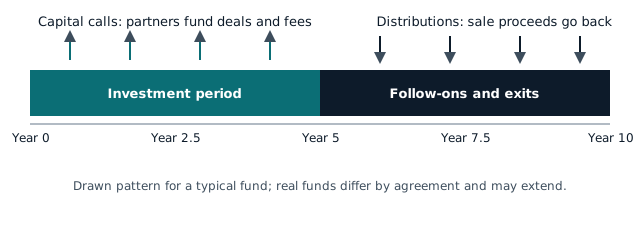
An investor does not hand over the whole sum on day one. Institutional investors make an unfunded commitment to the limited partnership, and the commitment is then drawn over the term of the fund2. The mechanism is the capital call: when managers are ready to buy, they issue a call and investors transfer the money7. Committed capital is available to be drawn throughout the life of the fund as opportunities appear8.
The commitment is a ceiling, not a promise to spend it all. If a firm cannot find suitable opportunities it will not draw the commitment, and the investor may end up investing less than expected2. The reverse holds too. Until the money is called, the investor still owes it.
The ten-year clock
Private equity funds are typically close-ended and raised with a life span of ten years8. Most carry the option to extend, typically with investor agreement, by up to three 1-year extensions8. A typical fund cycle opens with an investment period of around five years8, and that matches the academic study of fund terms: new companies in the first five years, follow-on investments and exits in the last five6.
That study used records on 238 funds raised between 1992 and 20066. About three-quarters of them focused on the United States and most of the rest on Europe6. Treat its percentages as history, and as a US and European sample, not an Asian one.
Each investment is held for less than the fund’s life. The time a fund holds a company is generally well below ten years and more often around three to five8.
The practical result is a lock-up. An investment in a private equity fund is often illiquid, and holding it for several years before any return is realised may be necessary1. Funds typically limit an investor’s ability to withdraw1. A fund interest is not meant to be traded, although it can be transferred to another investor2, usually with the manager’s consent2. Distributions are made as investments turn into cash, and limited partners typically cannot demand a sale2. An investor should be able to wait the requisite period before realising a return1.
What the manager is paid
Back to the lease. The management fee is the rent, paid whether or not the building appreciates. Carried interest is the share of the upside.
The fee
Once investors commit, they pay an annual management fee, typically 1 to 2%8. During the investment period it is generally a percentage of total commitments, and afterwards a percentage of invested capital8. In the 1992 to 2006 sample the most common initial fee level was 2 percent6. At 2 percent a year for ten years on committed capital, lifetime fees would reach 20 percent of commitments and investment capital would be the other 80 percent6.
Many funds soften that. One example is a 2 percent fee in the five-year investment period, falling by 25 basis points a year for the next five6. For most funds in that sample, lifetime fees came in below 20 percent of committed capital6. The median was 12 percent for buyout funds and 17.75 percent for venture funds6.
Buyout funds can earn on top. Transaction fees and monitoring fees are common for buyout funds and rare for venture funds6. Portfolio companies may pay the firm for such services1.
The carry
The second source is carried interest, a share of the profits paid to the manager, circa 20% above a pre-agreed return called the hurdle rate8. The word interest has no link to interest rates or to a loan or bank account3. In the sample, all 144 buyout funds used 20 percent as their carry level6.
Three terms define carry in practice6:
- Level: the percentage of profit the general partner claims6.
- Basis: the standard by which profit is measured6.
- Hurdle: whether the general partner must first give limited partners a preset return6.
Carry is paid after investors are made whole. The waterfall first returns each investor’s initial capital contribution3. Where there is a hurdle, virtually all funds in the sample set it between six and ten percent6. Hurdles are common among buyout funds and less so among venture funds, at 93.1% against 47.6%6. The majority of funds with a hurdle have a catch-up rate of 100 percent6. Carried interest is paid out only on a successful exit, which may take years3.
The simplest case in the study is a fund with no hurdle. Limited partners receive every dollar of exit proceeds until they have their whole committed capital back, and then the general partners receive 20 cents of every dollar after that6. The study’s own example is a fund that made $20M of profit on $100M of committed capital, and the general partners received 20 percent, or $4M, of that profit6. Laid out step by step, with the two subtractions and the 80% share added by us:
| What happens | Amount |
|---|---|
| Committed capital | $100M6 |
| Exit proceeds | $120M6 |
| Limited partners get their capital back first | $100M to limited partners6 |
| Profit left to share (120 minus 100, our arithmetic) | $20M6 |
| General partner, 20% of the profit | $4M6 |
| Limited partners, the other 80% of the profit (our arithmetic) | $16M6 |
| Limited partners in total, capital plus profit (our arithmetic) | $116M6 |
With a hurdle the order changes. A catch-up is the stretch where the general partner takes all, or most, of the next profit until it has caught up to its full share of the profit so far. The next table is our illustration, not a study figure. It is a one-off simplification: a simple 8% hurdle applied once, a full catch-up and the same profit as before, whereas a real fund follows its own agreement.2
| What happens | Amount |
|---|---|
| Profit to share, same as above | $20M6 |
| Hurdle: limited partners take 8% of $100M first (our arithmetic) | $8M to limited partners26 |
| Catch-up at 100%: the general partner takes the next slice until it holds 20% of profit so far (our arithmetic) | $2M to the general partner6 |
| The remaining $10M splits 80 and 20 (our arithmetic) | $8M to limited partners, $2M to the general partner6 |
| Totals (our arithmetic) | Limited partners $16M of profit, general partner $4M, which is 20%6 |
The hurdle protected the limited partners’ first slice of profit, and the catch-up then brought the general partner up to its full share. With a profit smaller than the hurdle, limited partners would keep all of it and the general partner would earn no carry.
Early carry has a catch. When a fund pays carry early, limited partners typically have the right to claw it back if later performance is too weak to return the full carry basis6.
The terms in one table
| Term | Typical value | Where it comes from |
|---|---|---|
| Fund term | Ten years, up to three 1-year extensions8 | Regulators’ report, 2010 |
| Investment period | Around five years8 | Regulators’ report, 2010 |
| Management fee | 1 to 2% a year, on commitments and then invested capital8 | Regulators’ report, 2010 |
| Management fee, 2021 | Rates stable at 1.5 to 2.0%17 | ILPA fund terms survey, 2021 |
| Lifetime fees | Median 12 percent of commitments for buyout funds6 | Study of 238 funds, 1992 to 2006 |
| Carry | About 20% above a hurdle8 | Regulators’ report, 2010 |
| Hurdle | Six to ten percent where one exists6 | Study of 238 funds, 1992 to 2006 |
| Catch-up | 100 percent in most funds with a hurdle6 | Study of 238 funds, 1992 to 2006 |
For current fee rates, read the 2021 row and not the 2010 one. Two of those sources are old: a 1992 to 2006 sample, mostly US and European, and a regulators’ summary from 201068. The one current public benchmark found is ILPA’s 2021 fund terms report. In it, management fee rates held steady at 1.5 to 2.0%17. The survey covers LPs invested in growth and buyout funds. Among those with Asia Pacific funds of $3-5B, 90% reported rates below 2%, against 76% in North America and Europe17. The whole-of-fund, or European, waterfall remains the dominant carry structure worldwide17. No current public benchmark for Asian carry or hurdle rates was found, so those rows stay on the labelled historical sample.
The same report shows where the fee does not reach. Deal sourcing costs, adviser and affiliate salaries and regulatory filings are routinely charged outside the management fee17. Read the headline rate together with the expenses clause. Side letters can also give an investor extra terms of its own8. For how a manager should report fees, expenses and carry, the standard is the ILPA Reporting Template18. In 2021, 59% of LPs reported receiving the industry standard fee template at least half the time17. The updated template, released in January 2025, replaces the 2016 version for funds still investing in the first quarter of 2026 and for funds starting on or after 1 January 202618.
How it ends: exits
The fund makes money when it sells. The exit routes have historically been an initial public offering or a sale to a strategic acquirer, known as a trade sale2. A sale to another private equity firm is called a secondary2. The deal pages follow each route. The investment approach page covers the Asian side, including Hong Kong’s IPO window.
What the standards bodies ask for
Investors have a trade body of their own. The Institutional Limited Partners Association built its Private Equity Principles to prompt talks between limited partners and general partners about fund partnerships4. Three principles form the core: alignment of interest, governance and transparency4. The third edition was published in June 2019 and covers fund economics, fund term and structure, key person, governance and disclosure4.
Risks, in plain words
Private equity can lose money, and an investor can lose all of its investment2. Conflicts of interest are part of the structure. As fiduciaries, advisers must make full disclosure of all conflicts of interest between themselves and the funds they manage1.
This page explains how funds work. It is not an offer, a recommendation or advice, and it does not rank funds or managers.
Questions people ask
Can a regular person invest in private equity?
Funds are offered to professional or accredited investors, not to the public. A Hong Kong individual needs a portfolio of at least HK$8 million11. A Singapore individual qualifies on any one of three tests: net personal assets over S$2 million (the home counted for at most S$1 million), net financial assets over S$1 million, or income of not less than S$300,000 in the preceding 12 months16. In the United States a fund is typically open only to accredited investors and qualified clients1. A pension plan can hold a fund on a member's behalf1.
Read next
- GP vs LP in private equity: roles and liabilityThe general partner runs a private equity fund and answers for its debts. Limited partners fund it and stay passive. Roles, liability and pay explained.
- Private equity fees: management fee and carryPrivate equity charges a 1 to 2% management fee and about 20% carried interest. Each charge explained with worked examples, Asian fund rates and Hong Kong tax.
- The private equity J-curve: why returns start negativeWhy private equity funds show losses before gains: fees on commitments, slow deployment and late exits, with cash flow data and Asia's exit queue.
Sources
- Private Equity Funds · U.S. Securities and Exchange Commission (Investor.gov) · investor.gov · checked 21 October 2026
- Private equity fund · Wikipedia · en.wikipedia.org · checked 21 October 2026
- Carried interest · Wikipedia · en.wikipedia.org · checked 21 October 2026
- ILPA Principles · Institutional Limited Partners Association · ilpa.org · checked 21 October 2026
- Limited Partnership Fund Ordinance (Cap. 637), Ord. No. 14 of 2020, English text as enacted · Companies Registry, Hong Kong · cr.gov.hk · checked 21 October 2026
- The Economics of Private Equity Funds (Metrick and Yasuda, working paper) · Wharton School, Rodney L. White Center · rodneywhitecenter.wharton.upenn.edu · checked 21 October 2026
- Capital call · Wikipedia · en.wikipedia.org · checked 21 October 2026
- Private Equity Conflicts of Interest: Final Report (FR11/10), November 2010 · IOSCO Technical Committee · iosco.org · checked 21 October 2026
- Licensing Handbook, October 2024 · Securities and Futures Commission, Hong Kong · sfc.hk · checked 21 October 2026
- Fund Manager Code of Conduct, Fifth Edition, October 2024 · Securities and Futures Commission, Hong Kong · sfc.hk · checked 21 October 2026
- Review of the Securities and Futures (Professional Investor) Rules, paper for the Legislative Council Panel on Financial Affairs, 2020 · Legislative Council, Hong Kong (paper by the Administration and the SFC) · legco.gov.hk · checked 21 October 2026
- Step 1: Understanding VCC features, eligibility and requirements · Accounting and Corporate Regulatory Authority, Singapore · acra.gov.sg · checked 21 October 2026
- Step 2: Choosing directors and key officers for a VCC · Accounting and Corporate Regulatory Authority, Singapore · acra.gov.sg · checked 21 October 2026
- Exempted Limited Partnership Act (2025 Revision) · Cayman Islands Government, Legislation · legislation.gov.ky · checked 21 October 2026
- Private Funds Act (2025 Revision) · Cayman Islands Monetary Authority · cima.ky · checked 21 October 2026
- Securities and Futures Act 2001, section 4A (specific classes of investors), 2020 Revised Edition as shown on Singapore Statutes Online · Attorney-General's Chambers, Singapore · sso.agc.gov.sg · checked 21 October 2026
- What's Market in Fund Terms? ILPA Industry Intelligence Report, 2021 (ILPA Fund Terms Survey data and Colmore data) · Institutional Limited Partners Association · ilpa.org · checked 21 October 2026
- ILPA Reporting Template · Institutional Limited Partners Association · ilpa.org · checked 21 October 2026
Published . Education only, not an offer or advice (terms). Rules, fees and market figures change, so each source shows the day it was read. How we check facts · Report an error.