Jump to a section
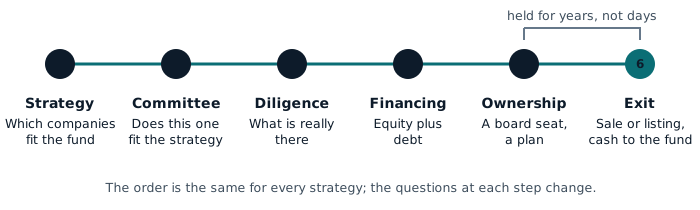
Ask a firm about its approach and you are asking about a filter. Before any company is on the table, the firm has decided what kind of company may pass through it. IOSCO puts the filter in one line: strategies are defined by the stage of development and the capital needs of the companies the fund intends to back, a plain reading of its final report on conflicts of interest1.
Everything else follows from that choice. Stage and capital need set the size of the cheque, how much of the company is bought, how much debt can sit on top and how long the money stays. The strategies section takes each style in turn, and the side-by-side comparison shows the differences in one table.
A fund holds each company for a fraction of its own life.
The clock sets the pace
The fund is the second filter. In IOSCO’s 2010 review of conflicts, most funds are set up with a ten-year life and scope for up to three 1-year extensions, subject to investor approval, and the opening move is an investment period of around five years in which the manager looks for deals. Money is not sitting in the fund on day one. Commitments are drawn as opportunities appear and stay binding for the whole life, which is why the asset counts as highly illiquid1.
New investments can be called only in that investment period. Afterwards calls cover expenses, fees, follow-ons and repayment of permitted debt1. For an approach the consequence is plain: the firm knows how long it has to find a deal, and it knows which fund gets the deal. A firm is usually barred from raising a fund with the same or a similar strategy until the last one has invested a set share of its commitments, typically between 75% and 90%1. Multi-strategy firms are common, so a fund document spells its mandate out with care1.
The committee
IOSCO’s account of the committee is short. A deal reaches senior staff as a proposal, and the committee asks whether it fits the fund’s strategy and whether the company can grow inside the time the fund has left, and it reads the last page first: the likely exit routes, whether the fund wants a partial or a full exit, and how much growth is left in the company1.
Diligence
IOSCO expects internal staff and outside advisers to have examined the company before completion1. What they hunt for depends on the strategy. In a leveraged buyout, firms prefer companies that are moderately undervalued to appropriately valued, run by executives who have worked together for a long time and roll over shares6. A venture investor wants an excellent team, a large potential market and above all high growth potential4, and detailed diligence because venture exits come slowly4. Growth investors work from records. Many track up-and-coming companies for as long as 10 or 15 years, flag the fast growers and call when funding looks needed, and expect a growth strategy so the return can be estimated5.
Pricing and financing
A firm pays for a company with equity and debt and aims to earn a return on the equity3. IOSCO adds that banks have traditionally supplied the debt1. Risk sets the mix. Firms taking big operating risks, such as turnarounds, use far lower leverage so management keeps room, while firms taking fewer operating risks often push leverage up and look for strong, stable cash flows to service it3. A leveraged buyout is built around the lender: the sponsor does not commit all the capital, and the debt is often non-recourse to the sponsor, with no claim on its other investments3. The amount banks provide depends on the asset’s cash flows, history, growth prospects and hard assets6. In Hong Kong the manager must also tell fund investors the maximum leverage it expects to use8.
One named Asia-Pacific deal: Blackstone’s US$16 billion acquisition of AirTrunk, one of the largest exits globally in the law firm King & Wood Mallesons’ 2025 paper9. The paper discloses that Blackstone is its client, so read the framing with that in mind9. The same paper counts 30 deals of $1 billion or more in 2024, nine of them in digital infrastructure and communications9. Our reading, not a finding of the paper: a sector with that many large deals gives lenders long-lived cash flows to lend against, which is the buyout recipe in miniature.
The strategy menu
Buyouts
Debt does the heavy lifting in a buyout, so the lender’s view of the cash flow shapes the deal. The firm adds borrowing to the company’s capital structure and lets the company repay it over time, which lowers the effective purchase price6. Two Asian habits show how firms keep that cash flow easy to read. One is the platform with bolt-ons, which is spreading among GPs because bolt-ons need smaller cheques and add no new risks to the portfolio9. The other is the carve-out. Carve-outs reached 20% of buyouts over $100 million in 2024, up from 11%9, and Japan and Korea are named as likely sources as conglomerates divest non-core units9. Both routes buy a business whose numbers can be pulled apart and checked, which is what a lender wants.
The management buyout is the variant worth knowing. It suits a public company that needs internal restructuring and wants to go private before it changes the organisation5. The team can raise the money through a private equity firm that takes a minority share5, and the route can give a retiring owner an exit5.
Growth equity
With no debt to carry the case, a growth deal turns on judgement about people. Success relies on a keen eye for a strong founder or team, plus careful research and projection5. Asia gives the style a theme: market commentary files India under growth and Japan under stability9. Across the region, though, the share of buyout deals grew to more than 50% while the share of growth deals shrank9. Both facts hold at once, and a growth investor in Asia has to read the second one as competition for deals.
Venture capital
Venture starts with the market, then the team. The money goes to new technology, new marketing concepts and products without a proven track record or steady revenue3, and it suits businesses with large up-front capital needs that cheaper sources such as debt cannot fund3. What the firm wants to see is an excellent management team, a large potential market and high growth potential4, and it has to be selective4. The exit is the pinch point. A buyout fund can sell to a trade buyer or to management1, but a venture fund leans harder on a listing, which is why the Hong Kong IPO figures below matter to it.
Secondaries
A secondary swaps the question “what will this company become” for “what is this stake worth today”. It buys an existing private equity asset3, which lets institutional investors, newcomers especially, reach older vintages than would otherwise be open to them3, and its cash flow profile softens the J-curve of a new fund3. In Asia, mid-cap deals are expected to stay much harder to exit9, so a buyer for a mature stake has room to work. That last step is our inference from the data, not a finding in it.
Other strategies
Mezzanine capital is subordinated debt or preferred equity that sits at the junior end of the capital structure, ahead of common equity3, so its holders ask a higher return for the risk3. In a loan-to-own distressed deal the investor buys debt hoping to end up owning and controlling the equity after funding a restructuring3. A search fund lets an entrepreneur raise money from investors to buy an existing small business3. A fund of funds invests in other private equity funds3.
Owning the company
After the deal the firm is a shareholder with a plan. It is common for the firm to require that one of its staff sit on the company’s board to monitor performance and drive improvement1. The plan comes in two main flavours: grow sales in new or existing markets, which lifts revenue, or cut costs, which widens margins3.
The holding period is shorter than the fund’s life. A fund generally holds an investment well below ten years, more often around three to five1.
Getting out
The fund earns by selling. The common routes are a trade sale to a company that wants the business to complement its own, a sale to the firm’s management team, repayment of preference shares, or a secondary sale to another private equity fund1. A listing is the other major route, and the firm often keeps a board seat after an IPO for as long as the fund holds a significant stake1.
The fund’s life keeps the pace. A manager increasingly focuses on transforming and disposing of investments as the committed capital is invested1. An extension is a tool, not a right, and needs investor approval1. Firms tend to raise follow-on funds at intervals of around five years1.
The Asian exit queue
In Asia the exit question is pressing. Cheaper money across most of the region seems to have driven a wave of buyouts9. By the end of 2024 the 2011-2019 vintages held more than 200 portfolio companies that had been owned for more than four years9. Mid-size deals are scarcer9, and mid-cap deals are expected to stay much harder to exit9.
The listing route has reopened. Hong Kong’s IPO market staged a remarkable resurgence in early 2025, raising around HK$18 billion across 15 IPOs in the first quarter of 20259. These are figures from a law firm’s trends paper built on AVCJ and Bain data, and one quarter is not a trend.
The six steps in one line
Ask a firm for a real example at each of the six steps, from the filter to the exit. None of this recommends a firm or forecasts how a deal will end.
Hong Kong’s rulebook for the manager
A manager licensed in Hong Kong works under the SFC’s Fund Manager Code of Conduct, which applies to licensed persons whose business involves managing collective investment schemes8. For an investment approach, three of its demands bite. The manager must run arrangements to identify, prevent, manage and monitor conflicts of interest8. It must set up procedures for a proper and independent valuation of fund assets8. And any material conflict must be disclosed to fund investors8. A breach counts against the manager’s fitness and properness and can lead to disciplinary action8.
How investors keep an approach honest
The fund’s own paperwork carries most of the checking. Investors often add side letters with extra terms, such as enhanced reporting or terms for one investor’s tax or regulatory position1. Reporting centres on regular fund valuation reports and transaction reports, produced quarterly, half-yearly or yearly1. When one fund trades with another in the same firm, it is common to seek a valuation from an independent third party1.
Funds in the more developed markets also keep an investor advisory committee, a small sample of the investors1. Its job is to be a forum for conflict management rather than for investment decisions1. Alignment has a plain test as well: the firm or its staff commit to co-invest a set percentage alongside the fund1. The fund page shows how Hong Kong, Singapore and Cayman law draw the same lines.
Where an approach can go wrong
An approach is only as good as the incentives behind it. Private equity firms often have interests that conflict with the funds they manage and so with their limited partners2. Through links with affiliates and portfolio companies, advisers can benefit themselves at the expense of the funds and investors2, and they may run several funds invested jointly in the same companies2.
Fees show it most clearly. A firm may charge portfolio companies fees for work done on a fund transaction1, and may keep collecting director’s, monitoring and consultancy fees from the company1. The usual fund economics are a management fee of 1 to 2% a year and carried interest of about 20% of profit above a hurdle1.
Investors judge these arrangements by a standard. The Institutional Limited Partners Association holds that three principles form the core of an effective private equity partnership: alignment of interest, governance and transparency7. The SEC’s guide to private equity funds covers fees and conflicts from the US side2.
This page maps the mechanics and recommends no fund, manager or investment.
If this left you with a question, start with Private equity due diligence: process and checklist or Buyout vs growth equity: key differences.
Sources
- Private Equity Conflicts of Interest: Final Report (FR11/10), November 2010 · IOSCO Technical Committee · iosco.org · checked 21 October 2026
- Private Equity Funds · U.S. Securities and Exchange Commission (Investor.gov) · investor.gov · checked 21 October 2026
- Private equity · Wikipedia · en.wikipedia.org · checked 21 October 2026
- Venture capital · Wikipedia · en.wikipedia.org · checked 21 October 2026
- 3 Key Types of Private Equity Strategies · Harvard Business School Online · online.hbs.edu · checked 21 October 2026
- Leveraged buyout · Wikipedia · en.wikipedia.org · checked 21 October 2026
- ILPA Principles · Institutional Limited Partners Association · ilpa.org · checked 21 October 2026
- Fund Manager Code of Conduct, Fifth Edition, October 2024 · Securities and Futures Commission, Hong Kong · sfc.hk · checked 21 October 2026
- In Private 2025: Top 10 trends for private capital (King & Wood Mallesons, citing AVCJ and Bain & Company's Asia-Pacific Private Equity Report 2025, data to end-2024) · King & Wood Mallesons · mallesons.com · checked 21 October 2026
Published . Education only, not an offer or advice (terms). Rules, fees and market figures change, so each source shows the day it was read. How we check facts · Report an error.