Before a private equity fund buys a company it checks what it is buying. That check is due diligence. This page follows it in order: the funnel that narrows many opportunities to a few purchases, the work streams run on the survivors, who does the work and who signs off.
It sits in the deals section and picks up where the investment approach page leaves off.
Key takeaways
- Due diligence is a detailed investigation of financials, operations, markets and risks before investment3.
- Most opportunities never reach it. The survey average is fewer than 24 of every 100 reaching deep due diligence1.
- The work is done by internal staff and external consultants or advisers2, and an investment committee decides2.
- Findings feed price and terms: issues found can be used to negotiate better terms or a lower purchase price8.
- It reduces risk and does not remove it11.
What due diligence is for
In private equity, due diligence is the detailed investigation of a target company’s financials, operations, markets and risks before investment3. Its goal is to validate the assumptions behind the deal and uncover issues that could affect returns3. Before a deal completes, the work will customarily have been done by internal staff and by external consultants or advisers, as the IOSCO report on private equity conflicts records2.
The work has two jobs. It screens out companies that would fail, and it turns what it finds into a price: information gathered during due diligence is a tool in negotiations, because uncovered issues or risks can be used to negotiate better terms or a lower purchase price8.
It does not guarantee anything. Risk management and due diligence processes seek to mitigate, but cannot eliminate, risk11.
The deal funnel: 100 opportunities, 6 closings
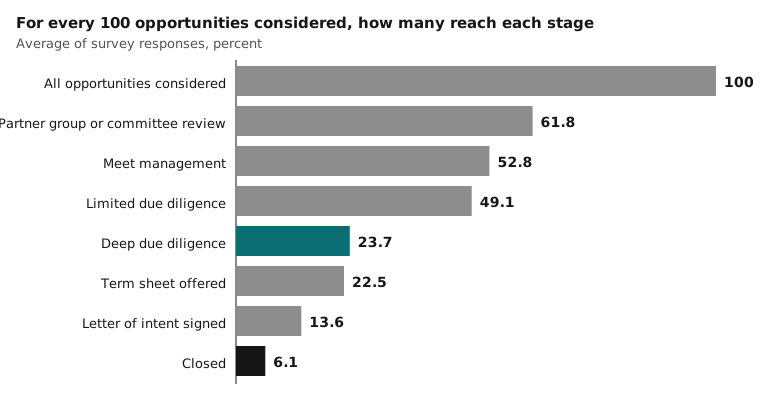
Most of the time spent on diligence produces no deal. A survey of 79 private equity investors with combined assets under management of over $750B1 reports the average funnel in its Table 19, the percentage of opportunities considered that reach each stage1. For every hundred opportunities considered, the average investor deeply investigates fewer than 24, signs an agreement with fewer than 14 and closes on only 61. The survey authors read this as evidence that investors devote considerable resources to evaluating transactions even though they will ultimately invest in only a very few1.
| Stage reached | Share of opportunities considered (survey mean) |
|---|---|
| Review with partner group or investment committee | 61.8%1 |
| Meet management | 52.8%1 |
| Limited due diligence | 49.1%1 |
| Deep due diligence | 23.7%1 |
| Term sheet offered and detailed terms negotiated | 22.5%1 |
| Letter of intent signed | 13.6%1 |
| Closed | 6.1%1 |
The sharpest drop is between limited and deep due diligence, from 49.1% to 23.7%1. Larger and older firms pass a greater fraction of their deals through to the next stage1.
Worked example (our arithmetic)
The funnel numbers convert into two ratios. The inputs are the survey means1:
| Step | Figure |
|---|---|
| Opportunities considered | 1001 |
| Reach deep due diligence | 23.71 |
| Closed | 6.11 |
| Deep diligences per closing, 23.7 divided by 6.1 | 3.9 (our arithmetic)1 |
| Opportunities considered per closing, 100 divided by 6.1 | 16.4 (our arithmetic)1 |
On the survey averages a firm carries out nearly four deep diligences for every company it buys, and weighs roughly sixteen opportunities for each one (our arithmetic from the averages above)1. The numbers are the managers’ own reports from a survey, not an audit of deal files, and they vary by firm.
The process step by step
The funnel stages map to a sequence that most firms recognise, although each firm names the steps differently.
- First, screen. The first thing a deal team does is compare a potential investment against the fund’s investment criteria9. A company can be dismissed immediately if its financial profile, geography or industry does not fit the fund9.
- Second, first read. The seller’s confidential information memorandum, a document often upwards of 50 pages9, starts the work. Good deal teams do not rely solely on it: they use it as a starting point for further due diligence9.
- Third, committee. Once a firm has identified a potential investment it typically makes a proposal to an investment committee formed from senior staff, which determines whether to pursue it and sets parameters for bidding2.
- Fourth, management and limited work. Management meetings and a limited round of checks come next1.
- Fifth, letter of intent. The firm submits a non-binding letter of intent that outlines the proposed purchase price or valuation range, key terms and conditions, and an exclusivity period for further due diligence8.
- Sixth, deep work. Comprehensive due diligence is a deep dive into all aspects of the target, including financial, legal, operational, commercial, IT and cybersecurity, and ESG due diligence8.
- Seventh, final price and structure. Based on the findings, the firm refines its valuation model and structures the deal8.
- Eighth, approval and signing. The committee decides on the basis of a wide range of factors, particularly compatibility with the fund’s investment strategy and the potential for growth within the remaining life span of the fund2.
The checks, work stream by work stream
A checklist is a set of questions grouped by who can answer them. One guide counts nine areas: finance, tax, legal, HR, assets, IT, competitive position, total addressable market and capital requirements9. The sections below take the four that most checklists open with.
Financial
Financial due diligence examines balance sheets, income statements and cash flow statements, typically for at least the past 3 to 5 years10. Quality of earnings analysis is an important part of it: it aims to verify the accuracy of a target company’s reported earnings8. It looks at adjustments such as one-time or non-recurring items and owner-related expenses in privately held companies8. Working capital matters because management of working capital shows the company’s short-term financial health8.
Legal
Legal due diligence analyses regulatory compliance, contractual obligations and intellectual property rights8. The reviewer reads contracts, intellectual property rights, pending or potential litigation and regulatory compliance10. One question matters for any buyer: whether any contracts contain change of control provisions that could be triggered by the acquisition8.
Human resources and management
The people check is partly formal, such as whether processes exist to attract, develop and retain key talent8, and partly informal. A weak management team is a problem a buyer may expect to fix, and that fact can only be uncovered by a deal team that meets with managers, visits suppliers and interviews customers9. The survey ranks the management team as an important selection factor, covered below1.
Information technology
IT due diligence assesses the target’s technological foundation, including its infrastructure, data security and overall IT strategy8. The same list puts IT and cybersecurity beside financial, legal, operational, commercial and ESG work in the comprehensive phase8.
Commercial, tax, ESG and the rest
Commercial work tests the market the company sells into and its place in it. Tax and asset reviews sit in the nine-area list9. ESG work is increasingly standard: the comprehensive phase includes environmental, social and governance due diligence8.
What decides a deal
Diligence produces facts, and the investment committee ranks them. In the survey, investors ranked the factors they consider in choosing an investment. The most important was the business model and competitive position of the company1. The management team, the investor’s ability to add value and the valuation were the three next most important and were roughly of equal importance1. The industry or market and the fit with the investor’s fund were of least importance1.
| Factor | Mean rank (higher is more important) |
|---|---|
| Business model / competitive position | 4.61 |
| Management team | 3.81 |
| Ability to add value | 3.61 |
| Valuation | 3.51 |
| Industry / market | 3.21 |
| Fit with the fund | 2.31 |
Table 21 of the paper ranks the factors on a scale where higher numbers are more important1.
Who does the work, and who decides
Deal teams do not work alone. Beyond the firm’s own staff and outside consultants2, almost 66% of the surveyed investors have an advisory board or use senior advisors1. The investors describe these advisers as helping with deal flow and assisting with investment due diligence, among other tasks1. Almost 32% hire strategy consultants to help with operating plans1.
The decision sits with an investment committee. In Hong Kong the composition of that committee has a licensing consequence under the SFC’s circular to private equity firms. Members of an investment committee who, individually or jointly, play a dominant role in making investment decisions for the funds are required to be licensed as representatives and, where appropriate, approved as responsible officers7. Members with no vote or veto, whose role is to give legal, compliance or internal control input, would generally not need to be licensed7. The Type 9 licence page covers the rest of the licensing test.
Where deals come from changes the diligence
How a deal reaches the firm affects how much room there is to look. In the survey, almost 36% of closed deals were proactively self-generated, 7.4% were provided by management and 8.6% came from the firm’s executive network1. In contrast, 33% were investment banking generated, 8.6% came from deal brokers and 4.3% came from other private equity firms1. The authors regard the first group as having the potential to be proprietary and the second as unlikely to be1. The survey reports where deals come from, not how deep the work went on each.
Due diligence on the manager
Investors diligence the manager too, on a separate track. The Institutional Limited Partners Association publishes a standard questionnaire. Its latest update is intended to standardise the key areas of inquiry posed by investors during their diligence of managers4. The update added sections on co-investments, GP-led secondaries, credit facilities and data security4, after the first release in 20134. The environmental, social and governance section adopts in full the Principles for Responsible Investment’s questionnaire for limited partners4.
ILPA’s ESG Assessment Framework helps limited partners benchmark general partners’ responses to due diligence efforts5. It sorts activities into four buckets: Not Present, Developing, Intermediate and Advanced5. Co-investing alongside a fund moves the work back to the investor’s desk: it requires more due diligence and different skills than fund investing3.
Who pays for the work
Diligence costs money, and the fund documents decide who bears it. The ILPA Principles say broken deal expenses should be charged to the fund6. They also say that expenses incurred through preliminary due diligence and sourcing should not be considered broken deal expenses6. So the cost of early sourcing and preliminary work stays outside the broken-deal charge to the fund6. The fees and carry page covers how fees and expenses are set.
Limits of this page
The funnel and the factor ranking are one survey of firms describing their own practice1. The work stream lists come from vendor guides, which are context and not a standard8. The checklists here are not a regulatory standard. Education only: nothing on this page is an offer or advice.
Read next
- Private equity investment approach, step by stepHow a private equity firm turns a strategy into a deal: filter, committee, diligence, financing, ownership and exit, with Hong Kong rules and Asia's exit queue.
- Buyout vs growth equity: key differencesBuyout, growth equity and venture capital differ in stake, leverage, company stage and exit. A side-by-side reference with the Asia-Pacific deal mix for 2024.
- How a leveraged buyout works: debt, equity, returnsA leveraged buyout buys a company mostly with borrowed money. How the debt and equity are layered, a worked return example, the risks, and the 2024 Asia data.
Sources
- What Do Private Equity Firms Say They Do? (NBER Working Paper 21133, April 2015; Gompers, Kaplan and Mukharlyamov; survey of 79 firms) · National Bureau of Economic Research · nber.org · checked 21 October 2026
- Private Equity Conflicts of Interest: Final Report (FR11/10), November 2010 · IOSCO Technical Committee · iosco.org · checked 21 October 2026
- Private Equity: What You Need to Know · KKR · kkr.com · checked 21 October 2026
- ILPA Releases Updated DDQ and Diversity Metrics Template (9 November 2021) · Institutional Limited Partners Association · ilpa.org · checked 21 October 2026
- ESG Assessment Framework: Key Considerations and FAQ (July 2021) · Institutional Limited Partners Association · ilpa.org · checked 21 October 2026
- ILPA Principles 3.0 · Institutional Limited Partners Association · ilpa.org · checked 21 October 2026
- Circular to private equity firms seeking to be licensed (7 January 2020) · Securities and Futures Commission, Hong Kong · apps.sfc.hk · checked 21 October 2026
- The Private Equity Due Diligence Process (And Checklist) · Grata · grata.com · checked 21 October 2026
- The complete private equity due diligence checklist · Affinity · affinity.co · checked 21 October 2026
- Key Considerations for Private Equity Due Diligence (1 February 2025) · E78 Partners · e78partners.com · checked 21 October 2026
- What is Private Equity & How it Works · BlackRock · blackrock.com · checked 21 October 2026
Published . Education only, not an offer or advice (terms). Rules, fees and market figures change, so each source shows the day it was read. How we check facts · Report an error.