Jump to a section
- What investors pay, in one table
- What is the 2 and 20 rule?
- How the management fee is charged
- What the fee covers, and what it does not
- Private capital fees: venture capital against buyout
- What is 20% carry?
- How to calculate carried interest
- Whole-of-fund or deal-by-deal?
- Fees in Asia and in Hong Kong tax
- Reading the fee terms in a fund document
What investors pay, in one table
| Charge | Who pays whom | Typical size and basis |
|---|---|---|
| Management fee | Investors to the manager | 1 to 2% a year, on commitments in the investment period and on invested capital afterwards1 |
| Carried interest | Investors to the general partner, out of profit | About 20% of profit above a hurdle1 |
| Transaction and monitoring fees | Portfolio companies to the firm | Common for buyout funds, rare for venture funds2 |
| Organisation and partnership expenses | The fund, so investors | Organisational expenses rose 123% from 2011 to 20213 |
| Offering-document costs | Set in the fund’s own documents | Disclosed in the offering documents and agreements9 |
The fundamentals section starts with how a private equity fund works. This page follows the money that flows to the manager and what shapes it.
What is the 2 and 20 rule?
“2 and 20” is the market’s shorthand: 2% of the fund’s assets a year as a management fee, and 20% of profit above a hurdle rate as carried interest6. Hong Kong’s tax authority uses the phrase in its 2016 practice note on offshore private equity funds, and calls it the industry standard pay formula6. It is also a rule of thumb that has slipped. In the Metrick and Yasuda study of 238 funds raised from 1992 to 2006, 2 percent was the most common initial fee2. By 2021, ILPA’s survey found rates holding at 1.5 to 2.0%3.
IOSCO’s description is the safer starting point. Investors pay a management fee, typically 1 to 2% a year1. The manager also earns carried interest of circa 20% of the fund’s profit above a pre-agreed cash return, the hurdle rate1. Read “2 and 20” as the upper edge of a range, not the rule.
About 60 percent of expected manager revenue in the study came from fixed components that do not depend on performance2. That is the plain reason the fee is negotiated hard: it pays whether or not the fund makes money.
How the management fee is charged
The fee is annual. During the investment period it is generally a percentage of total commitments, and after it a percentage of invested capital1. The study found the most common historical method was a constant percentage of committed capital2. At 2 percent a year for ten years, lifetime fees would be 20 percent of committed capital, leaving 80 percent to invest2.
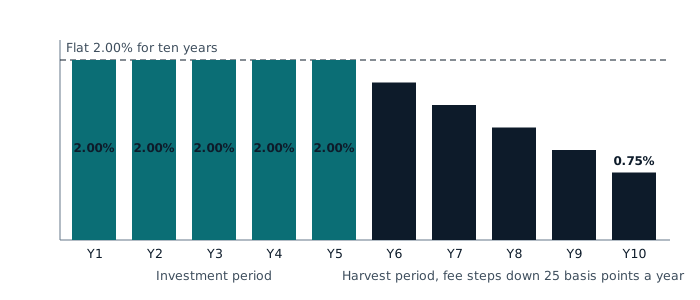
Most funds now concede something. A majority of funds in the study gave limited partners concessions after the investment period2. One schedule has a 2 percent fee for the five-year investment period, falling by 25 basis points a year for the next five2. Another cuts the percentage and changes the basis from committed to net invested capital2. ILPA wants the same direction: fees should step down significantly at the end of the investment period, when a follow-on fund is formed, or when the term is extended4.
Worked example (our arithmetic) on a $100M commitment, using the study’s step-down schedule2. The study gives the pattern, not these dollar amounts.
| Year | Fee rate | Fee in $M |
|---|---|---|
| 1 to 5, each year | 2.00% | 2.00 (our arithmetic2) |
| 6 | 1.75% | 1.75 (our arithmetic2) |
| 7 | 1.50% | 1.50 (our arithmetic2) |
| 8 | 1.25% | 1.25 (our arithmetic2) |
| 9 | 1.00% | 1.00 (our arithmetic2) |
| 10 | 0.75% | 0.75 (our arithmetic2) |
| Ten-year total | 16.25% of commitments | 16.25 (our arithmetic2) |
A flat 2 percent would cost $20M over the same ten years, and the step-down saves $3.75M (our arithmetic), which matches the study’s expectation that lifetime fees come in below 20 percent of committed capital for most funds2.
What the fee covers, and what it does not
ILPA’s position is that the management fee should rest on the normal operating costs of the fund4. Overheads, the salaries of the manager’s staff and advisers, travel and the cost of investing should sit inside it rather than be charged to the fund4.
Practice drifts the other way. In the 2021 survey, deal sourcing costs, adviser and affiliate salaries and regulatory filings were routinely excluded from the fee3. A quarter of responding LPs saw administrative costs such as in-house legal, accounting and software moved outside it3. The headline rate therefore understates what a fund costs.
Two more charges sit outside the fee. Buyout managers may charge portfolio companies fees for work done on a fund transaction1, and may keep collecting director’s, monitoring and consultancy fees afterwards1. Our reading: when you compare two funds, compare the fee, the expense clause and the portfolio-company fee clause together. One number is not a comparison.
Private capital fees: venture capital against buyout
The two main strategies are charged differently. In the study, median lifetime fees were 12 percent of committed capital for buyout funds and 17.75 percent for venture funds2. Transaction and monitoring fees are common features of buyout funds and rare in venture funds2. Hurdles show the same split: 93.1% of buyout funds had one, against 47.6% of venture funds2. A venture investor pays a higher fee on a smaller fund and rarely gets a hurdle. A buyout investor pays a lower fee but meets more charges around it. The strategy page explains why the two differ.
What is 20% carry?
Carry, or carried interest, is the general partner’s share of a fund’s profit8. The standard allocation has historically been 20% for buyout and venture funds, with some variability8. All 144 buyout funds in the study used 20 percent2. The word “interest” has nothing to do with interest rates8. Carry is paid only on a successful exit, which may take years8.
How to calculate carried interest
Carry is arithmetic on three terms2:
| Term | What it decides |
|---|---|
| Carry level | The percentage of profit the general partner claims2 |
| Carry basis | The standard by which profit is measured2 |
| Carry hurdle | Whether the general partner must first give investors a preset return2 |
To calculate carry, measure profit on the agreed basis, test it against any hurdle and catch-up, then apply the level. Where a fund has a hurdle, virtually all hurdles ran between six and ten percent2, and most had a catch-up rate of 100 percent2. Not every fund has a hurdle and a catch-up8. After the hurdle the split moves toward the manager, often 20% manager and 80% investors8.
ILPA argues for rules that favour investors. Carry should be calculated on net profit, after fund-level expenses4. No carry should be taken on current income distributions4. A “hard hurdle”, where carry applies only to profit above the investors’ preferred return, is the form ILPA prefers4.
The worked example on the fund page takes a $20M profit through capital return, hurdle, catch-up and a final split2.
Whole-of-fund or deal-by-deal?
A whole-of-fund waterfall returns all contributions plus the preferred return before the manager earns any carry. ILPA calls that best practice4, and its 2021 survey found it still the dominant structure worldwide3. A deal-by-deal waterfall pays carry as each deal exits. It starts paying sooner, so it needs a safety net, and the safety net is the clawback: when early carry is taken, investors can typically claw it back if later performance is too weak to return the full carry basis2.
Worked example (our arithmetic): two deals, 20% carry, no hurdle, no fees. The definitions come from the sources24. The deal sizes are ours.
| Step | Deal-by-deal | Whole of fund |
|---|---|---|
| Deal A: invest $50M, sell for $80M | Profit $30M, carry paid now: $6M (our arithmetic2) | No carry yet4 |
| Deal B: invest $50M, sell for $30M | Loss $20M, no carry (our arithmetic2) | Fund total: $110M back on $100M (our arithmetic4) |
| Fund profit after both deals | $10M2 | $10M4 |
| Carry the general partner has earned | $2M, which is 20% of $10M2 | $2M, paid after capital is returned4 |
| Carry already paid | $6M, so $4M is owed back2 | $2M, nothing to claw back4 |
ILPA’s view is that an “all capital back” waterfall is the best way to minimise clawbacks4. Where clawbacks do arise, it asks for accrued carry to sit in escrow with significant reserves, for example 30% of carry distributions or more4.
Fees in Asia and in Hong Kong tax
Geography had little impact on management fee rates in the 2021 survey, but a gap showed in larger funds3. Among LPs invested in growth and buyout funds, those in Asia Pacific funds of $3-5B reported rates below 2% in 90% of cases, against 76% in North America and Europe3. That is a sample of LP respondents, not a census of funds.
Tax shapes where managers sit. In 2016 the Hong Kong Inland Revenue Department wrote that carried interest paid to a Hong Kong investment manager or advisor would be examined when that person was not adequately paid for its Hong Kong functions, assets and risks6. That note is dated May 2016 and describes the law as it stood at publication6; the concession below is a later rule7. The current salaries tax concession excludes a percentage of eligible carried interest from a qualifying employee’s salaries tax, for carried interest received on or after 1 April 2020, and that percentage is at present 100%7. A qualifying employee is one who provides investment management services in Hong Kong for the qualifying person7. Eligibility has more conditions than these two lines; the IRD FAQ sets them out7. This page does not give tax advice.
Reading the fee terms in a fund document
Start where the money is described. Offering documents and agreements should disclose and govern the fees and expenses of the fund and its investors9, and investors should be vigilant about both9. ILPA asks that fees, expenses and carry calculations be disclosed regularly, reviewed periodically by the limited partner advisory committee and certified by an independent auditor4. In more developed markets funds typically keep such an investor advisory committee1, and investors often add side letters with extra terms1.
For reporting, the ILPA Reporting Template standardises how fees, expenses and carried interest are shown5. The updated version replaces the 2016 one for funds still investing in the first quarter of 2026 and for funds starting on or after 1 January 20265. In the 2021 survey, 59% of LPs said the standard ILPA fee template reached them at least half the time3.
The fee study behind much of this page covers 1992 to 2006, and about three-quarters of its funds focused on the United States2. The 2021 survey is the current public benchmark found3; no current public benchmark for Asian carry or hurdle rates was found, so those figures stay on the labelled sample. Compare terms against the ILPA standards in ILPA Principles 3.04, and see how GPs and LPs divide the work.
Nothing on this page recommends a fund or a manager or forecasts a return.
Questions people ask
What is the 2 and 20 rule in private equity?
It is shorthand for a 2% annual management fee plus carried interest of 20% of profit above a hurdle rate6. Fund terms vary. The most common initial fee in a 1992 to 2006 sample was 2 percent2, and ILPA's 2021 survey put typical rates at 1.5 to 2.0%3.
What is 20% carry in private equity?
Carry, or carried interest, is the general partner's share of a fund's profit, historically 20% for buyout and venture funds8. It is paid only on a successful exit8, and often only after investors have received a preset return2.
Does the 2% management fee in funds get charged annually?
Yes, it is an annual charge. During the investment period it is generally a percentage of total commitments, and afterwards a percentage of invested capital1. Most funds in one study softened it after the investment period2, and ILPA wants it to step down significantly4.
RelatedHow a private equity fund works in AsiaGP vs LP in private equity: roles and liabilityBuyout vs growth equity: key differences
Sources
- Private Equity Conflicts of Interest: Final Report (FR11/10), November 2010 · IOSCO Technical Committee · iosco.org · checked 21 October 2026
- The Economics of Private Equity Funds (Metrick and Yasuda, working paper) · Wharton School, Rodney L. White Center · rodneywhitecenter.wharton.upenn.edu · checked 21 October 2026
- What's Market in Fund Terms? ILPA Industry Intelligence Report, 2021 (ILPA Fund Terms Survey data and Colmore data) · Institutional Limited Partners Association · ilpa.org · checked 21 October 2026
- ILPA Principles 3.0 · Institutional Limited Partners Association · ilpa.org · checked 21 October 2026
- ILPA Reporting Template · Institutional Limited Partners Association · ilpa.org · checked 21 October 2026
- Departmental Interpretation and Practice Notes No. 51: Profits tax exemption for offshore private equity funds (May 2016) · Inland Revenue Department, Hong Kong · ird.gov.hk · checked 21 October 2026
- FAQ: Salaries tax concessions for eligible carried interest · Inland Revenue Department, Hong Kong · ird.gov.hk · checked 21 October 2026
- Carried interest · Wikipedia · en.wikipedia.org · checked 21 October 2026
- Private Equity Funds · U.S. Securities and Exchange Commission (Investor.gov) · investor.gov · checked 21 October 2026
Published . Education only, not an offer or advice (terms). Rules, fees and market figures change, so each source shows the day it was read. How we check facts · Report an error.