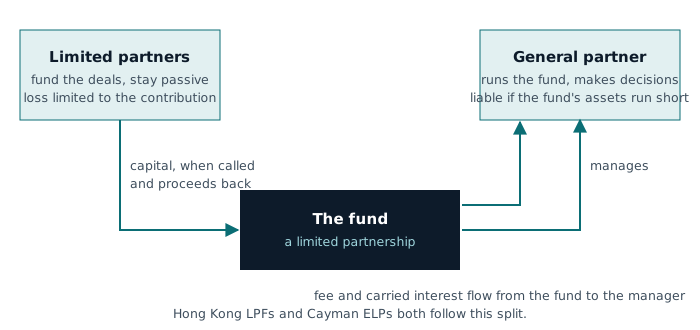
Every private equity fund is two parties joined by one contract. One party decides and carries the risk of the unknown. The other pays, waits and gives up control in return for a cap on what it can lose. Get the two roles straight and most fund terms stop looking arbitrary.
This page uses Hong Kong and Cayman partnership law as its Asian reference points. The fundamentals section has the wider map, and how a fund works covers the mechanics around the two roles.
The two roles side by side
| General partner (GP) | Limited partner (LP) | |
|---|---|---|
| What it is | The private equity firm acting as GP and adviser7 | The investor, from a pension plan to a wealthy individual6 |
| Money | Commits some, in the form ILPA wants5 | Commits capital that is drawn as investments arise7 |
| Control | Runs the fund and appoints its manager and auditor2 | No day-to-day management rights or control over the assets2 |
| Liability | Unlimited in Hong Kong1; for all debts if assets are inadequate in Cayman3 | Not beyond the agreed contribution2 |
| Fiduciary duty to partners | Stated standard of care expected5 | None to the GP or other LPs in Hong Kong2 |
| Paid by | Management fee and carried interest4 | Receives profit after the GP’s share2 |
What the general partner does
The GP is the firm that raises and manages the fund, as general partner and investment adviser7. Most funds are limited partnerships governed by the limited partnership agreement, the LPA7. Under the Hong Kong Ordinance the GP must appoint an investment manager to carry out the day-to-day investment functions, and the GP may be that manager itself2. It must also appoint an auditor2 and make sure the fund has proper custody arrangements for its assets2.
Behind those duties sits the money question. A GP calls capital as it needs it: an investor’s commitment is satisfied over time through capital calls7. A fund usually lives for ten years, in IOSCO’s 2010 report4, and firms tend to start raising a successor at intervals of around five years4. The GP is therefore selling the next fund while it is still running the last, which is why the way it treats today’s investors matters to it.
The GP’s own conduct is regulated where it is licensed. In Hong Kong the SFC’s Fund Manager Code of Conduct applies to licensed persons whose business is managing collective investment schemes8. It asks the manager to run arrangements that identify, prevent, manage and monitor conflicts of interest8 and to disclose material conflicts to fund investors8. In the United States the same duty is a fiduciary one: advisers must disclose conflicts in full to get informed consent6, and an adviser has a legal obligation to act in the best interests of each fund it manages6.
What the limited partner does, and cannot do
The LP’s role is mostly to fund the deals and wait. Nearly all investors in private equity are passive and rely on the manager to invest and to create liquidity7. Governance rights for LPs are typically minimal7, and LPs typically cannot demand that investments be sold7. The LP can sometimes sell its own fund interest to another investor7.
In exchange the LP gets the right to share in the income and profit of the fund2, does not owe any fiduciary duty to the GP or to other LPs2, and is not liable for the fund’s debts beyond its agreed contribution2. LPs are institutions as well as individuals: insurance companies, university endowments and pension funds, and high income and net worth individuals6.
The LP is not powerless. In more developed markets a fund typically keeps an investor advisory committee made up of a small sample of its investors4, and the committee’s task is conflict management rather than investment decisions4. ILPA’s principles want such committees to advise the fund on conflicts without making their members fiduciaries5. Side letters let a single investor negotiate extra terms, such as enhanced reporting4.
Where the two roles meet: liability
The line between the roles is drawn in statute, and it is the line that matters most in practice. A Hong Kong fund must have one GP with unlimited liability for its debts and at least one LP with limited liability1. A limited partner who takes part in the management of the fund becomes jointly and severally liable with the GP for the debts the fund incurred while the partner so takes part2.
The statute then lists what does not count as management, so investors know what they can do safely. The list includes serving on a committee of the fund2, reviewing accounts, valuation and assets2, and suing for the fund when the GP refuses without good reason2. It is not exhaustive2. The Hong Kong LPF guide goes through the rest of the Ordinance.
Cayman draws the line differently. The general partners are liable for all debts if the partnership’s assets are inadequate3. A limited partner who takes part in the conduct of the business in dealings with persons who are not partners can be liable if the partnership becomes insolvent3, but only to someone who dealt with the partnership knowing of that participation and who reasonably believed the partner to be a general partner3. Consulting and advising the general partner and consenting or withholding consent to proposed action are safe3. Our reading: Hong Kong looks at what the partner did, and Cayman looks at who relied on it. A prudent LP stays inside both lists.
Who can be a GP or an LP in Hong Kong
The Ordinance is generous about who may fill each seat. A GP may be a natural person aged at least 182 or a private company limited by shares incorporated under the Companies Ordinance2, among other kinds of entity2. An LP may be a natural person, a corporation, a partnership of any kind, an unincorporated body or any other entity, acting as trustee or in its own right2. The Companies Registry confirms that the fund’s GP has unlimited liability1, so the choice of GP entity is a liability decision. Our reading: a company as GP stands between the manager’s people and that liability.
Whether an individual can invest as an LP in practice depends on the investor tests for private placements, set out on the fund page.
The process of investing as an LP, step by step
Investing as an LP follows a fixed sequence. The investor receives offering documents with the material information about the investment and then enters into agreements as a limited partner of the fund6. The agreed amount is a commitment, and the money is not drawn at signing: the manager draws it through the life of the fund as investment opportunities become available4. The investor then waits. An investment in a private equity fund is often illiquid, and it may be necessary to hold it for several years before any return is realised6.
| Step | What happens |
|---|---|
| Offer | Offering documents describe the fund6 |
| Commit | The investor signs the agreements and makes an unfunded commitment67 |
| Call | The GP draws money as opportunities arise4 |
| Hold | The LP waits, with limited rights to force a sale7 |
| Distribute | Cash goes back as investments are converted to cash7 |
How the partnership ends: exits and the end of the term
The partnership ends when the investments are sold. Most funds are set up with a ten-year life and scope for up to three 1-year extensions, subject to investor approval4. The GP chooses among exit routes: a trade sale to a buyer that fits the company, a sale to the firm’s management team, repayment of preference shares, or a secondary sale to another private equity fund4. When a company lists, the firm often keeps a board seat for as long as the fund holds a significant stake4.
The LP sees an exit as a distribution, because distributions are made only as investments become cash7. An LP that wants out earlier can transfer its interest to another investor, though the fund is not meant to be traded7. Each extension needs investor approval, which is one of the few places where the LPs’ consent changes what the GP can do4.
How GPs and LPs keep each other honest
Private equity firms often have interests that conflict with the funds they manage and so with the LPs6. The contract is where the two sides negotiate the remedy. Four tools recur.
| Tool | What it does |
|---|---|
| GP commitment | ILPA wants a substantial equity interest in the fund, contributed in cash, not through waived fees5. Firms also demonstrate alignment by committing, with their staff, to co-invest a set percentage alongside the fund4 |
| Key person clause | Key persons should be those who determine investment outcomes, not just the founders5 |
| No-fault removal | ILPA argues a vote of two-thirds in interest of LPs should suffice to remove the GP or dissolve the fund5 |
| Investor advisory committee | A small group of investors reviews how conflicts are handled4 |
None of this is automatic. These are terms to look for in a fund document, and each is a negotiation. ILPA’s three guiding principles are alignment of interest, governance and transparency5.
How each side is paid, and in what order
The GP is paid in two ways: a management fee and carried interest4. The LP is paid out of the profit that is left. In ILPA’s preferred whole-of-fund model all contributions plus a preferred return go back to investors before the GP earns carry5. The management fee is the exception: it is charged during the fund’s life, not at the end4. The fees and carry guide gives the numbers and worked examples.
This page explains roles. It does not recommend a fund or a manager, and it forecasts nothing.
Questions people ask
What is the difference between GP and LP in private equity?
The GP is the firm that raises and manages the fund7. LPs are the investors, and nearly all are passive7. In Hong Kong the GP has unlimited liability and an LP has limited liability1.
Read next
- How a private equity fund works in AsiaA private equity fund is a ten-year limited partnership. Who the partners are, where liability stops, and how Hong Kong, Singapore and Cayman funds differ
- Private equity fees: management fee and carryPrivate equity charges a 1 to 2% management fee and about 20% carried interest. Each charge explained with worked examples, Asian fund rates and Hong Kong tax.
- Hong Kong limited partnership fund (LPF) explainedThe Hong Kong limited partnership fund is a registered private fund structure. Who qualifies, how registration works, duties after it and what it leaves out.
Sources
- Limited Partnership Funds: Overview · Companies Registry, Hong Kong · cr.gov.hk · checked 21 October 2026
- Limited Partnership Fund Ordinance (Cap. 637), Ord. No. 14 of 2020, English text as enacted · Companies Registry, Hong Kong · cr.gov.hk · checked 21 October 2026
- Exempted Limited Partnership Act (2025 Revision) · Cayman Islands Government, Legislation · legislation.gov.ky · checked 21 October 2026
- Private Equity Conflicts of Interest: Final Report (FR11/10), November 2010 · IOSCO Technical Committee · iosco.org · checked 21 October 2026
- ILPA Principles 3.0 · Institutional Limited Partners Association · ilpa.org · checked 21 October 2026
- Private Equity Funds · U.S. Securities and Exchange Commission (Investor.gov) · investor.gov · checked 21 October 2026
- Private equity fund · Wikipedia · en.wikipedia.org · checked 21 October 2026
- Fund Manager Code of Conduct, Fifth Edition, October 2024 · Securities and Futures Commission, Hong Kong · sfc.hk · checked 21 October 2026
Published . Education only, not an offer or advice (terms). Rules, fees and market figures change, so each source shows the day it was read. How we check facts · Report an error.