The Hong Kong LPF answers one practical question: where can a private equity or venture fund sit if its manager is in Hong Kong? The Companies Registry introduced the regime to attract private investment funds, private equity and venture capital funds included, to set up and register in Hong Kong1.
Two points shape everything below. The LPF is a registration, not an authorisation, so the Registry checks eligibility and nothing else. And it is a statute-backed wrapper for a limited partnership, so the parties still need a limited partnership agreement. The regulation section collects the rule-based pages, and the fund page shows where the LPF sits beside Singapore and Cayman options.
What a Hong Kong LPF is
The Limited Partnership Fund Ordinance, Cap. 637, set up a regime that lets private funds register as limited partnerships in Hong Kong, and it has been in operation since 31 August 20201. An LPF is a fund structured as a limited partnership and used to manage investments for the benefit of its investors1. The regime is a registration scheme administered by the Companies Registry1.
An LPF must be constituted by one general partner with unlimited liability for the fund’s debts and at least one limited partner with limited liability1. An existing fund set up as a limited partnership under the older Limited Partnerships Ordinance, Cap. 37, may also register as an LPF if it meets the eligibility requirements1. For the roles themselves, see GP vs LP in private equity.
Who qualifies: the eligibility checklist
A fund is eligible to register when, at registration, it meets every requirement in the table2.
| Requirement | What the Ordinance requires |
|---|---|
| Agreement | The fund is constituted by a limited partnership agreement whose arrangements do not contravene the Ordinance or any other applicable law2 |
| Partners | One general partner and at least one limited partner2 |
| Office | An office in Hong Kong to which communications and notices may be sent2 |
| Purpose | The fund is not set up for an unlawful purpose2 |
| Group test | Not all the partners are corporations in the same group of companies2 |
| Name | A name that would give the impression of a Government connection is refused2 |
A narrow exception lets a fund whose partners are all in one corporate group register if its application contains the required statement, which is a question for counsel2. Our reading: the group test is aimed at funds that are really one company group in partnership form. Treat the table as the checklist the Registrar works through, not a substitute for the text.
Who can be the general partner and the limited partners
The seats are open to many kinds of party. A general partner may be:
- a natural person aged at least 182;
- a private company limited by shares incorporated under the Companies Ordinance2;
- a registered non-Hong Kong company2, among other kinds of entity2.
A limited partner may be a natural person or any of these, acting as trustee or in its own right2:
The choice of general partner is a liability decision. The general partner carries unlimited liability for the fund’s debts1, while a limited partner is not liable beyond its agreed contribution2. Our reading: a company as general partner is the usual way to put a legal entity between the manager’s people and that exposure. The statute does not require it.
What the general partner must appoint
Three appointments come with the job:
- An investment manager to carry out the day-to-day investment management of the fund. The general partner may appoint itself2.
- An auditor for the fund’s financial statements2.
- Proper custody arrangements for the fund’s assets, as the limited partnership agreement specifies2.
Who qualifies as manager is limited by the Ordinance2.
Where the general partner is itself another limited partnership fund2 or a non-Hong Kong limited partnership without a legal personality2, it must also appoint an authorized representative, who is responsible for the management and control of the fund2. A change of that representative is notified within 15 days2.
Anti-money laundering applies too. The Ordinance applies the anti-money laundering schedule of Cap. 615 to a responsible person of an LPF2. The records the Ordinance requires must be kept at the fund’s registered office or another Hong Kong place made known to the Registrar2.
How registration works, step by step
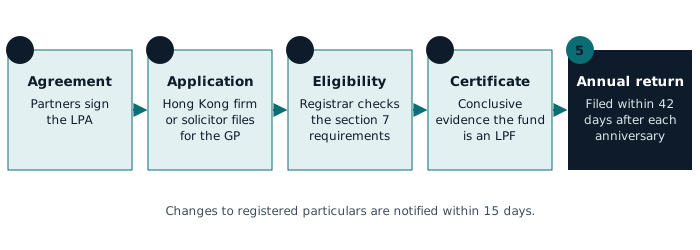
The path has five stops, drawn above. The general partner proposes the fund, and the application is made to the Registrar by the person proposed to be general partner2. A Hong Kong firm or a solicitor must submit it on that person’s behalf2. The Registrar may register the fund on application and, on registering it, must issue a certificate of registration2. The certificate is conclusive evidence that the fund is a limited partnership fund2. The date on the certificate also starts the clock for the first annual return2.
A refusal can be appealed to the Court, and the appeal must be made within 42 days after notice of the decision is issued2. The fees are set in the Ordinance’s schedule and are not repeated here, because fee schedules change. Check the Registry’s current notices before budgeting.
Duties and deadlines after registration
Registration creates a calendar. The general partner files a return with the Registrar within 42 days after each anniversary of the certificate2. A change in registered particulars is notified within 15 days after it occurs2. The general partner is the party that must appoint and keep an auditor and custody arrangements2, and the fund must keep its records in the places the Ordinance names2.
| Duty | Deadline or rule |
|---|---|
| Annual return | Within 42 days after each anniversary of the certificate2 |
| Notice of change | Within 15 days after the change2 |
| Records | At the registered office or another Hong Kong place known to the Registrar2 |
| Auditor | Appointed by the general partner for the fund’s financial statements2 |
| Custody | Proper arrangements as the limited partnership agreement specifies2 |
Worked example (our arithmetic). Assume a certificate of registration is issued on 1 March 2027. The first anniversary is 1 March 2028, and the return is due within 42 days after it2.
| Item | Date or count |
|---|---|
| Certificate issued (assumed) | 1 March 20272 |
| First anniversary | 1 March 2028 (our arithmetic2) |
| Filing window | 42 days from the anniversary2 |
| Last day to file | 12 April 2028 (1 March plus 42 days, our arithmetic)2 |
| Failure to file | An offence by the general partner2 |
Limited partners: protection and safe harbour
The limited partner’s bargain is short:
- It shares in the fund’s income and profits2.
- It has no day-to-day management rights or control over the assets2.
- It owes no fiduciary duty to the general partner or other limited partners2.
- It is not liable beyond its agreed contribution2.
One exception matters. If a limited partner takes part in the management of the fund, it and the general partner are jointly and severally liable for the fund’s debts incurred while it does2. A safe harbour lists what does not count as taking part, and the list is not exhaustive2. A conflict of interest in a decision is not, on its own, a reason to treat a limited partner who takes part in the decision as managing the fund2. Schedule 2 covers, among others2:
| Activity inside the safe harbour | Plain meaning |
|---|---|
| Acting as agent, member, contractor, officer or employee of the fund2 | An LP may hold an office without becoming a manager |
| Serving on a board or committee of the fund2 | An advisory committee seat is safe |
| Consulting, reviewing, approving or advising on the accounts, valuation or assets2 | An LP may look at the books and the valuations |
| Discussing with or advising the general partner, another LP or the investment manager2 | Talking to the GP is not managing |
| Calling, attending or taking part in a partners’ meeting2 | Meetings are safe |
| Approving or disapproving an amendment to the limited partnership agreement2 | Voting on the rules is safe |
| Acting as a guarantor for the fund or the general partner2 | Guaranteeing is safe |
| Taking part in a decision on borrowing2, a change in investment scope2 or extending the term2 | The big votes are safe |
| Suing for the fund when the general partner refuses without good reason2 | A rescue suit is safe |
| Having the LP’s name in the fund’s name2 | A name alone does not make a manager |
The fund page sets this beside the Cayman rule.
What registration does not do
Registration does not licence the manager. Under the SFC Licensing Handbook, a firm delegated discretionary power to make investment decisions on securities for a fund in Hong Kong needs a licence for Type 9 regulated activity3, which covers real estate investment scheme management and securities or futures contracts management3. The SFC generally expects such a firm to hold properly delegated discretionary authority3. The licensed manager then works under the SFC’s Fund Manager Code of Conduct, which applies to licensed persons whose business is managing collective investment schemes4. The Code asks for arrangements to identify, prevent, manage and monitor conflicts of interest4 and for policies that allow a proper and independent valuation of fund assets4.
Registration also does not decide who may invest. Private equity funds are among the private placement products offered to professional investors5. An individual qualifies with a portfolio of at least HK$8 million5, and a corporation or partnership with a portfolio of at least HK$8 million or total assets of at least HK$40 million5. The offering-document prohibition in the Securities and Futures Ordinance does not apply to an offer made to professional investors5.
Registration does not settle tax either. A bill to enhance the preferential tax regimes for privately offered funds and carried interest, with a view to attracting more funds and family offices to establish a presence in Hong Kong, has been gazetted6. The Government intends to bring it back to the Council for second reading before the end of 20267, and it is not law yet. The Hong Kong market page sets out what the bill proposes.
This page explains a registration regime. It is not legal advice and recommends no fund or structure. The text of the Ordinance cited here is the English version as enacted in 20202, so confirm the current consolidated text before relying on a clause.
Questions people ask
Read next
- GP vs LP in private equity: roles and liabilityThe general partner runs a private equity fund and answers for its debts. Limited partners fund it and stay passive. Roles, liability and pay explained.
- How a private equity fund works in AsiaA private equity fund is a ten-year limited partnership. Who the partners are, where liability stops, and how Hong Kong, Singapore and Cayman funds differ
- Private equity fees: management fee and carryPrivate equity charges a 1 to 2% management fee and about 20% carried interest. Each charge explained with worked examples, Asian fund rates and Hong Kong tax.
Sources
- Limited Partnership Funds: Overview · Companies Registry, Hong Kong · cr.gov.hk · checked 21 October 2026
- Limited Partnership Fund Ordinance (Cap. 637), Ord. No. 14 of 2020, English text as enacted · Companies Registry, Hong Kong · cr.gov.hk · checked 21 October 2026
- Licensing Handbook, October 2024 · Securities and Futures Commission, Hong Kong · sfc.hk · checked 21 October 2026
- Fund Manager Code of Conduct, Fifth Edition, October 2024 · Securities and Futures Commission, Hong Kong · sfc.hk · checked 21 October 2026
- Review of the Securities and Futures (Professional Investor) Rules, paper for the Legislative Council Panel on Financial Affairs, 2020 · Legislative Council, Hong Kong (paper by the Administration and the SFC) · legco.gov.hk · checked 21 October 2026
- Inland Revenue (Amendment) (Preferential Tax Regimes for Funds, Family-owned Investment Holding Vehicles and Carried Interest) Bill 2026 gazetted (12 June 2026) · Inland Revenue Department, Hong Kong (Information Services Department press release) · ird.gov.hk · checked 21 October 2026
- Hong Kong's Limited Partnership Fund: Six Years On, a Credible Alternative to Cayman (September 2026) · Conventus Law · conventuslaw.com · checked 21 October 2026
Published . Education only, not an offer or advice (terms). Rules, fees and market figures change, so each source shows the day it was read. How we check facts · Report an error.