Hong Kong is a place where private equity managers sit, where some of their funds are registered, where their investors have bank accounts and, increasingly, where their portfolio companies list. Those four roles are measured by four different statistics, and most confusion about the market comes from mixing them. This page takes them one at a time, with the figure, its date and who counted it.
For the regional picture and the deal data, start with private equity in Asia. This page narrows to Hong Kong.
How big is the Hong Kong private equity market?
The headline figure is capital under management. AVCJ Research data, reproduced in the Securities and Futures Commission’s survey, rank Hong Kong second in Asia after Mainland China, with US$229 billion under management by private equity funds, excluding real estate funds2. The year before the figure was US$221 billion2. The Financial Secretary’s January 2026 speech gives the same picture: Hong Kong is home to over 650 private equity firms with assets under management of around US$230 billion, second in Asia behind only the Chinese Mainland1. The Hong Kong Monetary Authority ranks the city as the second largest private equity centre after Chinese Mainland6.
Worked example (our arithmetic)
A year-on-year change is a subtraction and a division. The inputs are the two AVCJ figures reported by the SFC2:
| Step | Figure |
|---|---|
| Capital under management, 2023 | US$221 billion2 |
| Capital under management, 2024 | US$229 billion2 |
| Change, 229 minus 221 | US$8 billion (our arithmetic)2 |
| Change as a share of 2023, 8 divided by 221 | 3.6% (our arithmetic)2 |
Private equity capital under management in Hong Kong grew by about 3.6% in 2024 on those figures (our arithmetic)2. Treat it as a measure of size, not of returns: capital under management rises with new commitments and with valuations, and falls with distributions.
The same market, measured four ways
| What is counted | Figure | Who counted | Date |
|---|---|---|---|
| Capital managed by private equity funds, excluding real estate | US$229 billion2 | AVCJ Research, via the SFC | End-2024 |
| Private equity firms based in Hong Kong | Over 6501 | Financial Secretary | January 2026 |
| Private funds of every strategy managed by licensed corporations and registered institutions | HK$5,042 billion, 20% of AUM, up 16%2 | SFC survey | End-2024 |
| All asset and wealth management | Over HK$35 trillion, up 13 per cent1 | Financial Secretary | 2024 |
Two warnings follow. The SFC’s private-fund row covers every strategy, so it is wider than private equity2. And the SFC’s own counts cover only firms it licenses or registers: some private equity firms in Hong Kong are neither licensed corporations nor registered institutions2. A manager that runs a fund wholly from outside Hong Kong and only advises from the city can sit outside the survey, while the AVCJ figure may still include its funds. Currencies differ too: the SFC survey reports in Hong Kong dollars unless stated2, and the AVCJ and Financial Secretary figures are in US dollars. This page does not convert between them.
Who is in the Hong Kong private equity market
Managers
The managers are the 650-odd firms1. Their licensing sits inside a much bigger industry: the number of firms licensed to carry out asset management, Type 9 regulated activity, rose by 4% from 2,127 to 2,212 during 20242. Assets managed in Hong Kong made up 58% of the AUM of the asset management business, and 59% of these assets were invested in non-equity asset classes at the end of 20242.
Investors
Investors in Hong Kong private equity funds are typically professional investors based both in Hong Kong and offshore14. They include insurance companies, pension funds and financial institutions as well as wealthy individuals, investment offices of high-net worth families and funds of funds14. The professional investor test is concrete: an individual with a portfolio of at least HK$8 million qualifies14. The SFC survey shows the wider asset base that these investors sit inside: professional investors accounted for 73% of all asset management and fund advisory assets in 2024, up from 70%2. Money from governments, sovereign wealth funds and central banks fell by 2% over the year2.
Family offices form a second pool. The Financial Secretary counts more than 2 700 family offices in Hong Kong, over half of which manage assets of more than US$50 million1. The Government has committed to facilitating at least 220 family offices in establishing or expanding operations in Hong Kong from 2026 to 20281. Retail and high-net-worth investors are also increasingly seeking exposure to private equity1, a trend the Government is channelling through listed vehicles, covered under exits below.
The state as co-investor
The Hong Kong Investment Corporation Limited, HKIC, is a government-established vehicle that provides patient capital and makes strategic investments in high-potential ventures, particularly in hard technology, and co-invests in projects where justified1. The Financial Secretary reports that for every dollar it invests it attracts around six dollars in private investment1. It matters to this page as a market participant, not as an investment to buy: it sits beside private equity funds as a source of capital, and the Financial Secretary has said it is ready to collaborate with the private equity community1. The Office for Attracting Strategic Enterprises, a separate Government unit, has attracted more than 100 strategic enterprises over the past three years1.
Where Hong Kong-managed funds are set up
A fund is a legal vehicle, and where it is registered is a separate decision from where its manager works. Until recently the choice of fund vehicles in Hong Kong was very limited, and this changed with the introduction of the open-ended fund company in 2018 and the limited partnership fund in 202014. Before that it was relatively rare for private equity fund vehicles to be domiciled in Hong Kong, and the majority of private equity funds managed from Hong Kong were domiciled in offshore jurisdictions, for example the Cayman Islands or the British Virgin Islands14.
The limited partnership fund, LPF, is the vehicle built for private equity. The Limited Partnership Fund Ordinance (Cap. 637) commenced operation on 31 August 20207. The regime was introduced to attract private investment funds, including private equity and venture capital funds, to set up and register in Hong Kong7. An LPF has one general partner with unlimited liability and at least one limited partner with limited liability7. It is a registration scheme administered by the Companies Registry7. A limited partnership established in any jurisdiction outside Hong Kong may also register as an LPF without being dissolved or re-formed13. The limited partnership fund page sets out the mechanics, liability rules and annual filing.
How fast the register is growing
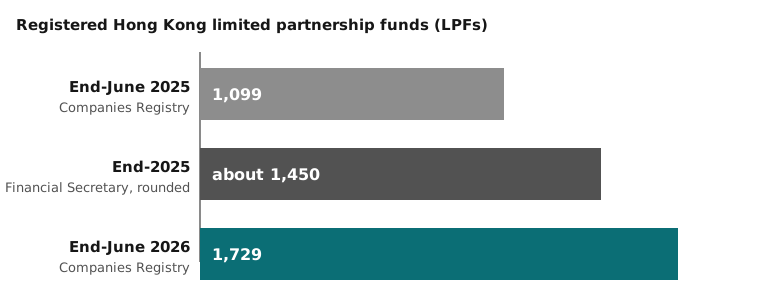
| Count | End-June 2025 | End-2025 | End-June 2026 |
|---|---|---|---|
| Limited partnership funds | 1,0994 | About 1 450, up 37 per cent on a year earlier1 | 1,7293 |
| New LPFs in the first half | 1164 | n/a | 4063 |
| Open-ended fund companies | n/a | Close to 680, up 43 per cent1 | 7523 |
The Companies Registry’s figures are counts of registrations, not of capital: a registered LPF can be empty or small, and the registry does not say how much money sits in them. They show how many managers chose a Hong Kong vehicle, not how much private equity money has moved.
Worked example (our arithmetic)
The two Companies Registry totals give the growth over a year43:
| Step | Figure |
|---|---|
| LPFs registered, end-June 2025 | 1,0994 |
| LPFs registered, end-June 2026 | 1,7293 |
| Increase, 1,729 minus 1,099 | 630 (our arithmetic)43 |
| Increase as a share of 1,099 | 57.3% (our arithmetic)43 |
| New registrations in the first half of 2026 against the first half of 2025, 406 divided by 116 | 3.5 times (our arithmetic)43 |
The register grew by roughly three-fifths in a year, and registrations in the first half of 2026 ran at three and a half times the pace of the first half of 2025 on the registry’s counts43. The registry figures do not show why.
Licensing: who needs a licence to manage a fund from Hong Kong
Registering a fund does not licence its manager. Where fund management activities are carried on in Hong Kong in relation to securities, the fund manager needs a licence for Type 9 regulated activity, asset management14. In the SFC’s circular to private equity firms the same rule applies to general partners: a GP that conducts fund management business in Hong Kong is generally required to be licensed for Type 98. A GP that has fully delegated all asset management functions to another entity licensed or registered for the activity need not be licensed itself8.
Two further rules shape day-to-day practice. An unlicensed GP should not represent to any prospective investor that it manages a private equity fund in Hong Kong8. And fund marketing activities generally constitute dealing in securities, so a firm carrying on that business would generally be required to be licensed for Type 1 regulated activity as well, unless it falls within an exemption for a Type 9 licensee8. The Type 9 licence page covers the decision path, the competence rules and the fees. The licensing rule is why the 2,212 Type 9 licensees above2 are the starting point for counting managers, and why some private equity firms still fall outside the SFC’s data2.
Tax: the fund exemption and the 2026 bill
Hong Kong’s tax treatment explains why a manager might base a fund here. The Inland Revenue Department’s practice note on the unified fund regime provides that all funds, regardless of their structure, their central management and control location, their size or the purpose that they serve, will enjoy profits tax exemption subject to meeting certain conditions9. One condition concerns who manages the fund: the transactions must be carried out in Hong Kong by, or arranged in Hong Kong by, a licensed corporation or registered institution, unless the fund qualifies in some other way9. The practice note also observes that private equity funds might not necessarily be managed by licensed corporations9.
Investments in private companies face four tests: whether the company holds immovable property, how long the investment is held, whether the fund has control, and how many short-term assets the company holds9. If the 10% threshold in the immovable property test is not exceeded, the investor will be exempt if the holding-period, control and short-term-asset tests are satisfied in good faith9.
The second concession concerns carried interest, the manager’s share of profit. A percentage of eligible carried interest received by a qualifying employee on or after 1 April 2020 is excluded from salaries tax, and at present that percentage is 100%10. An employee temporarily seconded to Hong Kong, without a separate employment contract with a qualifying person that carries on business in Hong Kong, is not a qualifying employee10.
The 2026 bill
On 12 June 2026 the Government gazetted the Inland Revenue (Amendment) (Preferential Tax Regimes for Funds, Family-owned Investment Holding Vehicles and Carried Interest) Bill 2026 to enhance the regimes for privately offered funds, family-owned investment holding vehicles and carried interest, with a view to attracting more funds and family offices to establish a presence in Hong Kong5. The Bill was scheduled for first reading on 24 June5. By 12 August 2026 the Bills Committee had finished going through it clause by clause, and the Government intends to bring it back to the Council for second reading before the end of 202613. It is not law yet. The table compares what the Bill proposes with the position described above.
| Topic | Position described above | What the Bill proposes |
|---|---|---|
| Who counts as a fund | Funds under the unified regime9 | Widened to cover pension funds, endowment funds, funds with a governmental entity, central bank or international organisation as sole investor, and funds of one with at least HKD 240 million of qualifying investments12 |
| Incidental profits | A 5% limit applies12 | The existing 5% limit on profits derived from incidental transactions will be removed12 |
| Qualifying investments | Specified classes | Expanded to include loans, equity interests in non-corporate private entities, immovable property outside Hong Kong and insurance-linked securities12 |
| Substance | Manager must be licensed or registered9 | A fund must have an adequate number of full-time qualified employees in Hong Kong, not less than two12, and operating expenditure of not less than HKD 2 million in the basis period12 |
| Carried interest hurdle | A hurdle rate in the fund documents | The requirement that carry be received on a hurdle rate will be removed12 |
| Carried interest certification | Funds are certified by the Hong Kong Monetary Authority | The Bill proposes to remove the certification requirement6 |
| Timing | Current law | Subject to enactment, effect retrospectively from 1 April 2025, the year of assessment 2025/2612 |
The HKMA has suspended the acceptance of new applications for certification of funds until further notice, in light of the proposed amendments6. The Bill adds a tax reporting mechanism and economic substance requirements, similar to those under the tax concession regime for family-owned investment holding vehicles5. For carried interest it adds a new condition: the entitlement to a share of profit must not be attributable to any capital contribution to the fund or be discretionary12. Carry may also be paid directly to an employee or through a carry vehicle12. This section covers a proposal. Check the text as enacted before relying on any detail.
The Mainland link
Much of Hong Kong’s private equity activity points north. The LPF regime was designed to facilitate the channeling of capital into corporates, including start-ups in the innovation and technology field in the Greater Bay Area7. On the asset management side, for Mainland-related firms in Hong Kong the AUM of their asset and wealth management business grew 15% to HK$3,086 billion, with net fund inflows up 68% to HK$256 billion2. That is the SFC’s wider survey category, not private equity alone, but it shows which direction the capital is coming from. Hong Kong calls itself the world’s largest cross-boundary wealth management centre5, and the HKMA ranks it the largest cross-border private wealth management and hedge fund centre in Asia as well as the second largest private equity centre6.
Deals and exits
Hong Kong’s own stock exchange is one exit route for portfolio companies. The Financial Secretary reports that Hong Kong recorded 119 initial public offerings in 2025, raising more than HK$285 billion, an increase of over two times year on year and first globally1. The Hang Seng Index rose by 28 per cent in 2025, following an 18 per cent increase in 20241. A vibrant stock market and robust IPO performance provide portfolio companies with clearer and more credible exit pathways1.
Early 2025 showed the pipeline building. In the first quarter of 2025 the market raised around HK$18 billion across 15 IPOs11. Six of the 15 IPOs raised over HK$1 billion each11. The IPO pipeline then included 120 applicants, up from 86 at the end of 202411.
Exits remain the sore point of the wider region. Asia-Pacific exit value dipped 1% in 2024 compared with the prior year, and both LPs and GPs see the exit environment as the biggest impediment to strong returns11. Greater China, in these data, includes China, Hong Kong and Taiwan11, so the regional exit picture is not purely a Hong Kong one.
Hong Kong is widening the routes. The listing regime has been modernised with listing avenues for companies from the new economy and emerging sectors, including pre-revenue biotechnology companies and specialist technology companies1. In February 2025 the SFC clarified the requirements for authorising closed-ended funds that invest mainly in private and less liquid assets1, and an MPF fund can gain limited exposure to such funds subject to approval of the Mandatory Provident Fund Schemes Authority1. The Asia private equity landscape itself is pivoting towards hard technology, particularly artificial intelligence, biotech and new energy1. The pages on growth equity and leveraged buyouts explain the deal types that end in these exits.
What the numbers do not show
- Scope differs by source. US$229 billion is AVCJ’s measure of funds excluding real estate2. HK$5,042 billion is the SFC’s measure of private funds of every kind2. They are not the same market.
- Registrations are not money. An LPF count says how many partnerships exist3, not how much each holds.
- Speeches and law-firm notes are context. The Financial Secretary’s figures come from a speech1. Law-firm summaries of the Bill are commentary on a draft12.
- Regional data include Hong Kong with its neighbours. The Greater China data in the Mallesons compilation combine China, Hong Kong and Taiwan and exclude deals under US$10 million11.
- Forecasts are not facts. The Bill is not law13, and no number on this page predicts the market’s next year.
Education only: nothing here is an offer or advice, and no fund, manager or vehicle is recommended. The Asia section collects the regional pages.
Read next
- Private equity in Asia: market size, hubs and 2024 dealsAsia-Pacific buyouts reached US$138 billion in 2024. Which markets lead, how Hong Kong, Singapore and Cayman funds are set up, and where exits are stuck.
- Hong Kong limited partnership fund (LPF) explainedThe Hong Kong limited partnership fund is a registered private fund structure. Who qualifies, how registration works, duties after it and what it leaves out.
- SFC Type 9 licence: who needs it, requirements, feesThe SFC Type 9 licence covers asset management in Hong Kong. Who needs it, how private equity firms are treated, capital, people, fees and timelines.
Sources
- Speech by the Financial Secretary at Asia Private Equity Forum 2026 (28 January 2026) · Government of the Hong Kong SAR (Financial Secretary) · info.gov.hk · checked 21 October 2026
- Asset and Wealth Management Activities Survey 2024 (July 2025) · Securities and Futures Commission, Hong Kong · sfc.hk · checked 21 October 2026
- Companies Registry releases statistics for first half of 2026 (17 July 2026) · Companies Registry, Hong Kong · cr.gov.hk · checked 21 October 2026
- Companies Registry releases statistics for first half of 2025 (18 July 2025) · Companies Registry, Hong Kong · cr.gov.hk · checked 21 October 2026
- Inland Revenue (Amendment) (Preferential Tax Regimes for Funds, Family-owned Investment Holding Vehicles and Carried Interest) Bill 2026 gazetted (12 June 2026) · Inland Revenue Department, Hong Kong (Information Services Department press release) · ird.gov.hk · checked 21 October 2026
- Competitive International Financial Platform (page updated after 26 June 2026) · Hong Kong Monetary Authority · hkma.gov.hk · checked 21 October 2026
- Limited Partnership Funds: Overview · Companies Registry, Hong Kong · cr.gov.hk · checked 21 October 2026
- Circular to private equity firms seeking to be licensed (7 January 2020) · Securities and Futures Commission, Hong Kong · apps.sfc.hk · checked 21 October 2026
- Departmental Interpretation and Practice Notes No. 61: Profits Tax Exemption for Funds (June 2020) · Inland Revenue Department, Hong Kong · ird.gov.hk · checked 21 October 2026
- FAQ: Salaries tax concessions for eligible carried interest · Inland Revenue Department, Hong Kong · ird.gov.hk · checked 21 October 2026
- In Private 2025: Top 10 trends for private capital (King & Wood Mallesons, citing AVCJ and Bain & Company, data to end-2024) · King & Wood Mallesons · mallesons.com · checked 21 October 2026
- Hong Kong: Enhanced Tax Concession Regimes for Funds, Family Offices and Carried Interest (30 July 2026) · Baker McKenzie · bakermckenzie.com · checked 21 October 2026
- Hong Kong's Limited Partnership Fund: Six Years On, a Credible Alternative to Cayman (September 2026) · Conventus Law · conventuslaw.com · checked 21 October 2026
- Hong Kong Private equity funds | Venture capital · Charltons · charltonslaw.com · checked 21 October 2026
Published . Education only, not an offer or advice (terms). Rules, fees and market figures change, so each source shows the day it was read. How we check facts · Report an error.