Jump to a section
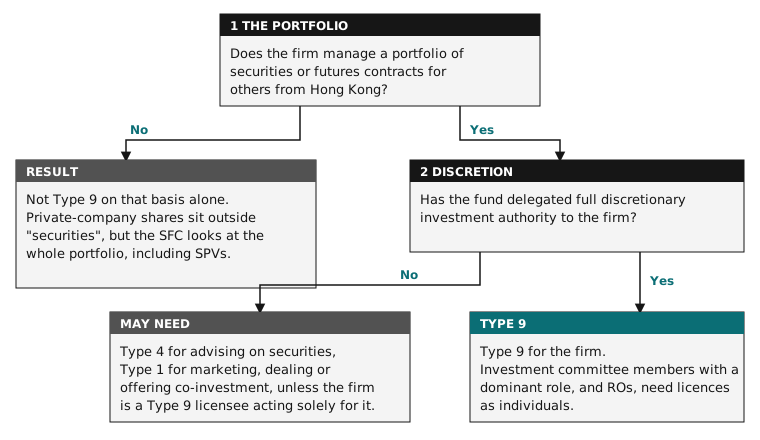
For a private equity or venture manager in Hong Kong, the Type 9 licence decides whether the firm may run a fund at all13. The rules sit in the Securities and Futures Ordinance (SFO), the SFC’s Licensing Handbook, and a 2020 circular written for private equity firms13. This page follows them in the order a manager meets them. The regulation section collects the neighbouring rule pages, including the Hong Kong limited partnership fund, a vehicle a Hong Kong manager can use.
What a Type 9 licence covers
Schedule 5 to the SFO stipulates 13 types of regulated activity and defines each one1. Under it, Type 9 regulated activity, asset management, means real estate investment scheme management or securities or futures contracts management1. For a corporation seeking Type 9, the SFC generally expects it to be able to exercise discretionary investment authority to make investment decisions for its clients, and that authority must be properly delegated to it1. The table lists the types a fund manager meets most often.
| Type | Activity | Why a fund manager meets it |
|---|---|---|
| 1 | Dealing in securities1 | Marketing or distributing a fund, or offering co-investment3 |
| 4 | Advising on securities1 | Advising a fund on its investments without any discretionary authority1 |
| 9 | Asset management1 | Managing the fund with discretion over investment decisions1 |
| 2, 5 | Dealing in and advising on futures contracts1 | The futures equivalents of Types 1 and 41 |
| 3, 6, 7, 8, 10 | Leveraged foreign exchange, corporate finance, automated trading, margin financing, credit rating1 | Not covered on this page |
Anyone carrying on regulated activities in the securities and futures markets in Hong Kong has to be licensed or registered with the SFC, unless a specific exemption applies1. A corporation carrying on a business in a regulated activity in Hong Kong needs a licence under section 1141. A corporation that actively markets such services to the public, in Hong Kong or from outside it, needs one under section 1151. Section 115(1) extends the prohibition to the provision and marketing of relevant services from a place outside Hong Kong to the public2.
Individuals are licensed separately. An individual performing a regulated function for a licensed principal has to be a licensed representative accredited to that principal1. An executive director must also be approved as a responsible officer under section 125(1)(a)1, and a responsible officer is a licensed representative approved under section 126 to supervise the regulated activity1.
The sanction is criminal. It is a serious offence to carry out a regulated activity in Hong Kong, or to actively market one to the Hong Kong public, without the required licence1. Section 114(8), as set out in a Legislative Council paper, makes a person who contravenes section 114(1) liable on conviction on indictment to a fine of HK$5 million and imprisonment for seven years2. The SFC keeps a public register of licensed corporations, licensed representatives and registered institutions1.
Does a private equity firm need one?
Usually the general partner does. It is common for a private equity fund to be constituted as a limited partnership3. The general partner assumes ultimate responsibility for managing and controlling the fund3. In light of that role, it is generally required to hold a Type 9 licence if it conducts fund management business in Hong Kong, provided the activities fall within the definition of asset management3. Individuals who perform asset management for the general partner in Hong Kong must be licensed as representatives and, where appropriate, approved as responsible officers3. The table sets out the situations the SFC has addressed.
| Situation | Licence consequence | Source |
|---|---|---|
| A general partner manages the fund from Hong Kong with discretion | Type 9 for the firm3 | Circular |
| A general partner has fully delegated all asset management to a licensed or registered entity | The general partner itself need not hold Type 93 | Circular |
| A firm is delegated discretion over a fund’s investment decisions on securities | Type 91 | Handbook |
| A firm has no discretion but markets or distributes the fund | Type 1, unless the Type 9 exemption applies1 | Handbook and circular |
| A firm has no discretion but advises on the fund’s investments | Type 41 | Handbook |
| A firm offers co-investment alongside the fund | Type 1, unless offered solely for Type 9 purposes3 | Circular |
| An investment committee member plays a dominant role in decisions | Licensed representative or responsible officer3 | Circular |
| A committee member has no vote or veto and gives legal, compliance or control input | Generally no licence3 | Circular |
Three of these deserve a closer look.
Discretion is the dividing line. To tell Type 9 apart from advising on securities or futures contracts, the SFC takes the view that licensed asset managers must be granted full discretionary investment authority over the funds they manage3. For a private equity firm it looks at the investment decision-making process, the roles of the licensed individuals and their involvement, and whether the delegation of authority is properly documented3. A responsible officer with sufficient authority and seniority to make investment decisions throughout the life cycle of each fund is an example of discretion3.
The portfolio is looked at as a whole. Shares or debentures of a private company within the meaning of section 11 of the Companies Ordinance are excluded from the definition of securities1. A firm that manages a portfolio of private equity or venture capital that involves no securities may therefore not, by itself, attract a licensing requirement1. In many other cases, where a firm manages shares of private offshore companies that fall outside the definition of private company, it is likely to need a licence1. Many funds hold investments through special purpose vehicles3. The SFC considers the composition of the entire portfolio, and if the underlying investments, or the vehicles themselves, are securities, it treats the management as asset management and the firm must be licensed3.
Calling yourself a manager is regulated too. Section 114 also prohibits an unlicensed person from holding itself out as carrying on a regulated activity, so an unlicensed general partner should not tell prospective investors that it manages a fund in Hong Kong3.
Exemptions and exceptions for fund managers
Licensing is activity-based, and several carve-outs follow from that1. A Type 9 licensee does not need separate licences for dealing in securities, dealing in futures contracts or advising on securities or futures if those activities are carried out solely for its asset management business1. The exemption normally covers fund managers who place trade orders or provide research in managing their own clients’ portfolios1. The same logic runs the other way for a Type 1 licensee: it does not need Types 4, 6 and 9 if they are wholly incidental to its securities dealing business1. The circular applies it to funds: a Type 9 firm may offer co-investment and market its funds without a Type 1 licence if the activity is conducted solely for the purpose of Type 9, for example as an integral part of the fund’s fundraising3.
Two limits matter. A temporary licence cannot be granted for Type 91. And a family office is not required to be licensed if its services are not a regulated activity or fall within a carve-out, but a company or family office set up as a business to manage assets that include securities may need a Type 9 licence1.
Profits tax exemption for managed funds
Tax is a separate question that touches the licence. Under Hong Kong’s profits tax exemption for funds, set out in the Inland Revenue Department’s practice note 61, a fund’s qualifying transactions must be carried out in Hong Kong by or through, or arranged in Hong Kong by, a specified person, unless the fund is a qualified investment fund7. A specified person is a corporation licensed, or an authorised financial institution registered, to carry on a regulated activity7. “Arranged in Hong Kong by” covers a case where a qualifying transaction is not carried out by a specified person but arranged in Hong Kong by one, to be carried out by another person7. The note is dated June 2020, and the current text of the Inland Revenue Ordinance should be checked before relying on it7. Private equity funds might not necessarily be managed by corporations that are licensed7.
Requirements for the firm
The SFC must refuse a licence if the applicant fails to satisfy it that it is fit and proper1. Section 129 of the SFO points the SFC to the applicant’s financial status or solvency, qualifications or experience for the functions, ability to carry on the activity competently, honestly and fairly, and reputation, character, reliability and financial integrity1.
| Requirement | Rule | Source |
|---|---|---|
| Incorporation | A company incorporated in Hong Kong, or an overseas company registered with the Companies Registry of Hong Kong1 | Handbook, incorporation |
| Structure | Proper business structure, good internal controls and qualified personnel1 | Handbook, structure |
| Responsible officers | Not less than two for each regulated activity1 | Handbook, officers |
| Availability | At least one responsible officer available at all times1 | Handbook, officers |
| Executive director | At least one proposed responsible officer must be an executive director, and all executive directors must seek approval as responsible officers1 | Handbook, officers |
| Timing | Responsible officer applications are lodged with the licence application1 | Handbook, officers |
| Senior management | Managers-in-charge of overall oversight and the key business line should seek approval as responsible officers1 | Handbook, senior management |
| Capital, no client assets | Liquid capital of HK$100,000, no paid-up capital requirement1 | Handbook, incorporation8 |
| Capital, any other case | Paid-up share capital HK$5,000,000 and liquid capital HK$3,000,0001 | Handbook, incorporation8 |
| Start-up funding | Projection of operating expenses for the first six months1 | Handbook, financial resources |
The board should approve the management structure, including the appointment of managers-in-charge1. The licence-condition route matters for cost: a Type 9 firm subject to the condition that it shall not hold client assets faces only the HK$100,000 liquid capital floor, while any other case faces the larger HK$5,000,000 and HK$3,000,000 pair1. A firm must also maintain paid-up share capital and liquid capital at all times, not just on the day of application1.
Requirements for the people
Under the Guidelines on Competence, the SFC assesses a responsible officer on ability, skills, knowledge and experience to manage and supervise the corporation’s proposed activities4. The competence criteria cover academic or professional qualifications, relevant industry experience, a recognised industry qualification or extra continuing professional training, management experience and a local regulatory framework paper1.
| Item | Responsible officer | Source |
|---|---|---|
| Relevant industry experience, options A and B | At least 3 years over past 6 years4 | Guidelines, responsible officers |
| Recognised industry qualification, Type 9 | HKSI LE Papers 7 and 124 | Guidelines, qualifications |
| Local regulatory framework papers, Type 9 | HKSI LE Papers 1 and 64 | Guidelines, regulatory papers |
| Extra CPT, where used instead of the qualification | Five CPT hours for each activity, a one-off requirement4 | Guidelines, Extra CPT |
| Currency of results | Qualification and papers not more than three years before applying4 | Guidelines, currency |
| Pre-2022 licensees without the academic route | At least eight years of relevant experience over the past 11 years4 | Guidelines, transitional route |
An individual re-entering the industry needs five CPT hours per regulated activity for each year of absence8. Applicants should generally pass the local regulatory papers within three years before applying8.
Private equity gets specific treatment. The SFC recognises a broader range of industry experience for responsible officers of private fund managers4. For private equity, relevant experience includes conducting research, valuation and due diligence of companies in related industries, managing and monitoring a fund’s underlying investments for the best interests of fund investors, and structuring corporate transactions such as management buyouts and privatisations4. The SFC also accepts private equity experience gained in a non-regulated situation, including overseas where the activities are not regulated3. Experience that is only indirectly relevant, such as sales or risk management of funds, will likely bring the Non Sole Condition on the licence4. Management experience means hands-on supervision of essential regulated functions, including the staff who carry them out, and the SFC would not normally accept management experience that is purely administrative4. Experience at a firm that was largely dormant for a prolonged period is critically reviewed4.
Residence matters. The SFC grants licences to individuals only if they will come to Hong Kong to carry on regulated activities for the licensed corporation1. A responsible officer stationed overseas should expect a non-sole condition1. Itinerant professionals should not be responsible officers, because responsible officers are required to oversee the regulated activity for which the principal is licensed1.
How to apply, how long it takes and what it costs
The application goes through the SFC’s WINGS platform, and once it is accepted the applicant receives a message requesting payment of the fee1. The licensed corporation application fee is HK$4,740 per regulated activity1. Timing follows the person applying.
| Application | Normal processing time | Source |
|---|---|---|
| Licensed corporation | About 15 weeks1 | Handbook, processing time |
| Responsible officer | About 10 weeks1 | Handbook, processing time |
| Normal licensed representative | About 8 weeks1 | Handbook, processing time |
| Provisional licensed representative | About 7 business days1 | Handbook, processing time |
Processing varies with the quality and completeness of the application, changes made during it, and the time taken for capital injection to meet the financial resources requirements1. Before refusing an application, the SFC gives the applicant an opportunity to be heard under section 1401. An applicant that is refused may, within 21 days, apply to the Securities and Futures Appeals Tribunal for a review1.
Worked example (our arithmetic)
Take a new fund manager with one regulated activity (Type 9), two responsible officers and three other licensed representatives. The Handbook’s annual fees are HK$4,740 per activity for a licensed corporation, HK$4,740 per activity for a representative approved as responsible officer and HK$1,790 per activity for a representative who is not1. The table adds the totals ourselves.
| Item | Calculation | HK$ a year |
|---|---|---|
| Licensed corporation, 1 activity1 | 1 × 4,740 | 4,740 (our arithmetic) |
| Two responsible officers1 | 2 × 4,740 | 9,480 (our arithmetic) |
| Three other representatives1 | 3 × 1,790 | 5,370 (our arithmetic) |
| Total annual fees1 | 4,740 + 9,480 + 5,370 | 19,590 (our arithmetic) |
The sum leaves out the one-off application fees for individuals and any fee waiver the SFC announces for a period1. It also leaves out the capital floors above.
After the licence: what a licensee must keep doing
| Obligation | Deadline or rule | Source |
|---|---|---|
| Audited accounts | Within four months after the end of each financial year1 | Ordinance, audited accounts |
| Financial resources returns | Monthly; semi-annual for Type 9 firms with the condition that they hold no client assets1 | Handbook, returns |
| Annual fee | Within one month after each anniversary of the licence1 | Ordinance, annual fee |
| Annual return | Within one month after each anniversary of the licence1 | Ordinance, annual return |
| Continuing professional training | 10 CPT hours per calendar year for individuals1 | Handbook, training |
| CPT records | Kept for a minimum of three years1 | Handbook, training |
A missed fee is expensive. The surcharge is 10% when the fee is less than a month overdue, 30% from one to two months and 50% from two to three months, then suspension and eventually revocation1. Failure to pay attracts a surcharge on the outstanding amount and possible suspension and revocation1. Licensed corporations and individuals confirm CPT compliance for the previous year when filing their annual returns1.
The SFC’s Fund Manager Code of Conduct sets the conduct standards on top. It applies to persons licensed by or registered with the SFC whose business involves managing collective investment schemes or discretionary accounts5. A fund manager should ensure its business is properly incorporated and its people properly licensed5, and maintain adequate financial and human resources5. On conflicts, it should have arrangements to identify, prevent, manage and monitor actual or potential conflicts of interest, and disclose material conflicts to fund investors5. Fund assets must be segregated from the manager’s own assets5, and the manager should have policies that allow a proper and independent valuation of the fund’s assets5. Where the manager’s group also undertakes corporate finance, banking or broking, functional barriers, “Chinese Walls”, should be in place5. A breach reflects on the manager’s fitness and properness and may lead to disciplinary action5. The Code itself does not have the force of law5.
Where Type 9 sits in the Hong Kong market
The SFC’s asset and wealth management survey counts the firms. The number of firms licensed for Type 9 in Hong Kong increased by 4%, from 2,127 to 2,212, during 20246. Asset management and fund advisory assets rose 13% to HK$25,960 billion at the end of that year6, with private funds at HK$5,042 billion, 20% of the total and up 16% on the year6. The survey counts values in Hong Kong dollars6. Assets managed in Hong Kong were 58% of asset management AUM6.
Private equity sits partly outside those counts. AVCJ Research data quoted in the survey rank Hong Kong second in Asia after Mainland China in 2024 by capital under management in private equity funds, excluding real estate funds, at US$229 billion6. Some private equity firms in Hong Kong are neither licensed corporations nor registered institutions6. The Handbook, circular and Code above are the rules that decide on which side of that line a manager stands. For what the licence is for, how a private equity fund works, the roles of GP and LP and what private equity is cover the structure it regulates. The Licensing Handbook and the circular are working documents that the SFC revises, so read the current versions before an application.
This page explains how the rules work and is not legal advice or an offer.
Questions people ask
What is a type 9 license in Hong Kong?
The Securities and Futures Ordinance names it asset management and defines it as real estate investment scheme management or securities or futures contracts management1. The regulator expects the holder to be able to make investment decisions for clients on its own authority1.
RelatedHong Kong limited partnership fund (LPF) explainedHow a private equity fund works in AsiaGP vs LP in private equity: roles and liability
Sources
- Licensing Handbook, October 2024 · Securities and Futures Commission, Hong Kong · sfc.hk · checked 21 October 2026
- Bills Committee on Stablecoins Bill: list of follow-up actions (LC Paper No. CB(1)195/2025(03)), Financial Services and the Treasury Bureau, February 2025 · Legislative Council, Hong Kong · legco.gov.hk · checked 21 October 2026
- Circular to private equity firms seeking to be licensed (7 January 2020) · Securities and Futures Commission, Hong Kong · apps.sfc.hk · checked 21 October 2026
- Guidelines on Competence, January 2022 · Securities and Futures Commission, Hong Kong · sfc.hk · checked 21 October 2026
- Fund Manager Code of Conduct, Fifth Edition, October 2024 · Securities and Futures Commission, Hong Kong · sfc.hk · checked 21 October 2026
- Asset and Wealth Management Activities Survey 2024 (July 2025) · Securities and Futures Commission, Hong Kong · sfc.hk · checked 21 October 2026
- Departmental Interpretation and Practice Notes No. 61: Profits Tax Exemption for Funds (June 2020) · Inland Revenue Department, Hong Kong · ird.gov.hk · checked 21 October 2026
- FAQs: Competence requirements for individuals · Securities and Futures Commission, Hong Kong · sfc.hk · checked 21 October 2026
Published . Education only, not an offer or advice (terms). Rules, fees and market figures change, so each source shows the day it was read. How we check facts · Report an error.