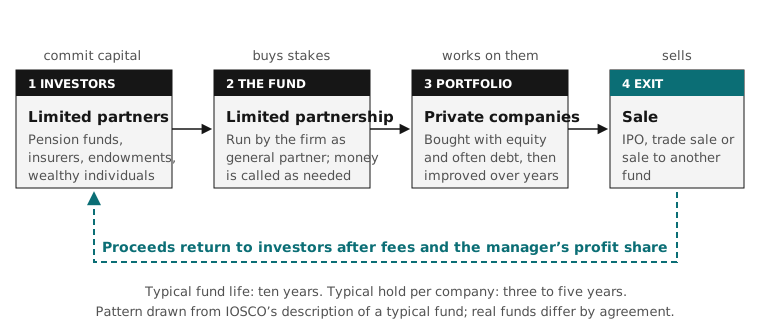
A takeover headline, a pension fund’s allocation, a founder selling to “a financial buyer”: each is private equity at work. This page strips the term back to its parts, the money, the people who manage it, the companies it buys and the way it comes out again, as the first stop in the fundamentals section. Asia and Hong Kong run through every section, because that is where the rules and the deal flow this site follows are found.
Key takeaways
- Private equity is equity raised by companies privately rather than through public fundraising1.
- Investors rarely buy companies themselves. They join a fund, a pooled vehicle that the adviser invests on their behalf2.
- Most funds are limited partnerships with a ten-year life1. Each company is held for a fraction of that: more often three to five years1.
- The manager earns a fee, typically 1-2% a year, and carried interest of circa 20% of profits above a hurdle1.
- Whether private equity beats listed shares is contested. Evaluations of the returns are mixed3.
- Fund interests are hard to sell. An investment is often illiquid and may need holding for several years before any return is realised2.
- In 2024 Hong Kong ranked second in Asia, after Mainland China, by capital under management in private equity funds, at US$229 billion8.
Private equity in plain terms
Private equity is, as the name suggests, equity raised by companies privately rather than through public fundraising1. In the encyclopaedic definition it is stock in a private company that does not offer stock to the general public3. A listed company sells shares to anyone with a brokerage account. A private one does not, and for the vast majority of private-equity investments there is no listed public market3.
“Equity” needs one line of definition. It means a shareholder’s stake in a company, valued after all debt has been paid4. A private equity firm invests by buying shares and expects them to be worth more than the original investment by a specified date4. The objectives are straightforward: buy, improve and sell at a higher valuation5. The buyer at the end is either another private or strategic owner or the public, through an initial public offering5.
The phrase also does double duty. In everyday speech “private equity” can refer to the investment firms rather than the companies in which they invest3. When a newspaper says “private equity bought the chain”, it means a firm and the fund it manages, not a type of share.
A fair question is why this counts as an industry and not just a rich person buying a business. Regulators draw the line like this, in IOSCO’s report on private equity conflicts: private equity firms can typically be differentiated from other private investors that take controlling stakes, such as individual large investors or family firms, because they raise capital on a regular basis in sequential fund raisings, not on an ad hoc basis for individual deals, and deploy it in multiple companies with common investment objectives1. Repetition is the business model: the firm raises a fund, invests it, returns it, and then goes back to the same investors for the next one.
Who is who: investors, firm, fund and portfolio company
Five terms recur in every private equity story, and the table fixes them before the jargon arrives. The pages on GP and LP roles and on how a fund works go deeper on each.
| Term | What it means | Source |
|---|---|---|
| Limited partner (LP) | An investor in the fund. The partnership is formed of the investors as limited partners1 | IOSCO |
| General partner (GP) and firm | The private equity firm acts as general partner1. In US usage it is the adviser that pools investors’ money and invests it on the fund’s behalf2 | IOSCO, SEC |
| Fund | A pooled investment vehicle2, generally a limited partnership or a legally similar structure that varies from country to country1 | SEC, IOSCO |
| Portfolio company | The operating company or business that the fund takes a controlling interest in2 | SEC |
| Investment committee | A committee of senior staff at the firm that receives each investment proposal1 | IOSCO |
An investor joins one specific fund and not the firm itself, so it benefits only from investments that fund makes3. A firm may have a number of active funds at any time, each formed as a separate legal entity with separate general partners1. The firm and its staff will typically also invest their own capital alongside the fund’s, generally around 2-5% of the total committed capital, and more in larger funds1. That personal stake is meant to keep the manager’s interests close to the investors’.
Who the investors are changes the shape of the whole market. The majority of private equity investors are institutional and sophisticated market participants, although retail exposure can occur through specific structures that pool retail funds1. One US rule sits behind that sentence. A fund’s adviser may be registered with the SEC while the private equity funds themselves are not, so the funds carry no regular public disclosure requirements2. That is a United States rule, and Hong Kong and Singapore draw the line differently.
How a private equity firm makes money for its investors
The manager buys equity stakes using a combination of equity and debt financing and aims to generate returns over a target horizon set by the fund and its strategy3. There are four main levers for driving returns: revenue growth, margin expansion, free cash flow generation or debt paydown, and expansion of the valuation multiple3. Put differently, returns are created through one or a combination of three factors: debt repayment or cash accumulation from operations, operating improvements that increase earnings, and selling the business for a higher price than was originally paid3.
Leverage deserves its own paragraph because it drives so much of the debate. Debt financing increases an investment’s return on equity by reducing the amount of initial equity required to purchase the target3. In a leveraged buyout, the acquisition debt is often non-recourse to the financial sponsor and has no claim on other investments the sponsor manages3. Banks traditionally supply that debt, often partly or fully redistributed to other banks and institutional debt market participants1.
Worked example (our arithmetic)
This is an invented illustration, not a real deal. The mechanics are the standard ones: debt alongside equity, with the company’s cash flows servicing the debt10. Every amount is ours (assumed, with our arithmetic), in round numbers of an unnamed currency. A fund buys a company for 100, paying 40 of its investors’ equity and 60 of borrowed money. Over five years the company’s cash flow repays 20 of the loan, leaving 40 owed. The fund then sells the company for 130 and settles the loan. Interest, fees and taxes are left out.
| Step | Currency units |
|---|---|
| Purchase price | 100 (assumed)10 |
| Equity put in by the fund | 40 (assumed)10 |
| Loan at purchase, 100 minus 40 | 60 (our arithmetic)10 |
| Loan left at sale, 60 minus 20 repaid from cash flow | 40 (our arithmetic)10 |
| Sale price after five years | 130 (assumed)10 |
| Cash to the equity holders, 130 minus 40 | 90 (our arithmetic)10 |
| Money multiple on the equity, 90 divided by 40 | 2.25 times (our arithmetic)10 |
| Money multiple if the whole 100 had been equity, 130 divided by 100 | 1.3 times (our arithmetic)10 |
The same company sold at the same price returns 2.25 times the equity with debt and 1.3 times without it (our arithmetic). The effect cuts both ways: if the sale price were 80, the debt-free buyer would get back 0.8 times its money, while the leveraged buyer would have 80 minus 40, or 40, for 40 of equity, a multiple of 1.0 times (our arithmetic). Read the gap as the direction of the effect, not a forecast. Part of the real-world profit comes from turning the company around, and part from a general rise in share prices in a buoyant market, the latter often being the greater component3. And buy-out operations can go wrong, in which case the loss is increased by leverage just as the profit is when all goes well3.
Private equity strategies at a glance
The word “strategy” in private equity means the stage and type of company a fund targets. A firm’s investment strategies are defined by the stage of development and capital requirements of the portfolio companies it intends to invest in1. Commonly they are early stage or venture capital, growth capital and late stage or leveraged buyouts, with a growing number of funds specialising in infrastructure, distressed debt and private investment in public equity1. The strategies are not rivals: they require different skills and each has a place in a company’s life cycle4.
| Strategy | Typical target | Typical stake | Source |
|---|---|---|---|
| Venture capital | An early-stage startup4 | Minority1 | HBS, IOSCO |
| Growth equity | An established, growing company4 | Most often a minority investment3 | HBS, Wikipedia |
| Buyout | A mature company4 | A controlling equity stake1 | HBS, IOSCO |
| Mezzanine | Often used to reduce the equity needed for a buyout3 | Subordinated debt or preferred equity3 | Wikipedia |
| Distressed | Financially weak companies3 | Debt or equity, to control or to turn around3 | Wikipedia |
| Secondaries | Existing private equity assets3 | Fund interests or portfolios3 | Wikipedia |
Venture capital is private equity invested in an early-stage startup4. Venture capitalists typically do not require a majority share of over 50 percent, which can be attractive to founders4. Growth equity is capital for an established, growing company that needs funding to grow4; it sits between early-stage venture capital and mature buyouts in its risk and return profile5. Buyouts occur when a mature company, typically public, is taken private and purchased by a private equity firm or its existing management team4. The type makes up the largest portion of funds in the private equity space4. The two main kinds are management buyouts, where the existing management team buys the company’s assets and takes the controlling share, and leveraged buyouts, which are funded with borrowed money4.
Other strategies
The edges of the category are looser. A special situation is an investment in an established company facing operational, financial or other strategic challenges5. Distressed investing covers the securities of financially weak companies3. Infrastructure funds invest in public works made as part of a privatisation initiative by a government entity3. A fund of funds puts its money into other private equity funds3. A search fund is a vehicle through which an entrepreneur, the “searcher”, raises money from investors to acquire an existing small business3.
Secondary deals work in the other direction: they buy existing private equity assets3. Sellers of fund interests sell not only the investments in the fund but also their remaining unfunded commitments3. The buyout and growth equity page sets the two largest strategies side by side, and the investment approach page follows a deal from first look to exit.
Private-equity firms: who runs the funds
A private equity firm is the management business, and the funds are the partnerships it runs. The firm that is easiest to name is not necessarily the best: size rankings measure money raised, not skill. Industry rankings such as the PEI 300 from Private Equity International order firms by direct-investment capital raised, and they give no indication of relative investment performance3.
The firm’s job differs at each stage of a fund’s life. The investment professionals identify companies, an investment committee decides, and external advisers help with diligence1. After the purchase comes the part that separates private equity from owning a few shares of a listed company: the typical strategy is to take a controlling interest in the portfolio company and engage actively in its management and direction in order to increase its value2. Other funds make minority investments in fast-growing companies or startups, where the influence is smaller2.
The life of a fund and investment timescales
Private equity funds are typically close-ended and raised to have a life span of ten years1. Close-ended here means the fund stops taking new investors after its final close3. Most funds can extend, typically with investor agreement, by up to three 1-year extensions1. The table follows one fund through its life.
| Phase | What happens | Typical timing | Source |
|---|---|---|---|
| Raising | The firm markets the fund and reaches a final close | Varies with market conditions and the firm’s track record3 | Wikipedia |
| Investing | The manager identifies suitable opportunities | An initial period of around five years1 | IOSCO |
| Managing and selling | The manager focuses on transforming and disposing of investments before the fund expires1 | Through to the end of the fund’s life1 | IOSCO |
| Next fund | The firm raises a successor | Often at intervals of around five years1 | IOSCO |
Investors do not pay in on day one. Committed capital is not drawn down at the point of agreement but is available to be drawn down by the manager throughout the life of the fund as opportunities appear1. Once investors have signed, they are obliged to remain committed, although the manager is typically permitted to call capital for new investments only during the investment period1. Afterwards, capital calls are usually allowed for expenses, management fees, follow-on investments and repayment of permitted indebtedness1. When the fund reaches its fundraising target it has a final close, and after that point new investors normally cannot join, unless they buy an interest on the secondary market3.
Investment timescales
The fund lives for ten years, but each company does not. The actual time a fund holds an investment is generally well below ten years and more often around three to five years1. The holding period for a given company runs on a separate clock from the fund’s, which is why a fund has both early and late exits.
Exits are the moment of truth. The common routes include a public sale of shares in an initial public offering, a trade sale to a company that wants to complement its operations, a sale to the firm’s management team, repayment of preference shares, or a secondary sale to another private equity fund1. The choice depends on whether the fund wants a partial or complete exit, the remaining growth potential, the relative costs and the market conditions1. A recapitalisation is another way in which returns arrive: cash is distributed to the fund from the company’s cash flow or from newly raised debt3. The fund mechanics page shows the capital call and distribution schedule in detail.
What the manager is paid
Two payments make up the manager’s income, and both are covered fully on the fees and carry page. Once investors have committed to a fund they pay a management fee, typically an annual percentage of 1-2%1. The base is total commitments during the investment period and invested capital after it1. The firm as general partner also typically earns carried interest, a percentage, circa 20%, of the fund’s profits above a certain level of pre-agreed cash return, the hurdle rate1.
The design is meant to align the manager with the investors. IOSCO found that the majority of firms and their staff accrue performance-related remuneration only on realised profits, and only after fund investors have received a full return on their investment plus a cost-of-money hurdle1. The rules of the game are written into the limited partnership agreement. The Institutional Limited Partners Association (ILPA) serves more than 515 member institutions representing over US$2 trillion of private equity assets6. Three guiding principles form the essence of an effective partnership in its view: alignment of interest, governance and transparency6. Its Principles were first published in September 2009 to encourage discussion between limited partners and general partners6. They are not a checklist: each partnership should be considered separately6.
Why invest in private equity: the case and the evidence
This section sets out the case investors and managers make. It is not advice, and the evidence is mixed. BlackRock presents private equity as a complement to public equity, with the potential for higher returns driven by an illiquidity premium and manager skill, alongside diversification across an expanded set of opportunities5. The opportunity-set argument is concrete: in the United States, private companies make up 80 percent of companies with revenue above US$100 million, and public companies only 20 percent5.
KKR puts private equity’s average lead over global public equities at 4-5% over the past 25 years10. That is a manager’s figure. Academic work offers a more cautious picture. An NBER study using a 1981-2001 dataset documented excess returns of five plus percent per annum relative to the aggregate public equity market9. One interpretation of that magnitude is compensation for holding a 10-year illiquid investment9. Other work reaches different answers. Academic studies of net-of-fees returns disagree on whether the average fund beats public markets3. Performance also varies a great deal across funds3.
Measuring any of this is hard. Unlike mutual funds, private equity funds need not disclose performance data3, and limited disclosure makes the returns relatively difficult to study3. The balanced summary is that evaluations of the returns of private equity are mixed: some find that it outperforms public equity, others find otherwise3. Primary studies, not a single headline spread, are the place to judge it.
Private equity versus hedge funds, venture capital and listed shares
Private equity is often confused with its neighbours. The table sets private equity against hedge funds, the one most often mixed up with it.
| Private equity | Hedge fund | |
|---|---|---|
| Typical horizon | Long-hold, multiple-year strategies3 | Short or medium term3 |
| Assets | Illiquid assets such as whole companies3 | Liquid securities that convert quickly to cash3 |
| Control | More control and influence over the company3 | No direct control over the business invested in3 |
| Positions | Private-equity firms only take long positions3 |
The SEC draws the same contrast from the investor’s side: unlike mutual funds or hedge funds, private equity firms often focus on long-term opportunities in assets that take time to sell, with an investment time horizon typically of 10 or more years2.
Venture capital is not a separate world. It is a broad subcategory of private equity covering equity investments in typically less mature companies3. The difference from a buyout is control: buyouts are generally “control equity positions” in which the fund buys a majority, while other strategies typically take minority stakes, which reduces their ability to effect transformational change3. Against listed shares, the contrast is liquidity and disclosure: for the vast majority of private-equity investments there is no listed public market, although a robust secondary market exists for sellers3.
Who can invest, and why access is limited
A private equity fund is typically open only to accredited investors and qualified clients in the United States2. These include institutional investors, such as insurance companies, university endowments and pension funds, and high income and net worth individuals2. The initial investment amount is often very high2. Even someone who owns no fund interest may hold exposure indirectly through a pension plan or an insurance policy2.
Hong Kong draws its own line, using the professional investor tests in the SFC’s rules. An individual qualifies with a portfolio of not less than HK$8 million11. A corporation or partnership qualifies with a portfolio of not less than HK$8 million or total assets of not less than HK$40 million11. Section 175 of the Securities and Futures Ordinance prohibits the offer of securities without an offering document, and that prohibition does not apply to offers to professional investors11. The Legislative Council paper lists unauthorised funds, including hedge funds and private equity funds, among its examples of private placement products11. The SFC completed a review of these thresholds in May 2020 and did not recommend changes11. Check the current text before relying on any figure.
Institutions carry most of the weight. Pension funds, insurers, endowments and sovereign wealth funds are the main institutional sources of capital3. Most institutional investors do not invest directly in privately held companies, lacking the expertise and resources to structure and monitor the investment, so they invest through a fund or a fund of funds3. Large owners such as pension funds, insurers and sovereign funds have a low likelihood of facing liquidity shocks in the medium term and can afford the required long holding periods3.
Access for individuals is widening only at the margin, through regulated platforms that fractionalise the assets3.
A short history
The history is short enough to read as a timeline, and the dates explain why the industry looks the way it does. Only dated items with a primary or standards-body source are listed.
- 1970s and 1980s. Private equity took shape as firms such as KKR pioneered the leveraged buyout, and the 1980s boom in such deals established the model10.
- 2008. An IFSL report cited by IOSCO estimated that US$189 billion of private equity was invested worldwide, down 40% from 20071.
- 2025. Preqin data put private equity assets under management at nearly US$10.5 trillion in August 202510.
Two threads run through it. One is scale, from a niche of venture and buyout deals to nearly US$10.5 trillion of assets by August 202510. The other is leverage: beginning in the 1970s, firms such as KKR pioneered the use of leveraged buyouts to acquire, restructure and improve companies10.
Private equity in Asia and Hong Kong
Asia was an investment destination before it was a fundraising centre. An IFSL report cited by IOSCO estimated that US$189 billion of private equity was invested worldwide in 20081. In that data, Asia-Pacific accounted for 9% of funds raised but 29% of global private equity investment1. Since 2000 the importance of Asia-Pacific and emerging markets as destinations has grown, particularly China, Singapore, South Korea and India1.
The latest regional numbers come from AVCJ and Bain data compiled in a King & Wood Mallesons paper and cover 2024. A law firm’s compilation is context, not a rule7.
| Asia-Pacific private equity, 2024 | Figure |
|---|---|
| Buyout share of deal value | More than 50%, while the share of growth deals shrank7 |
| Buyout deal value | US$138 billion, up 8.1% from US$127 billion in 20237 |
| Average deal size | US$133 million, up 22% over 20237 |
| Megadeals of US$1 billion or more | Up 50% on 20237 |
| Carve-outs | 20% of all buyouts over US$100 million, up from 11% in 20237 |
| Exit value | Dipped 1%, though manager sentiment on exits improved7 |
| Secondary exits | 27% of total exit value7 |
The region’s themes are visible in the table: more buyouts, bigger deals and a congested exit door. Both LPs and GPs see the exit environment as the biggest impediment to strong returns7. Secondary exits, where one fund sells to another, accounted for 27% of exit value in 20247. Co-investment is also growing: a StepStone survey covering 145 GPs and 420 funds found that co-investment volume had risen approximately 30% since before the pandemic7. Technology retains the highest share of deal value and count across the region7.
Hong Kong is both a market and a regulator. AVCJ Research data in the SFC’s 2024 survey rank Hong Kong second in Asia after Mainland China in 2024 by total capital under management by private equity funds, excluding real estate funds, at US$229 billion, against US$221 billion in 20238. The SFC adds a caution on coverage: some private equity firms in Hong Kong are neither licensed corporations nor registered institutions8. The rule that decides which side of that line a manager falls on is concrete. A firm delegated discretionary power to make investment decisions on securities for a fund in Hong Kong is required to obtain a licence for Type 9 regulated activity, asset management12. The SFC Type 9 licence page sets out the licensing rules, and the Hong Kong limited partnership fund page covers the vehicle most Hong Kong-managed funds use, and the regulation section collects the rule-based pages.
Risks, criticism and conflicts of interest
Every explainer should say where the model strains. Three risks lead the SEC’s investor guidance. First, illiquidity: because of the long horizon, an investment is often illiquid and may need to be held for several years before any return is realised, and funds typically impose limits on withdrawal2. Second, fees and expenses: the SEC has brought enforcement actions involving fees and expenses that funds and investors incurred without adequate consent or disclosure2. Third, conflicts: private equity firms often have interests that conflict with the funds they manage and, by extension, with their limited partners2. As fiduciaries, advisers must make full disclosure of all conflicts to obtain informed consent2.
A manager’s own list is similar: private equity carries risks beyond ordinary market risk, including the illiquidity of the underlying assets, limited regulatory oversight and fewer reporting requirements than listed counterparts5. Leverage adds its own risk, because it magnifies losses as it magnifies gains3.
Critics go further. Their argument is that an interest in short-term profits, without regard for the long-term effects, can lead to job loss, raised prices, asset stripping and a greater likelihood of bankruptcy for the companies acquired3. In 2024 the Bank of England warned that businesses owned by private equity firms were more vulnerable to default than other large businesses3. These are contested claims.
The regulators’ answer has been to rely on structure and disclosure. IOSCO’s work on conflicts found that mitigation typically takes the form of alignment of interest through incentive structures, disclosure and legal agreements1. Funds in more developed markets are typically set up with a contractual requirement to maintain an investor advisory committee, a small sample of investors, often the largest in the fund1. The committee’s main function is to review the firm’s approach to resolving material conflicts, a forum for conflict management and not for investment decisions1.
This page explains what private equity is. Nothing here is an offer, a recommendation or advice, and no fund or manager is ranked.
Questions people ask
What is private equity in simple terms?
It is money from investors that buys shares in companies not listed on a stock exchange3. A professional manager runs the companies alongside their owners for several years, then sells them, aiming for a higher price than was paid4.
How does private equity make its money?
The investors profit when the fund sells a company for more than it cost5. The manager is paid twice: a management fee, typically 1-2% a year, and carried interest of circa 20% of profits above an agreed return1.
Who are the big 4 PE firms?
There is no fixed list. Rankings such as the PEI 300 order firms by capital raised, and a size ranking says nothing about how well a manager performed3.
Read next
- How a private equity fund works in AsiaA private equity fund is a ten-year limited partnership. Who the partners are, where liability stops, and how Hong Kong, Singapore and Cayman funds differ
- GP vs LP in private equity: roles and liabilityThe general partner runs a private equity fund and answers for its debts. Limited partners fund it and stay passive. Roles, liability and pay explained.
- Buyout vs growth equity: key differencesBuyout, growth equity and venture capital differ in stake, leverage, company stage and exit. A side-by-side reference with the Asia-Pacific deal mix for 2024.
Sources
- Private Equity Conflicts of Interest: Final Report (FR11/10), November 2010 · IOSCO Technical Committee · iosco.org · checked 21 October 2026
- Private Equity Funds · U.S. Securities and Exchange Commission (Investor.gov) · investor.gov · checked 21 October 2026
- Private equity · Wikipedia · en.wikipedia.org · checked 21 October 2026
- 3 Key Types of Private Equity Strategies (13 July 2021) · Harvard Business School Online · online.hbs.edu · checked 21 October 2026
- What is Private Equity & How it Works · BlackRock · blackrock.com · checked 21 October 2026
- ILPA Principles 3.0 (2019) · Institutional Limited Partners Association · ilpa.org · checked 21 October 2026
- In Private 2025: Top 10 trends for private capital (King & Wood Mallesons, citing AVCJ and Bain & Company Asia-Pacific Private Equity Report 2025, data to end-2024) · King & Wood Mallesons · mallesons.com · checked 21 October 2026
- Asset and Wealth Management Activities Survey 2024 (July 2025) · Securities and Futures Commission, Hong Kong · sfc.hk · checked 21 October 2026
- The Cash Flow, Return and Risk Characteristics of Private Equity (NBER Working Paper 9454, January 2003) · National Bureau of Economic Research (Ljungqvist and Richardson, NYU Stern) · nber.org · checked 21 October 2026
- Private Equity: What You Need to Know · KKR · kkr.com · checked 21 October 2026
- Review of the Securities and Futures (Professional Investor) Rules, paper for the Legislative Council Panel on Financial Affairs, 2020 · Legislative Council, Hong Kong (paper by the Administration and the SFC) · legco.gov.hk · checked 21 October 2026
- Licensing Handbook, October 2024 · Securities and Futures Commission, Hong Kong · sfc.hk · checked 21 October 2026
Published . Education only, not an offer or advice (terms). Rules, fees and market figures change, so each source shows the day it was read. How we check facts · Report an error.