Asia is not one market. A buyout in Tokyo, a growth round in Bengaluru and a fund set up in Hong Kong run on different rules and different cycles, and the regional totals blend them all. This page gives the totals first, then the pieces.
How Asia became a private equity region
The region is a recent arrival. Since 2000 the Asia-Pacific region and emerging markets have grown in importance as investment destinations, particularly China, Singapore, South Korea and India3. By 2008 the Asia-Pacific region took 9% of funds raised but 29% of global private equity investment3. Asia was a place to invest before it was a place to raise money.
The buyout boom that peaked just before the financial crisis reached the region late. Private equity activity spread to new parts of the world, particularly Asia, although levels were still modest compared with Western Europe and North America4. Firms already had experience with minority equity investments, both in venture capital and in overseas investments, particularly in Asia4. That history explains a feature of the region today: growth and minority deals sit alongside buyouts, not behind them.
The figures in this section are dated. The IOSCO numbers describe 20083 and the Kaplan and Strömberg paper describes activity to 20074. The latest data below show a different region.
Asia-Pacific private equity in 2024
The latest regional data come from AVCJ and Bain figures compiled in a King & Wood Mallesons paper, covering 2024 and excluding real estate and deals under US$10 million1. The compilation comes from a law firm, so treat it as context.
| Measure, Asia-Pacific, 2024 | Figure | Source |
|---|---|---|
| Buyout deal value | US$138 billion, up 8.1% from US$127 billion in 2023 | 1 |
| Buyouts as a share of deal value | More than 50%, while growth deals shrank | 1 |
| Average deal size | US$133 million, up 22% on 2023 | 1 |
| Megadeals of US$1 billion or more | Up 50% on 2023 | 1 |
| Top 2% of deals | 42% of total deal value | 1 |
| Carve-outs | 20% of buyouts over US$100 million, up from 11% in 2023 | 1 |
| Exit value | Dipped 1% on the prior year | 1 |
| Secondary exits | 27% of total exit value | 1 |
| Minority stake sales | US$71 billion, 15% of the exit total | 1 |
Two patterns stand out. Deals are getting bigger: the top 2% of deals made up 42% of deal value, and the number of megadeals rose by half1. And buyouts now lead: they passed 50% of deal value while the share of growth deals shrank1. For the mechanics of the first, see how a leveraged buyout works; for the second, what growth equity is.
Market by market
Greater China. The region’s largest market by deal value, defined in the data as China, Hong Kong and Taiwan1. Greater China produced higher deal value than any other country in the region in 20241. Its weight is shrinking. As recently as 2020 China was more than half of all Asia-Pacific deal value, a share that declined to 27% in 2024 as GPs and LPs channelled a greater share of investment dollars to India and Japan1.
India. The region’s best performer in 2024, and the only country with double-digit growth in both deal value and count1. Global managers are placing large bets on it. Carlyle aims to allocate about 30% to 35% of its new pan-Asia fund to India, its largest market in Asia, and Bain Capital plans to invest 20% of its Asia fund there1. Those are stated intentions, not outcomes.
Japan. Only India and Japan kept their 2024 deal counts close to the previous five-year average1. The growth story is stability, helped by a weaker yen, recent reforms in corporate governance and a backlog of businesses ripe for private ownership1. Japan led consumer-sector dealmaking with 82 deals in 2024, 37% of the Asia-Pacific total, a record for the past decade1.
South Korea and Southeast Asia. Dealmaking is starting to revive in both1. Southeast Asia has an infrastructure gap of around US$3 trillion1.
Hong Kong. Both a market and a fund centre. By AVCJ Research data in the SFC’s 2024 survey, Hong Kong ranked second in Asia after Mainland China in 2024 by total capital under management by private equity funds, excluding real estate funds: US$229 billion, against US$221 billion in 20232. The SFC’s asset and wealth management survey is the regulator’s own source for that figure.
What gets bought
Technology retains the highest share of private equity deal value and deal count across the region1. Digital infrastructure follows at the top end: of the 30 deals worth US$1 billion or more in 2024, nine were in digital infrastructure and communications1. Secondary sales accounted for six of the ten largest exits globally in 2024, including Blackstone’s US$16 billion acquisition of AirTrunk1.
Consumer deals rebounded in 2024. Deal value rose 41% year on year to US$27.9 billion, and deal count rose 12% to 223 deals1.
Carve-outs, where a fund buys a division from a larger company, are taking a bigger share of the market. They were 20% of all buyouts over US$100 million in 2024, up from 11% a year earlier1. Despite lower average returns, 44% of the Asia-Pacific GPs in Bain’s survey name carve-outs as a top place to find deals1.
Which firms are active
There is no fixed ranking of private equity firms in Asia, and a size table says nothing about how any firm performed. The deals named in the 2024 review show who was active that year. Blackstone bought AirTrunk for US$16 billion1. Apollo acquired Panasonic Automotive Systems1. A PAG-led consortium acquired a 60% stake in the mall management business of Wanda Group1. EQT and ChrysCapital jointly acquired 90% of HDFC Credila, the education loan arm of HDFC1. KKR and SingTel invested in ST Telemedia Global Data Centres1.
These are dated examples from one source, not a list of the biggest firms and not a recommendation. The same applies to fund-raising intentions: Carlyle’s and Bain Capital’s India allocations above are plans1.
Exits are the pressure point
Asia-Pacific exit value dipped 1% in 2024, though manager sentiment on exits improved1. Limited partners and general partners alike rank the exit environment as the biggest obstacle to strong returns1. The 2011 to 2019 vintages included more than 200 portfolio companies held for more than four years at the end of 2024, a signal that managers should be looking for exits1.
Managers have adapted. Secondary exits, sales from one fund to another, made up 27% of exit value1. Minority stake sales, which monetise a slice of a company without a full exit, were worth US$71 billion in 2024, 15% of the exit total1. Co-investment is also rising: a StepStone survey covering 145 GPs and 420 funds found that co-investment volume has risen approximately 30% since before the pandemic1.
Public markets are one way out. In Hong Kong the market raised around HK$18 billion across 15 IPOs in the first quarter of 2025, and the IPO pipeline then included 120 applicants, up from 86 at 31 December 20241. Those are listing figures for one quarter, so they show direction, not a trend.
How an Asia-focused fund is set up
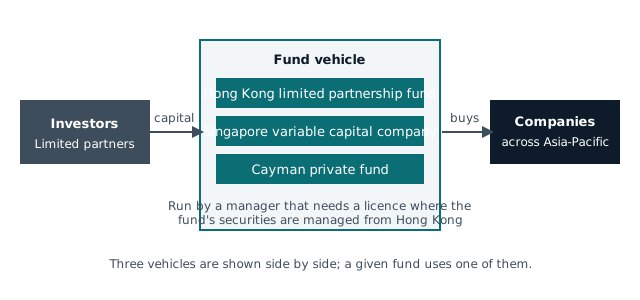
Investors rarely buy companies directly. They commit to a fund, and in Asia the fund sits in one of three common vehicles. The wider mechanics are in how a private equity fund works.
- Hong Kong limited partnership fund. Hong Kong’s Limited Partnership Fund Ordinance has been in operation since 31 August 20207. A fund under it has one general partner and at least one limited partner7, and a limited partner is not liable for the fund’s debts beyond its agreed contribution7. The Companies Registry text sets out the rest, and the limited partnership fund page walks through it.
- Singapore variable capital company. A VCC is a structure mainly for investment funds, not businesses6. The ACRA guidance covers eligibility.
- Cayman private fund. A private fund under the Cayman Islands Private Funds Act is a company, unit trust or partnership that issues investment interests the purpose or effect of which is the pooling of investor funds8.
Licensing follows the manager, not the vehicle. A firm delegated with discretionary power to make investment decisions on securities for a fund in Hong Kong must obtain a licence for Type 9 regulated activity, asset management5. A firm that handles private equity or venture capital that does not involve securities may not by itself attract a licensing requirement5. Not every Hong Kong private equity firm is a licensed corporation or a registered institution2. The Type 9 licence page covers the test in detail.
Read next
Start with what is private equity if the terms are new, then buyout versus growth equity for the two strategies that dominate the figures above. The Asia hub lists the regional pages. The sources for the regulator figures are the SFC’s Licensing Handbook and IOSCO’s report on private equity conflicts of interest. This page is education only and does not recommend any fund, manager or market.
Questions people ask
Is private equity a thing in China?
Yes. Greater China, which covers China, Hong Kong and Taiwan, produced higher deal value than any other part of Asia-Pacific in 20241. Its share has fallen: China was more than half of regional deal value in 2020 and 27% in 20241. Mainland China also ranks first in Asia by capital managed by private equity funds2.
What are the major private equity firms in Asia?
There is no fixed list. A 2024 deal review names Blackstone, KKR, Apollo, EQT, PAG and Carlyle among active investors, for example through Blackstone's US$16 billion AirTrunk deal and Carlyle's plan to put 30% to 35% of its pan-Asia fund into India1. A name in a deal list is neither a ranking nor a recommendation.
Read next
- What is private equity? How it works, with Asia dataPrivate equity explained: what it is, who the players are, how funds make money, the main strategies, who can invest, and where Hong Kong and Asia fit.
- Buyout vs growth equity: key differencesBuyout, growth equity and venture capital differ in stake, leverage, company stage and exit. A side-by-side reference with the Asia-Pacific deal mix for 2024.
- How a private equity fund works in AsiaA private equity fund is a ten-year limited partnership. Who the partners are, where liability stops, and how Hong Kong, Singapore and Cayman funds differ
Sources
- In Private 2025: Top 10 trends for private capital (King & Wood Mallesons, citing AVCJ, Bain & Company, Dealogic and Deloitte data; Asia-Pacific, 2024 unless stated) · King & Wood Mallesons · mallesons.com · checked 21 October 2026
- Asset and Wealth Management Activities Survey 2024 (July 2025) · Securities and Futures Commission, Hong Kong · sfc.hk · checked 21 October 2026
- Private Equity Conflicts of Interest: Final Report (FR11/10), November 2010 (citing IFSL data for 2008) · IOSCO Technical Committee · iosco.org · checked 21 October 2026
- Leveraged Buyouts and Private Equity (NBER Working Paper 14207, July 2008; Kaplan and Strömberg) · National Bureau of Economic Research · nber.org · checked 21 October 2026
- Licensing Handbook, October 2024 · Securities and Futures Commission, Hong Kong · sfc.hk · checked 21 October 2026
- Step 1: Understanding VCC features, eligibility and requirements · Accounting and Corporate Regulatory Authority, Singapore · acra.gov.sg · checked 21 October 2026
- Limited Partnership Fund Ordinance (Cap. 637), Ord. No. 14 of 2020, English text as enacted · Companies Registry, Hong Kong · cr.gov.hk · checked 21 October 2026
- Private Funds Act (2025 Revision) · Cayman Islands Monetary Authority · cima.ky · checked 21 October 2026
Published . Education only, not an offer or advice (terms). Rules, fees and market figures change, so each source shows the day it was read. How we check facts · Report an error.