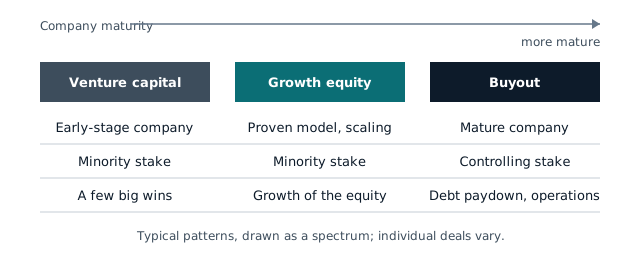
A founder has built something that works. Customers keep coming back and the business needs money to grow faster, but selling the company is not the plan. Growth equity is the investor’s answer to that situation: put money in, take a minority share, and leave the founder in the chair.
What is growth equity?
Growth equity is capital investment in an established, growing company4. It comes later in a company’s life than venture capital, once the business is established but needs more funding to grow4. The usual payment is a share of the company’s equity, typically a minority share4.
Three definitions agree on the shape. Growth capital targets companies beyond the startup stage that need capital to scale operations, enter new markets or accelerate growth5. In KKR’s classification, growth equity means minority stakes in scaling businesses with proven product-market fit that are growing quickly and are short of buyout maturity6. And the stake is a minority one: the usual holding is often 20 to 40% of the company, not a majority and not 100 percent2.
The strategy name varies, but the labels are stable. IOSCO groups strategies as early stage or venture capital, growth capital and late stage or leveraged buyouts7. Growth equity is the middle label. It is a distinct investment class with its own return and risk profile, which can appeal to limited partners looking to diversify1.
Growth equity has grown into a segment of its own. PE firms increasingly acquire noncontrolling stakes in targets where existing shareholders retain control1. One estimate from Preqin puts growth equity as a segment of private capital at almost US$920 billion at the end of March 2021, more than double its 2016 size1.
What kinds of company get growth equity investments?
The target is neither a startup nor a mature cash cow. The money goes to companies with proven business models that need capital to fund a specified expansion strategy outlined in their business plan10. A fund looks for a company that has already proven its business model, not one still searching for it2.
A peer-reviewed study of 1512 UK private companies over 2000 to 2021 gives the best data on the profile. Targets are younger, smaller, more intangible-asset intensive and more rapidly growing than the general pool of UK private companies3. They also differ significantly from venture capital and buyout targets, and the transaction structure differs too3. The study covers UK companies, so it is context for other markets, not a rule for them.
Ownership tells you something as well. Businesses targeted by growth equity funds tend to be founder-controlled1. For those owners, an investment brings growth capital and expertise while they keep control, perhaps ahead of an eventual sale or listing1. It can also let them realise part of their own stake1.
Sectors cluster. Capital tends to skew towards software, and to consumer discretionary and healthcare to a lesser degree10. Technology holds the highest share of private equity deal value across Asia-Pacific8.
A typical profile has several features at once:
- A proven product and a repeatable way to win customers, rather than an idea10.
- A specific use for the cash, such as new markets, product development or sales capacity10.
- Existing owners who want to stay in control1.
- A business that may be far from cash flow positive, because growth comes first10.
The last point matters. At this stage the company is likely far from being net cash flow positive10, and growth capital proceeds are used for expansion: entry to new markets to reach new customers and demographics, and internal development of existing product or service offerings10. That is why debt is a poor fit for the same company. A business burning cash to grow has little spare cash to pay interest.
Growth equity vs private equity
Growth equity is one strategy inside private equity, and the comparison that matters is with the buyout, the strategy that the plain term usually means. The two differ on control, debt and where the return comes from.
Control is the first difference. A buyout fund seeks a controlling equity stake in a mature company7. Growth equity investors usually take a minority and leave day-to-day operations with the founders and management2. A buyout buyer acquires a majority stake and a thesis that does not necessarily include rapid growth, whereas the growth fund is paying for growth10.
Debt is the second. Growth equity deals typically involve neither full control nor a lot of debt2. Growth equity firms rarely use debt10. In a buyout, by contrast, it is not unusual for 50 to 70 percent of the financing to come from debt2, which is the subject of how a leveraged buyout works. A growth deal is often smaller too. Because the amounts at stake are lower than in a buyout, the deals often involve no debt financing at all, which means they can proceed even when debt markets are shut1.
Returns are the third. The returns from a growth equity investment come predominantly from the growth of the equity itself10. A buyout’s returns depend more on the financial structure and paydown of debt10. No control premium is paid, because growth equity does not normally involve an auction1.
| Feature | Growth equity | Buyout | Source |
|---|---|---|---|
| Stake | A minority share, often 20 to 40%2 | A controlling stake7 | 2,7 |
| Target | Established, growing company4 | Mature company7 | 4,7 |
| Debt | Little or none2 | 50 to 70 percent of financing not unusual2 | 2 |
| Who runs it | Founders and management2 | The owner controls2 | 2 |
| Where returns come from | Growth of the equity10 | A significant part from financial engineering and debt paydown10 | 10 |
| Exit | Controlled by contract, not by the investor alone1 | Usually the investor determines timing and form1 | 1 |
For the full side-by-side, see buyout versus growth equity. The broader map of the asset class is in what is private equity.
Growth equity vs venture capital
Growth equity and venture capital both take minority stakes, so people blur them. The stage and the thesis differ.
Venture comes first. In most cases venture capital is the first institutional money into early-stage companies, for market research and product development10. Growth equity investors, unlike venture capitalists, can examine the company’s financial track record and speak to its clients4. A venture fund expects most of its portfolio to fail, with the return from a home run offsetting all those losses10. A growth investor has less room for failure, because it pays for a company that already works.
The growth profiles show the difference. Early-stage companies usually see growth rates near or far above 30%, while growth-stage companies grow around 10% and 20%10. Growth does not stop at the later stage; it slows. Growth equity funds also invest predominantly in late-stage venture-backed companies, whose founders have already given up some of their equity and governance rights in earlier funding rounds10.
Risk and return follow from that. Returns from growth deals tend not to be as high as successful venture investments, relative to the amounts invested1. The risk is lower, as these companies are often mature but still fast growing1. On the risk and return scale, growth equity sits right between venture capital and buyouts10.
VC investors also behave differently on exits. Venture firms do not typically ask for formal exit mechanisms, because their thesis assumes a larger number of failed investments with a few home runs generating the returns1. A growth investor with a minority stake cannot rely on that, which is why the contract matters so much (next section).
How growth equity investments are structured
Minority stakes need contracts. A fund that does not control the company cannot decide the exit, the budget or the next share issue on its own, so the rights are written down. Negotiations focus on the return on capital, mechanisms to control the exit and the minority protections1. Whether the investor wins those depends on the size of the stake and the expertise it brings1.
Preferred equity
Growth equity investments are often made through voting preferred equity1. Preferred shares are generally entitled to dividends accruing at a fixed annual rate on a compounding basis, paid to the investor before dividends reach other shareholders1. On an exit or a winding up, preferred shares rank junior to debt but senior to other classes of shares1. As a minimum, the preference amount is the investment itself1.
The preferred shares are also convertible into ordinary shares, at the investor’s election, on a pre-agreed conversion ratio1. That gives the investor a floor from the preference and a share of the upside from conversion. Companies and controlling shareholders often push for automatic conversion on events such as a listing or a control sale, to make those events easier1.
Exit rights
A control investor can determine the timing and manner of its own exit. A minority investor cannot, so it wants clearly defined contractual mechanisms for its exit1. Four appear repeatedly:
- Tag rights. At a minimum, the investor can sell its shares alongside controlling shareholders who sell1.
- Put rights. The right to require the company to redeem or buy back, or the controlling shareholders to acquire, its shares after a period, normally five to 10 years after the investment1.
- Exit obligations. A general obligation on the shareholders to start an exit such as a sale or listing, usually after three to five years from investment1.
- Minimum return. The investor often asks for a minimum return on a put or a drag sale, calculated from a minimum internal rate of return or a multiple of invested capital, as downside protection1.
The other side holds drag rights. The controlling shareholders, and not the minority investor, can require the minority to sell its shares1. Existing shareholders also ask for a lock-up period during which the investor cannot transfer its shares other than to affiliates1.
Board seats and reserved matters
A seat at the table matters. The right to appoint at least one director or an observer to the board is crucial, because it is a source of information on how the investment is performing and what lies ahead1. A minority investor typically appoints one director when it holds above 5 percent of the share capital1. For larger stakes of between 25 and 49 percent, the investor normally gets directors in proportion to its holding1. Growth equity investors will often pursue protective provisions and sit on the company’s board to keep some influence over decisions2.
Because minority investors often cannot pass shareholder resolutions on their own, they negotiate veto rights over reserved matters1. A distinction is normally drawn between fundamental matters, which affect the value or structure of the investment, and operational matters1. Fundamental matters include changes to the company’s constitutional documents, variation of share rights, issuing shares, changing the nature of the business and winding up the group1. Operational matters include increases in capital expenditure and taking on debt, usually subject to a leverage ratio threshold1. Investors have vetoes over the fundamental matters, and the larger the stake, the more operational matters they can block1.
Finally, anti-dilution. Investors want protection against dilution, often through pre-emption rights to join new share issues pro rata or a veto over them1.
Worked example (our arithmetic): a minority stake
The numbers below are invented to show how stake, preference and dilution interact. They are not a real deal and not a forecast. The structure follows the features above: a minority stake, a preference whose minimum is the investment itself, and protection against dilution1.
A fund invests 30 in a company, and the post-money value is 120, so the fund owns 30 divided by 120, or 25% (our arithmetic2). It exits five years later. Interest and fees are ignored.
| Case | Company sold for | Fund’s share | Money multiple | Annual return |
|---|---|---|---|---|
| A. Plan works, no dilution | 300 | 75 | 2.50 times (our arithmetic1) | 20.1% |
| B. Plan works, new shares dilute the fund to 20% | 300 | 60 | 2.00 times (our arithmetic1) | 14.9% |
| C. Flat | 120 | 30 | 1.00 times (our arithmetic1) | 0.0% |
| D. Company sold for 80, with a 1 times preference | 80 | 30, not 20 | 1.00 times (our arithmetic1) | 0.0% |
In case D, a plain 25% share would be 20, but the preference amount, at a minimum the investment itself, puts the fund first in line for 30 (our arithmetic1). That is the point of preferred equity. Case B shows what anti-dilution protection is for: without it, a later round would cut the same 300 exit from 75 to 60. Not every company is worth enough to pay the preference, and the preference is only as good as the exit.
How do growth equity managers add value?
Money is not the only product. A growth investor can be more than a capital provider along for the ride10. Common areas of expertise include capital structure, M&A, listings, relationships with lenders and investors, go-to-market planning and the professionalisation of internal processes10.
Three channels stand out.
Capital for the growth plan. Growth equity provides the cash to accelerate expansion, new products, acquisitions and scaling6. The proceeds are for expansion and often go to the company’s balance sheet, not to buying out earlier shareholders2.
Knowledge and access. A founder expanding into a new jurisdiction may want funding from an investor that can share its contacts there1. PE expertise and credibility help a company prepare for the next stage, perhaps an eventual sale or listing1. Some firms track promising companies for as long as 10 or 15 years, so they can approach them when funding is needed4.
Governance without control. The weight of an investor’s advice in board discussions rises with the value it contributes10. Without a majority stake, growth equity investors hold less influence over strategy and operations10, and cannot take matters into their own hands. Trust with management is the prime hurdle10.
The contrast with a buyout is sharp. With control, a buyout owner can install its own management or significantly influence company strategy2. A growth investor is more of a partner providing capital and guidance, not an owner overhauling the business2.
Growth equity firms and funds
PE firms are launching more and more dedicated growth equity funds1. Why? In a busy M&A market with auctions as the default way to sell a company, opportunities for PE firms to invest are limited and often expensive1. Growth equity offers a different path for deploying committed but uninvested capital, known as dry powder1. A minority investment can also position a firm for a later opportunity to take control1.
A growth equity fund is built like any other private equity fund. The firm acts as the adviser that pools investors’ money in a fund, and the fund is typically open only to accredited investors and qualified clients in the United States9. The legal form, life and fee structure follow the pattern described in how a private equity fund works, with the manager paid a fee and a share of the profits.
The firm’s deal approach differs from a buyout shop’s. Growth equity investors can examine the company’s financial track record and speak to its clients before investing4. They typically require a growth strategy from the company in order to estimate the return4. And it must align with management on market share, pace of growth, the capital needed and the exit strategy before it invests10.
A firm can also run several strategies at once. IOSCO’s three common categories, early stage or venture, growth capital and late stage or buyouts, are strategies of funds as much as labels for firms7.
Risks and returns of growth equity investing
Growth equity is not a safe cousin of the buyout. It carries its own risks.
Influence risk. Without a majority stake, an investor holds less influence over the company’s direction10. Contract rights partly make up for that, but a veto is a brake, not a steering wheel.
Exit risk. A minority investor cannot decide when to sell. That is why put rights, tag rights and exit obligations exist1. They only help when the company or its owners can honour them, and the owners may resist, as lock-ups and drag rights work against the investor1.
Growth risk. The return comes predominantly from growth of the equity itself10, so a company that stops growing delivers little. Case C in the worked example shows a flat company returning only its cost.
Leverage risk, indirectly. A peer-reviewed UK study finds that much of the extra expansion of growth equity investees was financed by significantly faster growth in leverage than at non-backed firms3. The same study finds that these firms dramatically outperform a matched sample on sales and asset growth, employment and earnings growth3. Faster growth with more borrowing is a package, and the data cover one country.
Liquidity risk for the fund investor. A fund interest is often illiquid, and several years can pass before any return is realised9.
On returns, the sources used here are descriptive. Returns tend not to be as high as successful venture investments, and the risk is lower1. That is a different return profile, not a better one, and nothing on this page is a forecast.
Growth equity in Asia
The latest regional data show a shift towards buyouts. In Asia-Pacific the share of buyout deals grew to more than 50% of deal value in 2024, while the share of growth deals shrank8. That figure comes from AVCJ and Bain data compiled in a King & Wood Mallesons paper, covering Asia-Pacific for 2024, so it is context and not a rule.
Hong Kong is a hub for the funds themselves. By AVCJ Research data in the SFC’s 2024 survey, Hong Kong ranked second in Asia after Mainland China in 2024 by capital under management by private equity funds (excluding real estate funds), at US$229 billion, up from US$221 billion in 202311. For the market in full, see private equity in Asia.
Read next
Buyout versus growth equity compares the two strategies point by point, and how a leveraged buyout works explains the debt that growth equity mostly avoids. The strategies hub lists the rest. The regulator’s own investor page on private equity funds, IOSCO’s report on conflicts of interest and the SFC’s survey of Hong Kong asset management are the primary starting points. This page is education only and does not recommend any fund, manager or investment.
Read next
- Buyout vs growth equity: key differencesBuyout, growth equity and venture capital differ in stake, leverage, company stage and exit. A side-by-side reference with the Asia-Pacific deal mix for 2024.
- How a leveraged buyout works: debt, equity, returnsA leveraged buyout buys a company mostly with borrowed money. How the debt and equity are layered, a worked return example, the risks, and the 2024 Asia data.
- What is private equity? How it works, with Asia dataPrivate equity explained: what it is, who the players are, how funds make money, the main strategies, who can invest, and where Hong Kong and Asia fit.
Sources
- Growth equity minority investments (Financier Worldwide, special report on private equity, September 2022; by Will Pearce and William Tong, Davis Polk & Wardwell London) · Financier Worldwide (reprint hosted by Davis Polk) · davispolk.com · checked 21 October 2026
- Understanding Buyouts and Growth Equity Investments (1 July 2025) · Commonfund · commonfund.org · checked 21 October 2026
- Growth equity investment patterns and performance (Lavery, Megginson and Munteanu, Journal of Corporate Finance 101, 2026; abstract on the University of Glasgow repository) · University of Glasgow, Enlighten (Journal of Corporate Finance) · eprints.gla.ac.uk · checked 21 October 2026
- 3 Key Types of Private Equity Strategies (13 July 2021) · Harvard Business School Online · online.hbs.edu · checked 21 October 2026
- What is Private Equity & How it Works · BlackRock · blackrock.com · checked 21 October 2026
- Private Equity: What You Need to Know · KKR · kkr.com · checked 21 October 2026
- Private Equity Conflicts of Interest: Final Report (FR11/10), November 2010 · IOSCO Technical Committee · iosco.org · checked 21 October 2026
- In Private 2025: Top 10 trends for private capital (King & Wood Mallesons, citing AVCJ and Bain & Company Asia-Pacific Private Equity Report 2025, data to end-2024) · King & Wood Mallesons · mallesons.com · checked 21 October 2026
- Private Equity Funds · U.S. Securities and Exchange Commission (Investor.gov) · investor.gov · checked 21 October 2026
- Growth Equity Primer | Fund Investment Strategy · Wall Street Prep · wallstreetprep.com · checked 21 October 2026
- Asset and Wealth Management Activities Survey 2024 (July 2025) · Securities and Futures Commission, Hong Kong · sfc.hk · checked 21 October 2026
Published . Education only, not an offer or advice (terms). Rules, fees and market figures change, so each source shows the day it was read. How we check facts · Report an error.