A page of logos tells you what a fund has bought. It does not tell you what each investment cost, what has been sold, what is still an estimate, or which deals were left off the page. Those four gaps decide whether a portfolio list is evidence or advertising. The rules that govern how managers present a track record are specific about each one.
What a portfolio company list shows
A portfolio company is a business owned by a fund3. During the investment period the firm works with its management to drive performance improvements3. The list of them is the fund’s inventory, and on its own it is the weakest document in an investor’s pack: names, perhaps sectors and dates, with no cost, no outcome and no valuation. Limited partners get far more than that. Investor reporting is built around regular fund valuation reports and transaction reporting, which give details of new investments and divestments, a breakdown of expenses, income and profit or loss, and a review of the performance of individual portfolio assets5.
The ILPA Principles show what the fuller picture looks like. An advisory committee agenda can carry a dashboard of performance per company relative to the original plan, a snapshot of each unrealised investment and the valuation methodology used over the last four quarters6. Annual reports arrive within 90 days of year-end6, and portfolio company information in them follows the ILPA standardised reporting for portfolio companies6. The table lists what the reporting adds to a list of names.
| Report | What it adds | Source |
|---|---|---|
| Quarterly | Unaudited profit and loss statements with year-to-date results6 | 6 |
| Quarterly | A summary of capital calls and distribution notices, with balances on uncalled commitments6 | 6 |
| Quarterly | Management comments about changes during the quarter6 | 6 |
| Quarterly | An explanation of any quarter-to-quarter valuation change, including any change of methodology6 | 6 |
| Annual | A management letter describing the fund’s activities, sent to all investors6 | 6 |
| Annual | Audited financial statements, with a clean opinion letter from the auditors6 | 6 |
| Annual | IRR calculations that set out their methodology6 | 6 |
| Annual | A schedule of aggregate carried interest received6 | 6 |
| Annual risk section | Concentration risk and foreign exchange risk at fund level, leverage risk at fund and portfolio company levels, strategy risk at portfolio company level, and realisation risk, meaning a change in the exit environment, at fund and portfolio company levels6 | 6 |
That standard has a history. ILPA released its Portfolio Company Metrics Template on 21 March 20197 as a standardised way for buyout and growth funds to report individual company information to a limited partner7. The aim was to cut the work of building and reading data reports that mostly arrived in bespoke formats7. The template covers portfolio risk exposure, value creation and compliance with the partnership agreement and side letters, and includes a voluntary returns template, a separate ESG template, an M&A activity section and a valuation section that allows for multiple methodologies7. A working group of 30 organisations built it during 20187.
Read a bare list of names as a starting point. Everything that makes it informative has to come from somewhere else: the fund’s reports, its audited accounts and the figures that standards bodies ask managers to disclose.
Selected and representative investments: what the rules say
A page of representative investments shows a subset. Regulators have a name for that and a rule about it. In the United States, the SEC’s marketing rule makes it unlawful for an investment adviser that is registered, or required to be registered, to disseminate an advertisement that breaks its paragraphs on content and performance2. The definition of extracted performance is the performance results of a subset of investments extracted from a portfolio2, and a portfolio can be an account or a private fund2. A handful of deals picked from one fund is therefore extracted performance.
| Presentation | What the SEC rule requires | Source |
|---|---|---|
| Any advertisement | No untrue statement of a material fact and no omission of a material fact needed to keep a statement from being misleading2 | 2 |
| Performance results and time periods | Not included or excluded in a manner that is not fair and balanced2 | 2 |
| Gross performance | Net performance presented too, with at least equal prominence and in a format designed to facilitate comparison2 | 2 |
| Net performance | Calculated over the same time period, and using the same type of return and methodology, as the gross figure2 | 2 |
| Extracted performance (a subset of investments) | The total portfolio’s results provided, or offered promptly2 | 2 |
| Related performance (similar portfolios) | All related portfolios included, unless the results are not materially higher than if all had been2 | 2 |
| Hypothetical performance, including targets and projections | Treated as its own category with separate conditions2 | 2 |
| Predecessor performance (results from another adviser) | Four conditions, covered below2 | 2 |
| Portfolios other than private funds | Results for one-, five- and ten-year periods2 | 2 |
The last row matters for readers of private equity materials. The one-, five- and ten-year requirement applies to portfolios other than a private fund2, so a private fund is not held to that grid. The protections that remain are the gross and net pairing, the all-related-portfolios test and the total-portfolio test for extracts.
Gross and net are defined in the rule. Gross performance is the result before the deduction of all fees and expenses that an investor has paid or would have paid2. Net performance is the result after that deduction2. Any statement, express or implied, that the SEC approved or reviewed the calculation or presentation of performance is itself prohibited2.
Targets, rankings and endorsements
Targets and projected returns are hypothetical performance2, which means results that were not actually achieved by any portfolio of the adviser2. Showing them takes three conditions: policies designed to keep the figures relevant to the audience2, enough information to understand the criteria and assumptions behind them2, and enough information to understand their risks and limitations2. Two general rules sit beside this. An advertisement may not discuss potential benefits without fair and balanced treatment of material risks2, and it may not include a material statement of fact the adviser cannot substantiate on demand2.
Ranking tables of firms often sit next to portfolio lists. Where an advertisement carries a third-party rating, the adviser needs a reasonable basis for believing the underlying survey makes it equally easy to give favourable and unfavourable responses and is not designed to produce a predetermined result2. The advertisement must disclose the date of the rating and the period it covers2, the identity of the third party that created and tabulated it2, and, if applicable, that the adviser paid compensation in connection with obtaining or using it2.
Endorsements carry their own disclosures. The advertisement discloses whether the person speaking is a current client or investor2, whether cash or non-cash compensation was provided2 and any material conflict of interest2. The adviser needs a written agreement that sets the scope of the activities and the terms of compensation2. Compensation counts as de minimis at $1,000 or less in the preceding 12 months2.
When the team has moved
Results from a previous employer have their own rule. Predecessor performance means results achieved by an account or private fund that was not advised at all times during the period shown by the adviser advertising the performance2. It may be shown only when the people primarily responsible for the prior results now manage accounts at the advertising adviser2, the accounts are sufficiently similar to those managed at the advertiser, and all similarly managed accounts are advertised unless leaving one out would not raise the results materially2. The advertisement must say clearly and prominently that the results came from accounts managed at another entity2. A reader who sees deals attributed to a team should ask whether those deals were made by the firm or by its people elsewhere.
Marketing rules in Hong Kong
The SFC’s Fund Manager Code of Conduct covers the same ground in principles. A fund manager should ensure that any representations it makes to a fund or investor are accurate and not misleading4. Marketing materials are authorised as required by the SFC before issue4, and are not false, biased, misleading or deceptive4, and are clear, fair and present a balanced picture of the fund with adequate risk disclosures4. They contain information that is timely and consistent with the fund’s offering document4, and only contain performance claims that can be verified4. IOSCO’s standard for private equity firms asks the same of disclosure to investors: clear, complete, fair and not misleading5.
What GIPS asks of a track record
A firm that adopts the CFA Institute’s Global Investment Performance Standards takes on specific duties. The central duty is inclusion. Firms must include all actual, fee-paying, discretionary segregated accounts in at least one composite defined by investment mandate, objective or strategy1. Pooled funds must also be included in any composite for which they meet the definition1. The effect is to prevent firms from cherry-picking their best performance1. A composite includes all portfolios that meet its definition, and a firm may not leave one out solely because of a legal structure difference1. A change to a composite definition is never applied retroactively1.
Valuation sits underneath all of it. Portfolios must be valued in accordance with the definition of fair value1. The underlying valuations of portfolio holdings drive performance, and the standards rely on the integrity of input data1. For a private equity fund that matters more than anywhere else, because the holdings have no market price.
A GIPS pooled fund report for a fund with committed capital carries a fixed set of figures. The table shows what each tells a reader.
| Item in the report | What it tells you | Source |
|---|---|---|
| Since-inception money-weighted return | The annualised return from the fund’s inception date to the most recent annual period end1 | 1 |
| Benchmark | The since-inception return of a benchmark over the same periods, unless there is no appropriate one1 | 1 |
| TVPI (investment multiple) | Total value divided by since-inception paid-in capital1 | 1 |
| DPI (realisation multiple) | Since-inception distributions divided by since-inception paid-in capital1 | 1 |
| RVPI (unrealised multiple) | Residual value to since-inception paid-in capital1 | 1 |
| Subjective valuation inputs | The share of assets valued with subjective unobservable inputs, if material1 | 1 |
| Credit line effect | Returns with and without a subscription line, unless the line was repaid within 120 days from a capital call1 | 1 |
| Labels | Whether returns are gross or net, and which periods are shown1 | 1 |
| Capital items | Since-inception paid-in capital, since-inception distributions and cumulative committed capital1 | 1 |
| PIC multiple | Since-inception paid-in capital to cumulative committed capital1 | 1 |
| Expense ratio | The pooled fund expense ratio appropriate to prospective investors1 | 1 |
The fund’s inception date marks where its track record begins1. Money-weighted returns require valuation at least annually and daily external cash flows1, and new portfolios enter composites on a timely and consistent basis1. A firm must also disclose if preliminary, estimated values are used to determine fair value1 and should disclose the key assumptions used to value investments1. For the arithmetic behind the multiples, see IRR, MOIC, DPI and TVPI.
Compliance is not the same as verification
A claim of compliance and an independent check are different things. Firms may choose to have an independent third-party verification1. Verification gives assurance that the firm’s policies and procedures for composites, pooled funds and performance calculation have been designed in compliance with the standards and implemented firm-wide1. A firm that wants to claim compliance in an advertisement must follow the GIPS Advertising Guidelines or include a GIPS report1. Firms submit a compliance notification form to CFA Institute when they first claim compliance and each year afterwards1.
How to read a portfolio list: seven questions
Each question below points at something the rules above require a manager to handle.
- Is it every deal or a selection? A subset is extracted performance, and the total portfolio’s results must be provided or offered promptly2. GIPS composites exist so that a firm cannot show only its best performance1.
- What did each deal cost and what has come back? Cash returned and value still held are separate figures: DPI is distributions to paid-in capital and RVPI is residual value to paid-in capital1.
- Who set the unrealised values? Private equity assets are hard to value8. Investors rely on net asset value estimates in quarterly reports because most assets have no liquid market8, and the process is subjective and based on data produced by the portfolio companies themselves8.
- Is the return gross or net? Gross figures need a net figure of at least equal prominence2, and GIPS requires the label1.
- Did a credit line lift the numbers? GIPS asks for returns with and without a subscription line unless the line was repaid within 120 days1. ILPA asks for disclosure of line usage and for fund performance excluding the line6.
- Whose deals are they? Results achieved before the current adviser took over are predecessor performance and carry disclosure conditions2.
- Does the record repeat? Fund-by-fund consistency is the thing a track record is meant to show, and the evidence on it is in a later section9.
Worked example (our arithmetic): the same fund read three ways
The numbers are invented to show the effect of selection and valuation. The fund does not exist and nothing here forecasts a return. The measure is total value divided by cost, the logic of the TVPI definition in the GIPS standards1. Each deal has a cost, and a value that is either cash already received or an estimate of what is still held.
| Company | Year invested | Status | Cost | Value | Multiple | Basis |
|---|---|---|---|---|---|---|
| A | 2016 | Sold | 10 | 35 | 3.50 | 35 / 10 (our arithmetic1) |
| B | 2017 | Sold | 12 | 30 | 2.50 | 30 / 12 (our arithmetic1) |
| C | 2017 | Sold | 8 | 4 | 0.50 | 4 / 8 (our arithmetic1) |
| D | 2018 | Sold | 15 | 15 | 1.00 | 15 / 15 (our arithmetic1) |
| E | 2019 | Held, estimated | 10 | 25 | 2.50 | 25 / 10 (our arithmetic1) |
| F | 2019 | Held, estimated | 12 | 9 | 0.75 | 9 / 12 (our arithmetic1) |
| G | 2020 | Held, estimated | 15 | 15 | 1.00 | 15 / 15 (our arithmetic1) |
| H | 2021 | Held, written off | 8 | 0 | 0.00 | 0 / 8 (our arithmetic1) |
| All eight | 90 | 133 | 1.48 | 133 / 90 (our arithmetic1) |
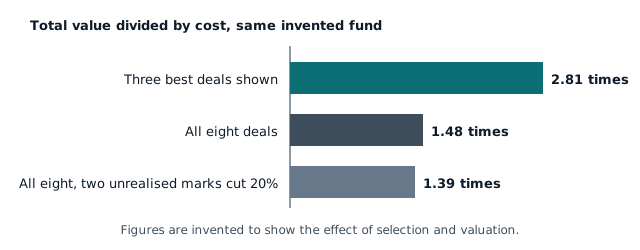
Reading one: three best deals. A page showing only A, B and E has a cost of 32 and a value of 90, a multiple of 2.81 times (our arithmetic1). Every statement on that page is true. Under the SEC rule it is extracted performance, so the whole portfolio’s results must be provided or offered2.
Reading two: all eight. Cost is 90 and value is 133, a multiple of 1.48 times (our arithmetic1). Cash received from the four sold deals is 84, which is 0.93 times the 90 invested, and 49 is still held at an estimate, or 36.8 percent of all value (our arithmetic1). In GIPS terms the first is the DPI idea and the second the RVPI idea1. More than a third of the value on the page is not yet cash.
Reading three: question the estimates. Mark E down from 25 to 20 and G down from 15 to 12, a cut of 20 percent on each, and total value falls from 133 to 125, a multiple of 1.39 times (our arithmetic1). A modest change in two estimates moves the whole fund by 0.09 times (our arithmetic1). That is why the share of assets valued with subjective unobservable inputs is a required line in a GIPS pooled fund report1.
The example is gross: it ignores fees, expenses and carried interest, which come off before a limited partner’s net figure. The net side is in private equity fees and carry.
Why a track record counts, and why valuations need questions
A track record deserves weight, and the evidence is academic. In a study of Venture Economics data, general partners whose funds outperform the industry in one fund are likely to outperform in the next, and those who underperform are likely to repeat it9. The persistence does not appear to be caused by risk differences9. Better performing funds are more likely to raise follow-on funds and larger funds9, and fund flows are positively related to past performance9. Funds raised in boom times are less likely to raise a follow-on fund, which indicates they probably perform poorly9, so the year a fund was raised belongs next to its deals. The same study finds that average fund returns net of fees approximately equal the S&P 500, with a large degree of heterogeneity9. That spread is why selection matters, and why a list that shows only the best deals tells a reader nothing about where the manager sits in it. The paper is from June 20039, so treat its numbers as history and its logic as the point.
The valuation problem cuts the other way. Managers may have an incentive to distort reported valuations if investors use them to decide on commitments to later funds managed by the same firm8. A study using a large dataset of buyout and venture funds finds evidence that some under-performing managers boost reported returns while fundraising takes place8. Those managers are unlikely to raise a next fund, which suggests investors see through much of the manipulation8. Top-performing funds likely understate their valuations8. IOSCO flags the same conflict: a manager can be incentivised to overstate valuations with a view to a larger management fee or to presenting past performance to potential investors5.
The fee basis already limits the incentive. Fees based on the current market value of a fund or its investments are uncommon in developed markets5. Accepted market practice is to base fees during the investment period on committed capital at the final close5, and afterwards on still-invested drawn-down capital held at cost, or written-down value where appropriate5. The standards bodies respond with process as well. Fund investors need timely, relevant and standardised valuations and information about the assumptions behind them5. IOSCO adds that it may be advisable to establish and disclose valuation policies and procedures, and that using external fund auditors is established industry practice5. The IPEV Board exists to provide uniform, globally acceptable, best practice guidance for private capital valuation10. It was created as an independent body in 200510 and published its updated guidelines on 14 December 202210. ILPA’s view on deal-by-deal waterfalls is conservative: all unrealised investments should be valued at the lower of cost or market6.
When one company appears in two funds
A manager that runs several funds may list the same company under more than one. That raises a conflict a reader should know about. The timing of an exit can favour one fund over another where an investment is jointly owned by two or more funds operated by the same manager5. The generally preferred approach is to divest all funds simultaneously5, with timing normally set by the fund that made the original investment or reached the end of its life first5. Even then, a younger fund may gain from a longer hold while an older fund needs cash5.
Some deals move a company from one fund to another. A manager may sell the majority of a fund’s investment to a third party and keep a minority stake for one of its other funds5. The manager is in effect on both sides of the transaction, representing two sets of fund investors, which creates a conflict over pricing5. A similar conflict exists where a manager seeks the sale of an asset between the funds it manages5.
The mitigants are disclosure and approval. Fund agreements can require disclosure of exit criteria, including advisory committee approval of non pro-rata divestitures5. Actual divestments are disclosed to investors through ongoing performance reporting5. It is common practice to refer the proposed handling to the relevant investor advisory committees before the deal proceeds5, and an advisory committee can validate the approach used to set the price in a transaction between funds under the same management5. When a list shows one company in two funds, the useful question is who set the price when it moved.
How Hong Kong regulation handles valuation
The SFC’s code puts valuation on the fund manager. A manager should ensure that policies and procedures exist so that a proper and independent valuation of fund assets can be performed and that valuation methodologies are consistently applied to similar assets4. Price overrides are handled on the record: the manager documents the reason for any override or deviation4, and a functionally independent party reviews it4. The manager reviews the valuation policies and procedures periodically4. If a third party performs valuation services, the manager remains responsible for the valuation of the fund’s assets4. A manager responsible for the overall operation of a fund also discloses the frequency and basis of valuation to fund investors4.
For a reader in Hong Kong, those clauses turn the questions above into things to ask for. Ask who values the unrealised holdings and whether a functionally independent party reviews overrides. Ask how often valuation happens and on what basis. Then compare the answers with the marketing page, which under the same code may contain only performance claims that can be verified4. For the licensing side of a Hong Kong manager, see the SFC Type 9 licence, and for the market, the Hong Kong private equity market.
Read next
Due diligence in private equity shows how a buyer tests a company, and the private equity investment approach shows how firms choose deals before they appear on a list. How a private equity fund works and GP and LP explained cover the structure behind the figures, and the strategies hub lists the rest. The primary texts for this page are the SEC’s marketing rule, the SFC’s Fund Manager Code of Conduct, the GIPS standards for firms, the ILPA Principles and IOSCO’s report on conflicts of interest. No fund, manager or investment is recommended on this page, which is education only about disclosure.
Read next
- Private equity investment approach, step by stepHow a private equity firm turns a strategy into a deal: filter, committee, diligence, financing, ownership and exit, with Hong Kong rules and Asia's exit queue.
- Buyout vs growth equity: key differencesBuyout, growth equity and venture capital differ in stake, leverage, company stage and exit. A side-by-side reference with the Asia-Pacific deal mix for 2024.
- How a private equity fund works in AsiaA private equity fund is a ten-year limited partnership. Who the partners are, where liability stops, and how Hong Kong, Singapore and Cayman funds differ
Sources
- Global Investment Performance Standards (GIPS) for Firms, 2020 edition · CFA Institute · gipsstandards.org · checked 21 October 2026
- 17 CFR 275.206(4)-1, Investment adviser marketing (Electronic Code of Federal Regulations, via Cornell LII) · U.S. Securities and Exchange Commission (rule text) · law.cornell.edu · checked 21 October 2026
- Private Equity: What You Need to Know · KKR · kkr.com · checked 21 October 2026
- Fund Manager Code of Conduct (October 2024) · Securities and Futures Commission, Hong Kong · sfc.hk · checked 21 October 2026
- Private Equity Conflicts of Interest: Final Report (FR11/10), November 2010 · IOSCO Technical Committee · iosco.org · checked 21 October 2026
- ILPA Principles 3.0 · Institutional Limited Partners Association · ilpa.org · checked 21 October 2026
- ILPA releases Portfolio Company Metrics Template as resource for the private equity industry (21 March 2019) · Institutional Limited Partners Association · ilpa.org · checked 21 October 2026
- Do Private Equity Funds Manipulate Reported Returns? (NBER Working Paper 22493, August 2016) · National Bureau of Economic Research · nber.org · checked 21 October 2026
- Private Equity Performance: Returns, Persistence and Capital Flows (NBER Working Paper 9807, June 2003) · National Bureau of Economic Research · nber.org · checked 21 October 2026
- IPEV Board publishes updated International Private Equity and Venture Capital Valuation Guidelines (14 December 2022) · IPEV Board · privateequityvaluation.com · checked 21 October 2026
Published . Education only, not an offer or advice (terms). Rules, fees and market figures change, so each source shows the day it was read. How we check facts · Report an error.