A private equity fund earns nothing on paper. It is paid when it sells, and how it sells decides how much cash comes back, how fast, and what the fund still owns afterwards. This page walks through each route in the order a fund would weigh them, then looks at the Hong Kong IPO rules, the Asian market, and the conflicts that appear when exits stall. It belongs to the deals, valuation and exits section.
Key takeaways
- Common routes are an IPO, a trade sale, a sale to management, repayment of preference shares and a secondary sale to another fund1.
- Most buyout exits since 2000 were not IPOs11, and the choice depends on partial or full exit, remaining growth, relative cost and market conditions1.
- An IPO usually leaves the fund with a stake and a lock-up9; a trade sale or secondary buyout usually ends the relationship9.
- In Asia-Pacific, IPO and open-market exit value rose more than 70% in 2025 and took back the top exit channel7.
- The exit date feeds straight into reported returns: see the IRR, MOIC, DPI and TVPI page.
The routes side by side
The IOSCO conflicts report lists the common routes: a public sale of shares at the portfolio company’s IPO, a trade sale to a company that wants to complement its operations, a sale to the firm’s management team, repayment of preference shares, or a secondary sale to another private equity fund1. Wikipedia groups the same outcomes into three avenues: an IPO, a merger or acquisition, and a recapitalisation11. The table lines the main routes up on what readers usually ask first.
| Route | Who buys | What the fund keeps | Time and cost |
|---|---|---|---|
| IPO | The public market; shares offered to the public11 | Usually a significant stake, to show confidence to investors9 | At least 6 months from inception to float; costs significantly higher, mainly underwriting fees9 |
| Trade sale | A company that wants to complement its existing operations1 | Usually nothing: the sponsor can dispose of its entire shareholding9 | Weeks, in extreme cases days9 |
| Secondary buyout | Another private equity fund1 | Usually nothing; some sponsors roll part of their value into the new vehicle9 | Weeks, in extreme cases days9 |
| Sale to management | The firm’s own management team1 | Nothing, unless a stake is rolled | Often financed with bank debt or private equity10 |
| Recapitalisation | No outside buyer: cash is distributed to the sponsor11 | The company, now carrying new debt or other securities11 | Paid from cash flow or from raising debt or other securities11 |
| Continuation fund | A new fund run by the same manager11 | Existing investors may roll into the new vehicle11 | Governed by ILPA guidance on process and timing5 |
The speed and cost figures for the IPO and trade-sale rows come from a 2015 article by a UK law firm, so read them as market practice at that date, not as a rule9.
IPO: partial exit, public price
In an IPO the shares of the company are offered to the public, which typically gives the sponsor a partial immediate realisation and a public market into which it can later sell more11. A sponsor will usually not be able to sell down all its shares in the offer, because institutional investors want to see it keep a significant holding9. The retained piece also lets the fund keep benefiting from growth after listing9.
Three things follow from keeping a stake.
- A lock-up. In the UK market of 2015, sponsors could expect a lock-up of between 6 and 12 months after the IPO, followed by an orderly market period of typically up to 12 months more9.
- A board seat. After an IPO it is common for the firm to keep a board seat for as long as the fund holds a significant stake1. That director owes duties to the listed company and is limited in what information can pass to the firm, which in turn restricts the firm’s ability to sell the fund’s remaining shares1.
- A slower exit. The firm may sell down with a view to resigning the board seat so that the fund can trade out freely1.
IPO preparation is slow. One adviser puts the work of readying a business at 12 to 18 months10, and an aborted IPO is a more public affair than a cancelled private sale9. IPOs are also not the main route in most years: most buyout exits after 2000 were not IPOs11.
Hong Kong: what the listing rules ask of a fund
A company must pass one of three financial tests under Main Board Listing Rule 8.052. The table sets them out.
| Test | Core thresholds | Common to all three |
|---|---|---|
| Profit test | Profit attributable to shareholders of not less than HK$35,000,000 in the latest year and HK$45,000,000 in aggregate for the two years before2 | Trading record of at least three financial years; management continuity for three years; ownership continuity and control for the latest audited year2 |
| Market capitalisation, revenue and cash flow test | Market capitalisation of at least HK$2,000,000,000 at listing2 | Revenue of at least HK$500,000,000 for the latest audited year, plus cash flow from operations2 |
| Market capitalisation and revenue test | Market capitalisation of at least HK$4,000,000,000 at listing2 | Revenue of at least HK$500,000,000 for the latest audited year2 |
The ownership-continuity limb matters to a fund that bought the company recently. A failure to meet it may raise concerns on packaging, because there may have been a material change in influence on management2.
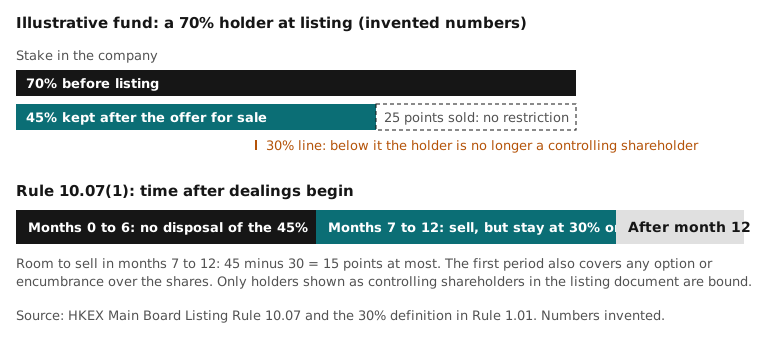
After listing, Rule 10.07 restricts a person shown in the listing document as a controlling shareholder. That person may not dispose of the shares, or agree to, from the date the listing document discloses the shareholding until 6 months after dealings begin3. For a further 6 months the holder may not make a disposal that would leave it no longer a controlling shareholder3. Shares sold in an offer for sale contained in the listing document are outside these restrictions3. A controlling shareholder is anyone who can exercise or control 30% or more of the voting power at general meetings, or who can control the board4.
Worked example: a retained stake under Rule 10.07 (assumed numbers, our arithmetic)
A fund owns 70% of a company before listing (assumed). It sells 25 points in an offer for sale in the listing document (assumed), leaving 45% (our arithmetic)3. Dealings begin on 1 July 2027 (assumed).
| Period | What the fund may do with the 45% | Rule |
|---|---|---|
| From the shareholding date in the listing document to 1 January 2028 (6 months after dealings begin, our arithmetic) | Nothing: no disposal, agreement to dispose, option or encumbrance3 | Rule 10.07(1)(a)3 |
| 1 January 2028 to 1 July 2028 (the next 6 months, our arithmetic) | Sell, provided the holding stays at 30% or more; room is 45 minus 30, which is 15 points at most (our arithmetic)34 | Rule 10.07(1)(b)3 |
| After 1 July 2028 (our arithmetic) | Rule 10.07(1) no longer restricts the shares3 | Rule 10.07(1) ends3 |
A holder below 30% of the voting power that also does not control the board falls outside the controlling-shareholder definition4. Any lock-up on such a fund would be a matter of contract with the issuer and its bank, as in UK practice9. The diagram shows the same sequence.
Hong Kong’s listing regime has also opened avenues for pre-revenue biotechnology companies and specialist technology companies, and the Financial Secretary has pointed to them as ways for private equity investors to realise through public markets6.
Trade sale: a full exit to an industry buyer
A trade sale hands the company to another business in the same field, which wants it to complement its operations1. A trade buyer will often pay above market rate because of expected synergies, and competitive tension between bidders can push the price up10. Of all the exit routes, a trade sale gives the greatest liquidity, because the buyer usually takes 100% of the business10.
It has costs. The seller must open its accounts and business manual to an outside party, which risks leaking information to a competitor or supplier10. The sponsor, on the other hand, can usually dispose of its entire shareholding with no continuing relationship beyond any deferred consideration9, and a sale can close in weeks9. In Asia, trade exits were the second-largest exit channel in 2025 after growing more than 60% on the year7.
Secondary buyout: selling to the next fund
In a secondary buyout the buyer is another private equity fund1. For the seller it looks like a trade sale: a clean exit, no board seat, no lock-up9. Some sponsors have become more willing to roll a proportion of their value into the new buyout vehicle, to keep benefiting from growth and to bridge a valuation gap9.
Secondaries matter more when public markets are shut. In 2024, secondary exits made up 27% of total Asia-Pacific exit value, with deal values of $181 billion8. The KWM review links that to the weak IPO outlook of the time, which was pushing managers towards secondaries to speed up distributions while investors pressed for liquidity8. One result of the squeeze is that mid-cap companies can be harder to exit when deal value concentrates in a few megadeals8.
Other ways out
Sale to management. A management buyout is a purchase of the equity by a team already involved in the business, often financed through bank debt or private equity10. It can price lower than a trade sale because the synergies a trade buyer pays for are missing10.
Recapitalisation. The company pays cash to the sponsor and its funds from its own cash flow or from raising debt or other securities11. The fund gets cash back and still owns the company.
Repayment of preference shares. IOSCO lists this beside the sale routes1. It returns capital by the company paying back instruments the fund holds instead of selling to a buyer.
Minority stake sales. A manager can sell a slice of a portfolio company to fund growth or pay investors out, and Bain data put these at $71 billion in 2024, or 15% of the Asia-Pacific exit total8. They let a manager raise cash and keep exposure to assets still ripening8.
Keeping a minority stake. A manager may sell most of an investment to a third party and keep a minority stake for one of its other funds1. The manager is then on both sides of the pricing, which IOSCO flags as a conflict1.
Continuation funds
A continuation fund moves one or more portfolio companies from an existing fund into a new vehicle run by the same manager. The manager keeps control of its best assets, and existing limited partners can take early liquidity11. The ILPA guidance starts from the conflict: the GP sits on both sides of the deal5. It sets two principles. These deals should maximise value for existing LPs, and rolling LPs should be no worse off than if no deal had happened5.
| Topic | What ILPA asks for5 |
|---|---|
| Price | A competitive process with third-party price validation5 |
| Conflicts | The LPAC votes on waivers, even where the fund agreement pre-clears them5 |
| Time | At least 30 calendar days or 20 business days for LPs to choose, where some LPs have been given as little as 10 days5 |
| Fees | No increase to the fee basis or percentage for rolling LPs5 |
| Carry | No crystallisation for rolling LPs; carry on selling LPs’ interests rolled into the new vehicle5 |
| Silence | An LP that does not respond is treated as selling, never forced to roll5 |
Each LP chooses between rolling pro rata, selling, rolling and buying more, or a combination5. ILPA asks that the rationale be heavily scrutinised when the existing fund is within its first five years or has unfunded capital left5. A fairness opinion from an independent adviser, a partial sale to a third party, or an arm’s-length minority sale can help show that the price is fair5.
Valuation: how the route affects the price
No route guarantees a better price. The sources point to tendencies. When markets are right, IPOs are conventionally thought to deliver higher valuations9. A 2015 count of the ten biggest European private equity exits of 2014 found five IPOs, four trade sales and one secondary buyout9. A trade buyer may pay above market for synergies10, while a management buyout may price lower10. The Hong Kong Financial Secretary argues that a strong IPO market gives portfolio companies clearer exit pathways, better price discovery and, when conditions allow, better valuations6.
Because the IPO window can shut, sponsors sometimes run a twin-track process, preparing an IPO and a sale together9. That has a reputational cost: institutional investors can react badly if a float is pulled9.
Exits in Asia
Bain’s Asia-Pacific report for 2025 shows a rebound. Exit value rose 24% on 2024 and exit count rose 8%7. IPO and open-market exit value rose more than 70% and retook the top spot among exit channels7, and trade exits grew more than 60%7. Robust IPO markets and strong public markets were cited as the main catalysts by 56% of the managers surveyed7.
| Market | 2025 exit signal7 |
|---|---|
| Greater China | Regained the position of largest exit market; exit volume and value surged 76%7 |
| India | Exit value grew 13% on 20247 |
| South Korea | Exit value grew 38%7 |
| Region, exits above $1 billion | Value and number roughly fourfold, the highest since 20217 |
Hong Kong’s IPO market gives one measure of the IPO side. The city recorded 119 IPOs in 2025, raising more than HK$285 billion6. See the Hong Kong private equity market page for the fund regime behind the numbers. The same speech adds that in February 2025 the SFC clarified the requirements for authorising closed-ended funds that invest mainly in private and less liquid assets6.
The 2025 improvement has not cleared the backlog. The number of portfolio companies held more than five years rose 18% on 20247, and Bain talks about a structural exit overhang from ageing holdings and weak 2020 to 2022 vintages7. One year earlier, more than 200 companies from the 2011 to 2019 vintages had been held for more than four years8. Net distributions to investors turned positive in 2025 after three years of net outflows7. In the review KWM cites, both LPs and GPs see the exit environment as the biggest impediment to strong returns8. The figures are Bain’s and KWM’s secondary reporting of survey and deal data, so treat them as market context. They are not a regulator’s count.
When exits stall
The fund’s clock keeps running. Most funds are set up for ten years, usually with scope for up to three one-year extensions that need investor approval1. The extensions exist so the manager does not have to sell at a reduced price or distribute the remaining assets in specie, which investors generally dislike1.
Extensions carry a conflict: a manager could use them to collect more management fees1. Investors can negotiate that some or all of the extensions need investor advisory committee approval1. The fees and carry page covers the fee side. The J-curve page shows why late exits drag on reported returns.
Conflicts around the exit
IOSCO groups the exit-stage conflicts. When two funds under one manager hold the same company, it is generally preferable to divest all funds simultaneously, and the timing usually follows the fund that invested first or reached the end of its life first1. That still leaves a choice between selling for the older fund and holding for a younger one1. Mitigants include disclosing exit criteria in the fund agreement, putting non-pro-rata sales to the advisory committee, and reporting actual divestments1. Good practice also includes telling investors, at the fund’s start, how the manager will divest in an IPO1. Sales between funds of the same manager raise the same pricing conflict1.
Questions that help read an exit
These follow IOSCO’s list of what drives the choice1.
- Is the sale full or partial?
- How much growth does the company have left?
- What does each route cost, and is it feasible in today’s market?
- Who is on the other side, and could the manager be on both?
On an IPO, check which shares are in the offer, who is bound by a lock-up, and for how long. On a continuation fund, check the price evidence, the roll-or-sell window and what happens to carry.
Limits of this page
The Hong Kong example uses invented figures to show how Rule 10.07 operates. It is not a forecast and not advice on any listing. The lock-up and cost comparisons for IPOs and trade sales come from a 2015 UK law-firm article and a 2022 adviser guide aimed at founders, and market practice in Hong Kong may differ910. Regional exit statistics come from Bain press material and a KWM review of AVCJ and Bain data78. Education only: nothing here is an offer or advice, and no fund, manager or transaction is recommended.
Read next
- Private equity due diligence: process and checklistHow private equity due diligence works: the deal funnel from 100 opportunities to 6 closings, the checks run, who does the work and who pays.
- Hong Kong private equity market: size, funds, exitsHong Kong ranks second in Asia for private equity, with US$229 billion under management in 2024. Funds, licences, tax rules and exits explained.
- How a leveraged buyout works: debt, equity, returnsA leveraged buyout buys a company mostly with borrowed money. How the debt and equity are layered, a worked return example, the risks, and the 2024 Asia data.
Sources
- Private Equity Conflicts of Interest: Final Report (FR11/10), November 2010 · IOSCO Technical Committee · iosco.org · checked 22 October 2026
- Main Board Listing Rule 8.05 (financial eligibility tests) · Hong Kong Exchanges and Clearing (HKEX Rulebook) · en-rules.hkex.com.hk · checked 22 October 2026
- Main Board Listing Rule 10.07 (restrictions on disposal by controlling shareholders) · Hong Kong Exchanges and Clearing (HKEX Rulebook) · en-rules.hkex.com.hk · checked 22 October 2026
- Main Board Listing Rule 1.01 (definitions) · Hong Kong Exchanges and Clearing (HKEX Rulebook) · en-rules.hkex.com.hk · checked 22 October 2026
- Continuation Funds: Considerations for Limited Partners and General Partners (May 2023) · Institutional Limited Partners Association · ilpa.org · checked 22 October 2026
- Speech by the Financial Secretary at Asia Private Equity Forum 2026 (28 January 2026) · Government of the Hong Kong SAR (Financial Secretary) · info.gov.hk · checked 22 October 2026
- Exit rebound and positive net distributions signal optimism in Asia-Pacific private equity market in 2026 (Bain & Company press release, 23 March 2026) · Bain & Company (via PR Newswire) · prnewswire.com · checked 22 October 2026
- In Private 2025: Top 10 trends for private capital (King & Wood Mallesons, citing AVCJ and Bain & Company, data to end-2024) · King & Wood Mallesons · mallesons.com · checked 22 October 2026
- Private equity exits: IPOs vs trade sales and secondary buyouts (4 February 2015) · Osborne Clarke · osborneclarke.com · checked 22 October 2026
- The different routes to exit (27 July 2022) · Buzzacott · buzzacott.co.uk · checked 22 October 2026
- Private equity · Wikipedia · en.wikipedia.org · checked 22 October 2026
Published . Education only, not an offer or advice (terms). Rules, fees and market figures change, so each source shows the day it was read. How we check facts · Report an error.