Mainland China ranks first in Asia by private equity capital under management, with Hong Kong second7. Reading that market from outside takes three keys. Which currency a fund is raised in decides who may invest and how money moves. A national fund regulation, in force since 2023, now sets the rules for managers. And the state is both a regulator and a large investor, through guidance funds that shape what gets funded and how it exits.
How big is China’s private equity market?
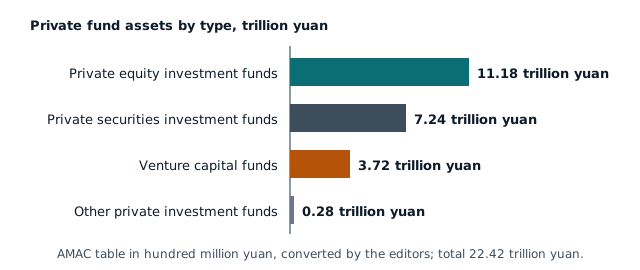
The Asset Management Association of China (AMAC) publishes the clearest count. Its quarterly statistics, titled 2025 Q4, put the total assets of asset management products at 81.58 trillion yuan2, of which private fund products hold 22.42 trillion yuan2. The table below is AMAC’s own breakdown of those private funds. AMAC gives the assets in hundred million yuan2.
| Fund type | Number of funds | Assets (hundred million yuan) | Source |
|---|---|---|---|
| Private equity investment funds | 29,8182 | 111,800.822 | 2 |
| Venture capital funds | 27,3422 | 37,178.342 | 2 |
| Private securities investment funds | 80,3822 | 72,361.082 | 2 |
| Other private investment funds | 7462 | 2,802.032 | 2 |
| All private funds | 138,3052 | 224,191.352 | 2 |
Managers follow the same pattern. AMAC counts 11,523 private equity and venture capital investment fund managers, 7,531 private securities investment fund managers and 19,231 managers in total2. One caution on the dating: the title of the document reads 2025 Q4, while its opening line refers to the end of the third quarter of 20252. Quote the figures as AMAC’s statistics titled 2025 Q4.
Worked example (our arithmetic): what the AMAC table implies
The figures below are the editors’ arithmetic on the AMAC table, not AMAC statements. Converting hundred million yuan to trillions, private equity funds hold 11.18 trillion yuan and venture capital funds 3.72 trillion yuan (our arithmetic2). Together the two types are 57,160 funds out of 138,305, or 41.3 percent of the count, and 148,979.16 out of 224,191.35 hundred million yuan, or 66.5 percent of private fund assets (our arithmetic2). The 11,523 private equity and venture capital managers are 59.9 percent of the 19,231 managers (our arithmetic2).
Average size separates the two strategies. A private equity fund holds 111,800.82 divided by 29,818, or 3.75 hundred million yuan, about 375 million yuan; a venture capital fund holds 37,178.34 divided by 27,342, or 1.36 hundred million yuan, about 136 million yuan (our arithmetic2). The average venture fund is therefore well under half the size of the average private equity fund, which fits a market of many small early-stage funds. Private funds as a whole are 27.5 percent of the 81.58 trillion yuan in asset management products (our arithmetic2).
Hong Kong gives a regional yardstick. It has over 650 private equity firms with assets under management around US$230 billion, second in Asia behind the Chinese Mainland8. The SFC’s 2024 survey, citing AVCJ Research, puts Hong Kong’s capital under management by private equity funds at US$229 billion in 2024 against US$221 billion in 20237. AMAC reports in yuan and Hong Kong in US dollars, so the two sets cannot be set side by side without a conversion neither source supplies.
Two tracks: US dollar funds and RMB funds
Money reaches Chinese companies through two kinds of fund, and the split shaped the market. A law firm special report from 2010 laid it out: private equity investment into China occurs within two distinct frameworks, offshore US dollar-denominated funds and onshore renminbi-denominated funds1. The bifurcation is largely due to China’s foreign direct investment and currency control regimes1. An international investor faces governmental approvals, ownership and other restrictions when investing in Chinese companies, while a domestic Chinese investor generally does not1.
For a US dollar fund the consequence was classification. Dollar funds, typically organised offshore under foreign law and funded by investors from outside China, are classified as foreign investors under the FDI regime1. An RMB fund funded entirely by domestic investors can invest in a broader range of industries and sectors than its dollar counterpart1. Because it invests in local currency, central government approvals are not required to convert foreign currency into RMB and to repatriate1.
The 2010 report defined two RMB structures. A purely domestic RMB fund is denominated in RMB, organised under Chinese law, raised from domestic Chinese investors and invested in domestic Chinese companies1. A foreign-invested RMB fund is also denominated in RMB and organised under Chinese law, but is essentially a foreign-invested enterprise with full or partial foreign ownership1. The operating model for the domestic type was to raise capital from domestic investors and invest in onshore companies that could be sold to the public through domestic listings or to trade buyers1.
Sponsors that ran both types faced a conflict. Deal allocation and resource competition between a sponsor’s offshore China-oriented funds and its onshore RMB funds was a major challenge for international sponsors1. That is a useful lens for reading any manager’s China track record, because the same company can sit in either vehicle.
| Question | 2010 | Later source | Source |
|---|---|---|---|
| National rule for setting up funds | None; sponsors looked to rules for other investment vehicles1 | State Council regulation of 62 items, effective 1 September 20233 | 1,3 |
| Who supervised funds | Local development and reform commissions or financial affairs bureaus1 | Regulation covers manager and custodian obligations, fundraising and investment operations3 | 1,3 |
| Foreign investors as LPs in RMB funds | Major cities developing local QFLP pilot programmes1 | QFLP in close to 100 pilot areas by early 20244 | 1,4 |
| Exit expectation | Domestic listings or trade buyers1 | STAR Market with 592 listed companies6 | 1,6 |
How foreign money gets in: the Foreign Investment Law and QFLP
Two layers govern foreign entry. The general layer is the Foreign Investment Law, which gives foreign investors access treatment no less favourable than that for domestic investors and their investments, except where a negative list applies9. The State Council issues the negative list, or approves its issuance9. The list itself is a separate instrument; read its current edition at the source.
The private equity layer is QFLP, the Qualified Foreign Limited Partner regime. Since its launch in Shanghai in 2010, QFLP has been one of the key routes for foreign investors to deploy capital into onshore private equity and venture capital4. In the typical structure the fund is managed by a domestic fund manager, with the foreign investor putting in foreign currency4. That currency is converted into RMB under the applicable foreign exchange rules4, and the fund may also raise money from domestic limited partners4. The idea was already set out in 2010: international investors meeting qualification criteria would be allowed to invest as limited partners or shareholders in RMB funds1.
QFLP has spread. By early 2024 programmes had been launched in close to 100 pilot areas nationwide4. In Shanghai alone, by the end of 2020 more than 70 institutions had taken part, investing nearly RMB 40 billion in sectors including biopharmaceuticals, environmental protection and information technology4. The regime appealed because it could secure relatively large foreign-exchange quotas at fund level, which cut the number of transaction-by-transaction inbound investment approvals4. Read the measures of the specific pilot area before relying on any condition of a QFLP structure.
For the Hong Kong end of a cross-border structure, see the Hong Kong limited partnership fund and the Hong Kong private equity market.
The 2023 regulation on private investment funds
China’s first national rulebook for private funds is a State Council regulation. Premier Li Qiang signed the decree3, and the regulation, with 62 items in seven chapters, took effect on 1 September 20233. It aims to encourage the standardised and healthy development of the private investment fund industry, better protect the rights and interests of investors, and encourage the industry to serve the real economy and promote scientific and technological innovation3.
Its coverage is wide. It clarifies the scope of application, specifies the obligations and requirements of private fund managers and custodians, regulates fundraising and investment operations, makes special provisions for venture capital funds, and strengthens supervision and legal liability3. For how those venture provisions sit beside the other Asian regimes, see venture capital funds.
State capital: government guidance funds
The state is the largest single force behind early-stage money. In January 2025 the General Office of the State Council issued guidelines on government investment funds covering an appropriate scale, a reasonable layout, sound operations and risk control10. The guidelines contain 25 specific measures across seven areas10. Fund operations should be market-oriented, professional and based on the rule of law10. The layout is coordinated to prevent homogeneous competition and avoid crowding out non-governmental capital10. The funds focus on major strategies, key areas and weak links where the market cannot function fully10, and act as long-term and patient capital10.
The same guidelines address exits. The withdrawal system is to be optimised by expanding exit channels, encouraging private equity secondary market funds and promoting merger and acquisition funds10.
On 26 December 2025 China launched a national venture capital guidance fund5. The table lists its design.
| Feature | Design | Source |
|---|---|---|
| Sponsors | Jointly initiated by the National Development and Reform Commission and the Ministry of Finance5 | 5 |
| Regional funds | Three: Beijing-Tianjin-Hebei, the Yangtze River Delta and the Guangdong-Hong Kong-Macao Greater Bay Area5 | 5 |
| Life | 20 years, with extended investment and exit periods5 | 5 |
| Stage focus | At least 70 percent of capital to seed-stage and early-stage enterprises5 | 5 |
| Structure | Fund company, regional funds and sub-funds5 | 5 |
| Expected scale | More than 600 sub-funds across the three regions5 | 5 |
| Operation | Market principles, professional institutions chosen competitively, no mandatory geographic reinvestment requirement5 | 5 |
Its stated principle is investing early, investing small, investing long-term and investing in hard technology5. For the global comparison with other venture fund rules, see venture capital funds, which covers India, Singapore and the United States as well.
Exits: the STAR Market and the listing route
A private equity fund returns money when its companies are sold or listed, so the exit venue shapes the whole market. The STAR Market was established on the Shanghai Stock Exchange in November 2018 with a pilot of the registration-based IPO system6. It now has 592 listed companies6. The sector has raised RMB 934.6 billion through IPOs and RMB 208.8 billion through refinancing, over RMB 1.1 trillion in all, with a total market value above RMB 9.6 trillion6.
Venture capital is part of nearly every listing story. About 90% of STAR companies received investment from venture capital institutions before listing6. In the past year 15 new companies listed, including three first-batch companies in the STAR Market Growth Tier6. The Growth Tier serves unprofitable technology enterprises, and its first three companies listed in October 20256. Among the 57 companies that were unprofitable at listing, 22 have achieved profitability and dropped the unprofitable label6. Over 80% of STAR companies are in strategic emerging industries such as next-generation information technology and biopharmaceuticals6.
The exchange’s own measure of the market’s purpose is hard technology: it serves enterprises that conform to national strategies and break through key core technologies6. Those sectors are where the state’s guidance funds are pointed too5, so the fundraising side and the exit side of the market lean the same way. That alignment is context for a limited partner, not evidence about returns; nothing here predicts them.
Where Hong Kong fits
Hong Kong sits beside the mainland market as a hub for funds and managers. Its fund vehicles are growing: close to 680 open-ended fund companies had been set up by end-2025, a 43 per cent year-on-year increase, and about 1 450 limited partnership funds were registered, up 37 per cent8. The government set up the Hong Kong Investment Corporation to provide patient capital and strategic investments in high-potential ventures, particularly in hard technology8. Asia’s private equity landscape is pivoting towards hard technology, particularly artificial intelligence, biotech and new energy8, and China’s 15th Five-Year Plan period is the backdrop8.
For the licensing of a Hong Kong manager, see the SFC Type 9 licence, and for the wider region private equity in Asia.
Read next
Private equity in Asia places China beside the other markets, and the Hong Kong private equity market covers the nearest hub. Venture capital funds and growth equity cover the strategies most active in the STAR Market pipeline. The Asia hub lists the rest. The primary texts for this page are the State Council’s reports on the fund regulation, the government investment funds guidelines and the national venture capital guidance fund, the NPC’s Foreign Investment Law and the Shanghai Stock Exchange’s STAR Market review. Nothing here recommends a fund, a manager or an investment; the page is education only, on how the market is organised.
Read next
- Private equity in Asia: market size, hubs and 2024 dealsAsia-Pacific buyouts reached US$138 billion in 2024. Which markets lead, how Hong Kong, Singapore and Cayman funds are set up, and where exits are stuck.
- Hong Kong private equity market: size, funds, exitsHong Kong ranks second in Asia for private equity, with US$229 billion under management in 2024. Funds, licences, tax rules and exits explained.
- Venture capital fund vs private equity fund: how each worksHow a venture capital fund differs from a private equity fund: stages, fees, what returns data show, and fund rules in Singapore, India, China and Hong Kong.
Sources
- The Rising Tide of Chinese RMB Funds, Investment Funds Practice Special Report (2010) · Akin Gump Strauss Hauer & Feld LLP · akingump.com · checked 21 October 2026
- Quarterly Asset Management Statistics (2025 Q4) · Asset Management Association of China · amac.org.cn · checked 21 October 2026
- China unveils regulation on private investment funds (Xinhua, 9 July 2023) · State Council of the People's Republic of China · english.www.gov.cn · checked 21 October 2026
- The Evolution of QFLP Tax Administration in China: Navigating Permanent Establishment Challenges (30 December 2025) · King & Wood Mallesons · kingandwood.com · checked 21 October 2026
- China unveils national venture capital guidance fund to boost innovation (Xinhua, 26 December 2025) · State Council of the People's Republic of China · english.www.gov.cn · checked 21 October 2026
- Seven Years of the STAR Market: 592 Companies + Over RMB 1.1 Trillion + Over RMB 9.6 Trillion (November 2025) · Shanghai Stock Exchange · english.sse.com.cn · checked 21 October 2026
- Asset and Wealth Management Activities Survey 2024 (July 2025) · Securities and Futures Commission, Hong Kong · sfc.hk · checked 21 October 2026
- Speech by the Financial Secretary at Asia Private Equity Forum 2026 (28 January 2026) · Government of the Hong Kong SAR · info.gov.hk · checked 21 October 2026
- Law of the People's Republic of China on Foreign Investment (English text) · National People's Congress of the People's Republic of China · npc.gov.cn · checked 21 October 2026
- China to promote high-quality development of government investment funds (Xinhua, 8 January 2025) · State Council of the People's Republic of China · english.www.gov.cn · checked 21 October 2026
Published . Education only, not an offer or advice (terms). Rules, fees and market figures change, so each source shows the day it was read. How we check facts · Report an error.