Investors in a private equity fund pay the manager a share of the profit, but only after they have earned a minimum return themselves. That minimum is the hurdle. This page defines it, shows how common each version is, and works one set of numbers through the whole thing so the effect of compounding, the catch-up and the start date is visible. It is part of the fundamentals section and picks up the carry mechanics from the fees and carry page.
Key takeaways
- Hurdle rate and preferred return are two names for the same thing: the return investors must get before the manager’s carried interest1.
- It is usually 8%2 and usually compounded2.
- A hurdle does not stop the manager earning carry in a good fund. With a 100% catch-up the manager still ends with the full carry share of the profit if the fund is profitable enough5.
- The same sale can pay the manager very different carry depending on how long the money was out. Later exits face a higher hurdle.
- The start date of the clock, and fund borrowing, change the result2.
What the hurdle does
Carried interest is a share of profit, and the fund’s documents decide when it becomes payable. The glossary in the ILPA Principles puts the trigger this way: carried interest is payable once investors have recouped their original investment in the fund, plus a defined hurdle rate, if applicable1. The hurdle rate or preferred return is the internal rate of return a fund must achieve before the manager may receive an increased interest in the proceeds1. Sponsors typically do not participate in returns until investors receive an amount equal to their original investment plus a minimum return4.
The usual order of payment runs through four steps6.
| Step | Who is paid | What happens |
|---|---|---|
| First: return of capital | Investors | Returns first repay each investor’s initial capital contribution, including the manager’s6 |
| Second: preferred return | Investors | Returns go to investors up to the agreed rate of return, the hurdle or preferred return6 |
| Third: catch-up | Manager | Returns go to the manager until it has received a return equal to the hurdle rate6 |
| Fourth: split | Both | Remaining profit is shared at the carry rate, often 80% to investors and 20% to the manager6 |
Not every fund provides for a hurdle and a catch-up6. In the ILPA 2021 sample 16% of funds had no hurdle at all2. The IOSCO conflicts report adds that the majority of private equity firms accrue performance pay only on realised profits, and only after investors have received a full return plus a cost-of-money hurdle, after fund costs and fees3. The hurdle is one part of the distribution waterfall, not a free-standing rule.
Hurdle rate, preferred return, IRR and target return
The terms get mixed up, so the table separates them.
| Term | Meaning | Source |
|---|---|---|
| Hurdle rate / preferred return | The return investors must receive before carry; ILPA treats the two as one1 | ILPA glossary |
| IRR | The actual rate of return earned by the fund, which may be above or below the hurdle7 | Moonfare |
| Cost-of-money hurdle | IOSCO’s phrase for the return investors get before performance pay3 | IOSCO |
| Target return | What a firm hopes to earn on an investment: a survey of 79 firms found a typical 22% target IRR, mostly between 20% and 25%11 | NBER survey |
The last row matters because “hurdle rate” is also used in corporate finance for the minimum return a project must clear. A fund’s preferred return of 8%2 and a firm’s 22% target11 answer different questions. The first is a contract term between investors and manager. The second is an internal underwriting aim, which no investor is promised.
How common and how high
The sources measure different samples, so the numbers are listed with their scope.
| Source | Finding | Scope |
|---|---|---|
| ILPA fund terms report, 2021 | 8% hurdle in 67% of funds; compounded in 78% of waterfalls; 16% with no hurdle2 | Colmore LPA data, all fund types2 |
| Goodwin terms database, 2023 | More than 50% of funds at 8%, 16% at 7%; nearly 80% of private equity funds at 8%4 | Private investment funds, all asset classes4 |
| Goodwin, other asset classes | 29% of real estate funds at 8%; credit funds mostly between 5% and 7%4 | As above4 |
| Metrick and Yasuda (2007) | Hurdles on 93.1% of buyout funds against 47.6% of venture funds; virtually all between six and ten percent5 | Older sample, funds raised before 20075 |
| Wikipedia | Customary hurdle 7% to 9% a year6 | Encyclopaedic summary6 |
Taken together the sources agree on the centre. Eight percent is the standard24, and the spread of hurdles around it runs from six to ten percent5. Private equity is the tightest asset class: nearly 80% of private equity funds sit at 8%4. Hong Kong’s tax authority treats carry of around 20% of profit above a hurdle rate as the private equity norm8. No public benchmark for Asian hurdle rates was found, so the figures stay on the labelled samples.
Compounded, simple, hard or soft
Compounded. Hurdle rates are cumulative and compounded annually7, and 78% of waterfalls in the ILPA sample compounded the hurdle2. Compounding means the preferred return earns a preferred return itself. Over a longer hold the gap from simple interest widens.
Hard or soft. A soft hurdle lets the manager share in all returns once the hurdle is passed. A hard hurdle lets it share only in the excess7. With an 8% hurdle and a 16% cumulative return, a soft hurdle would let the manager share in the full 16% and a hard hurdle only in the excess 8%7. ILPA prefers the hard form: carry based only on the portion of profit that exceeds the investors’ preferred return1, and it suggests a GP may use a hard hurdle to foster alignment1.
Catch-up. In a soft-hurdle fund the catch-up is what makes the manager whole after the hurdle. Private equity and venture funds usually have a 100% catch-up after payment of the preferred return4. Real estate funds are more likely to have a 50/50 catch-up4. In the Metrick and Yasuda sample most funds with a hurdle had a 100 percent catch-up and most of the rest 80 percent5, and only two funds had a hurdle without any catch-up5.
Why the catch-up is important: a worked example
The effect of a hurdle on expected revenue depends greatly on whether there is a catch-up5. With a catch-up, the manager still receives the same fraction of profit as long as the fund is sufficiently profitable5. The next example shows both halves of that sentence: full carry when the fund is comfortably above the hurdle, less when it is not, and nothing when it is below.
Worked example: one sale, four exit dates (our arithmetic)
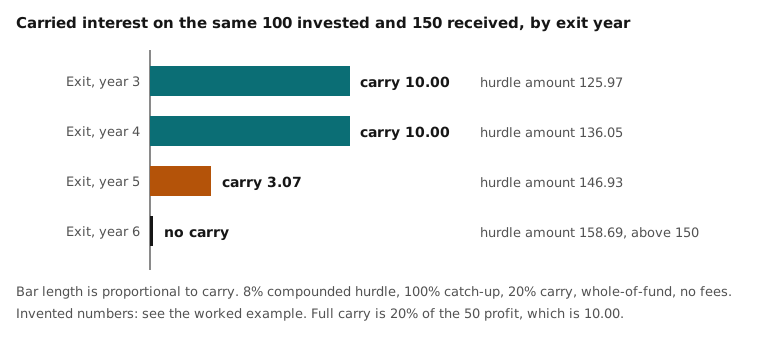
All inputs are invented. A fund invests 100 on day one (assumed) and sells the investment for 150 at the end of year 3, 4, 5 or 6 (assumed), so profit is 50 in every case (our arithmetic). The hurdle is 8% compounded2. The catch-up is 100% and carry is 20%42. There are no fees and no other investments (assumed).
The hurdle amount is 100 multiplied by 1.08 for each year held, and the preferred return is that amount minus 100 (our arithmetic)7. With a 100% catch-up and 20% carry, the catch-up needed is one quarter of the preferred return (our arithmetic)4. The column on the right shows the hard-hurdle version, where the manager takes 20% only of the profit left after the preferred return1.
| Exit | Hurdle amount | Preferred return | Profit left after it | Catch-up paid | Carry, with catch-up | Carry, hard hurdle |
|---|---|---|---|---|---|---|
| Year 3 | 125.97 | 25.97 | 24.03 | 6.49 | 10.00 (20.0% of 50) | 4.8115 |
| Year 4 | 136.05 | 36.05 | 13.95 | 9.01 | 10.00 (20.0% of 50) | 2.7915 |
| Year 5 | 146.93 | 46.93 | 3.07 | 3.07 (partial) | 3.07 (6.1% of 50) | 0.6115 |
| Year 6 | 158.69 | 58.69 | none | none | 0 | 015 |
Every figure in the table is our arithmetic on the assumptions above57.
Read down the column. At years 3 and 4 the profit left after the preferred return is bigger than the catch-up, so the manager completes the catch-up and ends with 10.00, which is 20% of the 50 profit (our arithmetic)5. At year 5 the profit left (3.07) is smaller than the catch-up that would be needed (11.73), so the manager receives only 3.07 (our arithmetic)4. At year 6 the hurdle amount of 158.69 is above the 150 sale price and the manager receives nothing, and the investors keep all 150 (our arithmetic)5. The sample paper makes the same point at a smaller scale: if a $100M fund with an 8% hurdle earned only $8M or less in profit, all of it would go to the investors5.
Two lessons follow. A catch-up turns the hurdle from a deduction into a threshold, because once it is cleared by enough, the manager is back at the full carry share5. And a hard hurdle without a catch-up costs the manager more than half its carry in the first two rows, 4.81 against 10.00 and 2.79 against 10.00 (our arithmetic)1.
Compounding against simple interest
Worked example: four years at 8% (our arithmetic)
On 100 held for four years (assumed), a simple 8% a year would give 32 of preferred return, and 8% compounded gives 36.05 (our arithmetic)7. Compounding adds 4.05 over four years (our arithmetic)7. The gap grows with the hold, which is why a compounded hurdle is harder for the manager to clear than a simple one of the same headline rate2.
When the clock starts
The date the preferred return starts to accrue is a term investors negotiate. ILPA’s principles ask for the preferred return to run from the date capital is called to the point of distribution1. Where capital comes from a bridging facility secured on uncalled commitments, the preferred return should run from the date the facility is drawn, which is when capital is at risk, and not from the date LPs are later called1. ILPA’s survey report lists less favourable conventions: starting the clock when the fund uses the contribution rather than when it is paid in, ending it when the fund receives proceeds rather than when it distributes, and leaving gaps when proceeds are recycled2. Some funds also stop accruing once capital is returned, so unpaid preferred return no longer compounds2.
Worked example: a credit line delays the clock (our arithmetic)
Reuse the numbers above2. The fund draws a credit facility to invest 100 on day one (assumed), calls LPs at the end of year 1 (assumed), and sells for 150 at the end of year 5 (assumed).
| Start of the preferred return | Years of accrual | Carry, with catch-up |
|---|---|---|
| From the facility draw, as ILPA prefers1 | 5 | 3.07 (our arithmetic)2 |
| From the LP call, as a fund agreement may provide2 | 4 | 10.00 (our arithmetic)2 |
A one-year difference in the start date moves the carry from 3.07 to 10.00, more than three times as much (our arithmetic)12. The investors’ money was exposed for five years, and only the first convention counts them. This is why ILPA also asks that subscription lines serve the partnership as a whole, not mainly to enhance reported IRR in order to accelerate carry1, and that they stay short, for example no more than 180 days and no more than 20% of commitments1. The survey report suggests LPs negotiate a clean-down of the facility within 12 months2. The IRR page shows the same delay raising IRR with the multiple unchanged.
Variants
Not every fund follows the 8% template2. The sources show four common departures412.
| Variant | What it does |
|---|---|
| Lower hurdle | Some managers have negotiated lower hurdle rates4 |
| Return-of-capital multiple | A fixed approach that returns 120% to 130% of invested capital before any carry4 |
| Partial catch-up | The manager takes a portion of profit, for example 50%, during the catch-up12 |
| Tiered carry | Multiple hurdle rates and catch-up periods in one fund12 |
The hurdle always has to be read with the whole waterfall: carry and catch-up details can change profit sharing as much as the headline rate4. Whole-of-fund waterfalls remain the dominant structure globally2, and ILPA asks that carry on recapitalisations be paid only once the full invested capital of the recapitalised investment is realised1.
Hong Kong: the hurdle in the carried interest tax concession
Hong Kong’s tax authority treats carry of around 20% above a hurdle rate as a common private equity arrangement8. The hurdle also appears in the tax concession. A Baker McKenzie review of the 2026 package says the requirement that carried interest be received on fulfilment of a hurdle rate stated in the fund documents will be removed10. The Financial Secretary’s January 2026 speech lists the same change, removing the certification requirement for funds and the reference to a hurdle rate9. Under that change a hurdle would no longer be a condition of the concession. The Hong Kong market page covers the wider tax and fund regime.
Questions to ask of a fund’s terms
These follow the ILPA material above.
- What is the rate, and is it compounded2?
- When does the clock start: call, draw of a facility, or investment1?
- When does it stop: distribution or receipt of proceeds2?
- Is the catch-up 100%, partial or absent, and is the hurdle hard or soft112?
- Are credit lines limited in length and size1?
- Is the waterfall explained in terms a non-lawyer can follow1?
Limits of this page
The worked examples use invented figures, a single investment and no fees, so they show the mechanics and are not a forecast of any fund. Real waterfalls vary by fund and by asset class4. The survey figures come from ILPA’s 2021 report and Goodwin’s 2023 database, and the older Metrick and Yasuda sample covers funds raised before 20075. This is education only. It makes no offer, gives no advice and recommends no fund or manager.
Read next
- Private equity fees: management fee and carryPrivate equity charges a 1 to 2% management fee and about 20% carried interest. Each charge explained with worked examples, Asian fund rates and Hong Kong tax.
- IRR, MOIC, DPI and TVPI explained with worked examplesWhat IRR, MOIC, TVPI, DPI and RVPI measure in private equity, how they relate and how to read them, with worked examples and GIPS and ILPA definitions.
- How a private equity fund works in AsiaA private equity fund is a ten-year limited partnership. Who the partners are, where liability stops, and how Hong Kong, Singapore and Cayman funds differ
Sources
- ILPA Principles 3.0 (2019) · Institutional Limited Partners Association · ilpa.org · checked 22 October 2026
- What's Market in Fund Terms? ILPA Industry Intelligence Report, 2021 (ILPA Fund Terms Survey data and Colmore data) · Institutional Limited Partners Association · ilpa.org · checked 22 October 2026
- Private Equity Conflicts of Interest: Final Report (FR11/10), November 2010 · IOSCO Technical Committee · iosco.org · checked 22 October 2026
- Half of private investment funds set hurdle rates at 8% but rates differ by asset class and strategy (29 November 2023) · Goodwin · goodwinlaw.com · checked 22 October 2026
- The Economics of Private Equity Funds (Metrick and Yasuda, working paper, September 2007) · Wharton School, Rodney L. White Center · rodneywhitecenter.wharton.upenn.edu · checked 22 October 2026
- Carried interest · Wikipedia · en.wikipedia.org · checked 22 October 2026
- Hurdle rate (preferred return) in private equity · Moonfare · moonfare.com · checked 22 October 2026
- Departmental Interpretation and Practice Notes No. 61: Profits Tax Exemption for Funds (June 2020) · Inland Revenue Department, Hong Kong · ird.gov.hk · checked 22 October 2026
- Speech by the Financial Secretary at Asia Private Equity Forum 2026 (28 January 2026) · Government of the Hong Kong SAR (Financial Secretary) · info.gov.hk · checked 22 October 2026
- Hong Kong: Enhanced Tax Concession Regimes for Funds, Family Offices and Carried Interest (30 July 2026) · Baker McKenzie · bakermckenzie.com · checked 22 October 2026
- What Do Private Equity Firms Say They Do? (NBER Working Paper 21133, April 2015; survey of 79 firms) · National Bureau of Economic Research · nber.org · checked 22 October 2026
- Understanding the Catch-Up Period in Private Equity (25 September 2024) · Rundit · rundit.com · checked 22 October 2026
Published . Education only, not an offer or advice (terms). Rules, fees and market figures change, so each source shows the day it was read. How we check facts · Report an error.