Jump to a section
Two Singapore regimes sit side by side in every fund set-up. The first is the vehicle: the variable capital company, registered with the Accounting and Corporate Regulatory Authority (ACRA). The second is the manager: a firm that holds a licence from the Monetary Authority of Singapore (MAS). The vehicle cannot exist without the manager, so this page takes both, in the order a sponsor meets them. It is part of the regulation and fund structures section.
The VCC at a glance
| Feature | Rule | Source |
|---|---|---|
| Purpose | The sole object of a VCC is to be one or more collective investment schemes in the form of a body corporate1 | VCC Act, object clause |
| Use | A structure mainly for investment funds, not businesses; either one single fund or an umbrella with many sub-funds2 | ACRA |
| Shareholders | At least one, with no maximum2 | ACRA |
| Shares | Can be issued and redeemed without shareholder approval, and dividends can be paid from capital, not just profits2 | ACRA |
| Privacy | Member lists need not be shared with the public2 | ACRA |
| Tax | Taxed at corporate tax rates; each sub-fund of an umbrella VCC is taxed separately2 | ACRA |
| Life | Exists until wound up or struck off; sub-funds can be wound up or struck off individually2 | ACRA |
The Variable Capital Companies Act 2018 took effect on 14 January 20207. Singapore had approximately 1,200 VCCs by 31 March 20256. They are flexible structures for both open-ended and closed-end funds across public and private assets, and the vast majority are offered only to accredited or institutional investors6.
Breaking the object rule is an offence. A VCC may not carry on any business inconsistent with being a collective investment scheme1, and a VCC that does faces a fine of up to $150,000 on conviction1. This is why a VCC cannot be used as an operating holding company.
Standalone, umbrella, open or closed
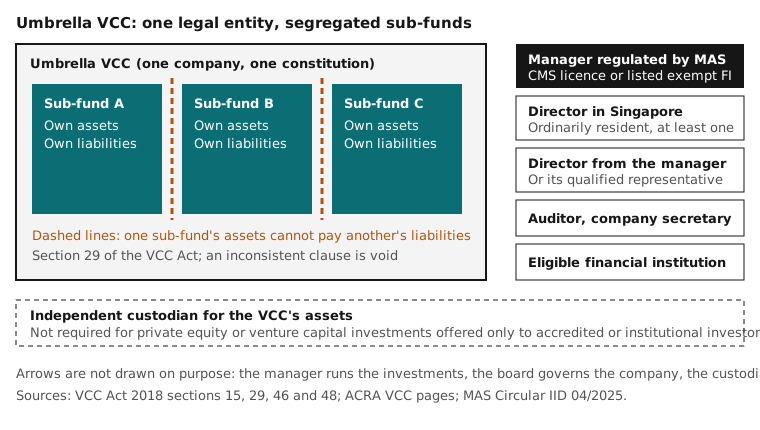
A standalone VCC has one pool of assets and liabilities7. An umbrella VCC puts several sub-funds under one legal entity7. The diagram shows the second.
| Choice | What it means in practice |
|---|---|
| Standalone | One pool of assets and liabilities, simplest governance7 |
| Umbrella | Several sub-funds, each with its own strategy and investors7 |
| Open-ended or closed-ended | An umbrella VCC may hold both types7 |
| Sub-fund into sub-fund | A sub-fund may invest in other sub-funds of the same VCC, within regulatory and constitutional limits7 |
The key legal feature of an umbrella is segregation. The assets of a sub-fund must not be used to discharge any liability of the VCC or of any other sub-fund, including in a winding up1. A clause in a constitution or contract that conflicts with this is void1. A breach carries a fine of up to $150,000 if committed with intent to defraud, and $50,000 otherwise1. A sub-fund has no separate legal personality, yet it is treated as if it were a separate person for insolvency and enforcement purposes7.
For a private equity sponsor the usual question is whether one vehicle can hold several vintages or strategies without cross-liability. The umbrella answers it, and the registration cost is modest, as the next example shows.
Worked example: registration cost of an umbrella VCC (our arithmetic)
ACRA’s fee is $8,015, made up of a $15 name registration fee and an $8,000 incorporation fee, plus $400 for each sub-fund2.
| Item | Amount |
|---|---|
| VCC registration, as published | $8,0152 |
| Three sub-funds at $400 each (assumed number of sub-funds) | $1,200 (our arithmetic)2 |
| ACRA registration total | $9,215 (our arithmetic)2 |
The sum covers ACRA’s registration fees only. It leaves out the manager’s licence fees, the audit, any corporate service provider and legal drafting.
Who must manage a VCC
A VCC must at all times have a manager1. The Act lists three kinds of manager: a holder of a capital markets services licence for fund management under the Securities and Futures Act 2001, a person mentioned in section 99(1)(a) to (d) of that Act (the exempt financial institutions), or a person prescribed by regulation1. A VCC cannot be its own manager1, and a holder of a suspended licence does not qualify1.
| Permissible manager | Notes |
|---|---|
| Licensed fund management company (LFMC) | Holds a capital markets services licence for fund management1 |
| Exempt financial institution | A person in section 99(1)(a) to (d) of the SFA, such as banks licensed under the Banking Act 19703 |
| Venture capital fund manager (VCFM) | An LFMC under a simplified regime for venture capital funds4 |
One point needs checking before reliance. ACRA’s directors and officers page, updated on 29 January 2026, also lists a registered fund management company as a permissible manager3. The current Act text shows paragraph (b) of the manager list as deleted by Act 24 of 2025 with effect from 6 May 20261. A sponsor planning a new manager should confirm the current list with ACRA and MAS, and treat the Act as the controlling text.
Governance and custody
MAS lists four VCC-specific requirements: the VCC is one or more collective investment schemes, it has a MAS-regulated manager, at least one of its directors is from the manager, and it engages an eligible financial institution for anti-money laundering checks under MAS Notice VCC-N016. The manager must segregate the VCC’s assets and keep them with an independent custodian6. The exception matters to private equity: independent custody is not needed where the assets are private equity or venture capital investments offered only to accredited or institutional investors6.
Directors and officers
| Role | Requirement | Source |
|---|---|---|
| Director, local | At least one director ordinarily resident in Singapore1 | VCC Act, directors |
| Director, manager link | At least one director who is a director or qualified representative of the manager; may be the same person as the local director1 | VCC Act, directors |
| Director, personal | A natural person aged 18 or over1 | VCC Act, directors |
| Local residency | Singapore citizen, permanent resident, EntrePass or Employment Pass holder; Employment Pass holders need a Letter of Consent3 | ACRA |
| Authorised schemes | At least three directors, one independent3 | ACRA |
| Company secretary | Appointed within six months of incorporation; a real person3 | ACRA |
| Auditor | Appointed within three months; the Companies Act audit exemptions do not apply3 | ACRA |
| Ongoing | Annual general meetings, annual returns, an eligible financial institution for AML2 | ACRA |
The directors rule has teeth. If a VCC carries on business for more than six months without the two required directors, a member who knows of it is liable for the debts contracted in that time1. Extra directors who do not come from the manager are allowed, but where they engage in regulated activity such as deal sourcing or marketing they must be appointed as licensed representatives of the manager6.
MAS licences for fund managers
MAS requires a company that carries on fund management activity regulated under the Securities and Futures Act to be a licensed fund management company holding a capital markets services licence, as its fund management licensing page sets out4. The Guidelines on Licensing and Conduct of Business for Fund Management Companies (SFA 04-G05) set three categories5.
| Category | Who it may serve | Base capital |
|---|---|---|
| Retail LFMC | All types of investors5 | S$1,000,000 for any collective investment scheme offered to investors other than accredited or institutional5 |
| A/I LFMC | Qualified investors only5 | S$250,000, the category for fund management other than the two cases above and below5 |
| Venture capital fund manager | Qualified investors only, venture capital funds only54 | Exempt from specified provisions of the fund management rules, subject to the venture capital appendix5 |
A separate S$500,000 figure applies to fund management other than a collective investment scheme for customers who are not accredited or institutional5. Where a firm serves only qualified investors through a limited partnership, the general partner may be a company controlled by the fund manager or owned by its key officers5. The guidelines say A/I LFMCs and VCFMs should not target retail investors through structures that circumvent the class restrictions5.
Base capital and risk-based capital
An LFMC must always meet the base capital thresholds and should hold a buffer above them5. It must also keep financial resources of at least 120% of its total risk requirement5. The two tests are separate.
Worked example: which capital test bites (assumed numbers, our arithmetic)
An A/I LFMC has a total risk requirement of S$400,000 (assumed)5.
| Test | Calculation | Result |
|---|---|---|
| Base capital for an A/I LFMC | Published threshold | S$250,0005 |
| Risk-based capital | 120% of S$400,000 | S$480,000 (our arithmetic)5 |
In this case the risk-based test needs more than the base capital figure (our arithmetic)5. The risk requirement depends on the business, so a manager should compute it before choosing a capital buffer.
Staffing and experience
MAS sets minimum staffing for each category in Table A1 of the guidelines5. The table is the part of the process that most often decides how long a start-up manager needs before it can apply.
| Requirement | A/I LFMC | Retail LFMC |
|---|---|---|
| CEO relevant experience | 5 years5 | 10 years5 |
| Directors | At least 25 | At least 25 |
| Relevant professionals | At least 25 | At least 35 |
| Full-time representatives resident in Singapore | At least 25 | At least 35 |
Nominee directors such as legal advisers or corporate secretaries do not count towards the director minimum5. One individual can fill several roles, so a small team can meet the table5.
What MAS looks for
MAS weighs the credibility and substance of the business plan, risk management and compliance, the track record of management and major shareholders, fitness and propriety, and the ability to meet financial requirements4. The guidelines add specific tests.
- Substance. A company must conduct substantive fund management activity in Singapore, such as portfolio management, investment research or trade execution5.
- No conduits. A company does not qualify if it merely provides a channel for customers to structure assets as fund units without providing substantive input5, or sets up funds solely to raise capital for its own operating businesses5.
- Own money. A company that manages only its own assets in form and substance does not need a licence5, and experience from investing one’s own or family money does not count as relevant experience5.
- Control. Where a manager is owned by individuals and sits outside an established group, its CEO and executive directors are expected to hold more than 50% of the voting interest between them5, and passive shareholders should be minimised5.
- Place. An LFMC should be a Singapore-incorporated company with a permanent physical office5, dedicated, secure and accessible only to directors and staff4.
MAS also lists class exemptions that need no licence, for example managing assets for related corporations or family members, or a pool of immovable assets for accredited and institutional investors4.
Timeline and fees
| Stage | Time or fee |
|---|---|
| Application | Form 1, filed online through the eLicensing system4 |
| Review | MAS expects up to 6 months for a complete application from an applicant meeting all criteria4 |
| In-principle approval to licence | Up to 6 months to meet the stated requirements4 |
| Extension | MAS may extend by a further 3 months for strong reasons4 |
| After licence | The licence lapses if fund management does not start within 6 months5 |
| Annual corporate fee | S$4,000, plus S$5 per representative from the 101st for an LFMC4 |
Worked example: how long can licensing take? (our arithmetic)
For a clean application, review takes up to 6 months and the applicant has up to 6 months to meet the in-principle conditions4. That is 12 months at most, or 15 months if MAS grants the 3-month extension (our arithmetic)4. Applications that fall short of the criteria or have complex models may take longer4. A sponsor planning a VCC should start the manager’s application first, because the VCC needs a licensed manager in place1. Bird & Bird makes the same planning point, putting licensing at roughly six months7.
The venture capital fund manager route
Venture capital fund managers (VCFMs) follow simplified admission criteria in the venture capital appendix of the guidelines4. A VCFM may only manage funds that meet set criteria5.
| Criterion | Rule |
|---|---|
| Non-qualifying investments | No more than 20% of committed capital in unlisted ventures over ten years old, or bought in the secondary market5 |
| Fund type | Not continuously open for subscription and not redeemable at the investor’s discretion5 |
| Investors | Accredited or institutional investors, or an equivalent class abroad5 |
| Listed securities | The funds cannot invest in listed securities or IPOs; securities acquired before listing may still be held5 |
| Key people | A CEO resident in Singapore and at least two directors, one of them an executive director5 |
A VCFM is exempt from some provisions that bind other managers, and it must tell investors so5. The regime does not suit a buyout sponsor: those funds invest in older companies, in secondary purchases above the 20% limit, or in listed securities.
After registration: what MAS found in 2024
MAS carried out a thematic review of VCCs and their managers in 20246, and published the results in Circular IID 04/2025. The circular that followed sets out supervisory expectations that apply to any VCC manager6.
| Finding | Expectation |
|---|---|
| Empty VCCs | Managers should periodically assess and wind down VCCs with no assets or no investors6 |
| Conduit use | A manager that merely helps move investors’ existing assets into a VCC, without investment inputs, is not carrying out substantive fund management6 |
| Active role | The manager should be actively involved in portfolio construction, investment due diligence and analysis6 |
| Extra directors | Directors engaged in regulated activity must be licensed representatives of the manager6 |
| Custody | Assets need independent custody unless they are private equity or venture capital offered only to accredited or institutional investors6 |
Set-up sequence
The order follows the constraints in the sources.
- Manager first. A licensed or exempt manager must exist before the VCC does1, and a new licence takes months4.
- Name. A name application is generally processed within 1 working day, and the name is reserved for 120 days, within which the VCC must be incorporated7.
- People. Directors, a company secretary and an auditor, with the deadlines in the officers table3.
- Type. Standalone or umbrella, and the financial year end2.
- Registration. The ACRA fee and, for an overseas fund, re-domiciliation if the fund has a similar corporate structure2. Foreigners living overseas must engage a corporate service provider to register2.
- Constitution. It must name the manager and set out the rights attaching to shares7.
- Ongoing. Annual general meetings, annual returns and audited accounts, which may use Singapore, IFRS or US GAAP standards27.
How this compares with Hong Kong
Hong Kong asks the same two questions through different instruments: a fund vehicle and a manager licence. The limited partnership fund page covers the first and the SFC Type 9 licence page the second. The fund structure comparison sets the three Asian vehicles side by side.
Limits of this page
The rules here are as the Act, ACRA and MAS publish them on the dates shown, and the page covers the vehicle and the manager licence only. It does not cover tax incentives for funds, which have separate conditions that this page does not cite. The worked examples use invented numbers except where marked as published. Law firm material is context, not proof of a rule7. Education only: nothing here is an offer or advice, and no manager, fund or structure is recommended.
RelatedHong Kong limited partnership fund (LPF) explainedSFC Type 9 licence: who needs it, requirements, feesHow a private equity fund works in Asia
Sources
- Variable Capital Companies Act 2018 (2020 Revised Edition), sections 15, 29, 46 and 48 · Singapore Statutes Online (Attorney-General's Chambers) · sso.agc.gov.sg · checked 22 October 2026
- Step 1: Understanding VCC features, eligibility & requirements (updated 29 January 2026) · Accounting and Corporate Regulatory Authority, Singapore · acra.gov.sg · checked 22 October 2026
- Step 2: Choosing directors & key officers for a VCC (updated 29 January 2026) · Accounting and Corporate Regulatory Authority, Singapore · acra.gov.sg · checked 22 October 2026
- Fund Management Licensing · Monetary Authority of Singapore · mas.gov.sg · checked 22 October 2026
- Guidelines on Licensing and Conduct of Business for Fund Management Companies [SFA 04-G05] (last revised 3 September 2025) · Monetary Authority of Singapore · mas.gov.sg · checked 22 October 2026
- Circular IID 04/2025: Governance and Management of Variable Capital Companies (26 June 2025) · Monetary Authority of Singapore · mas.gov.sg · checked 22 October 2026
- Singapore VCCs: Legal & Regulatory Essentials (20 January 2026) · Bird & Bird · twobirds.com · checked 22 October 2026
Published . Education only, not an offer or advice (terms). Rules, fees and market figures change, so each source shows the day it was read. How we check facts · Report an error.